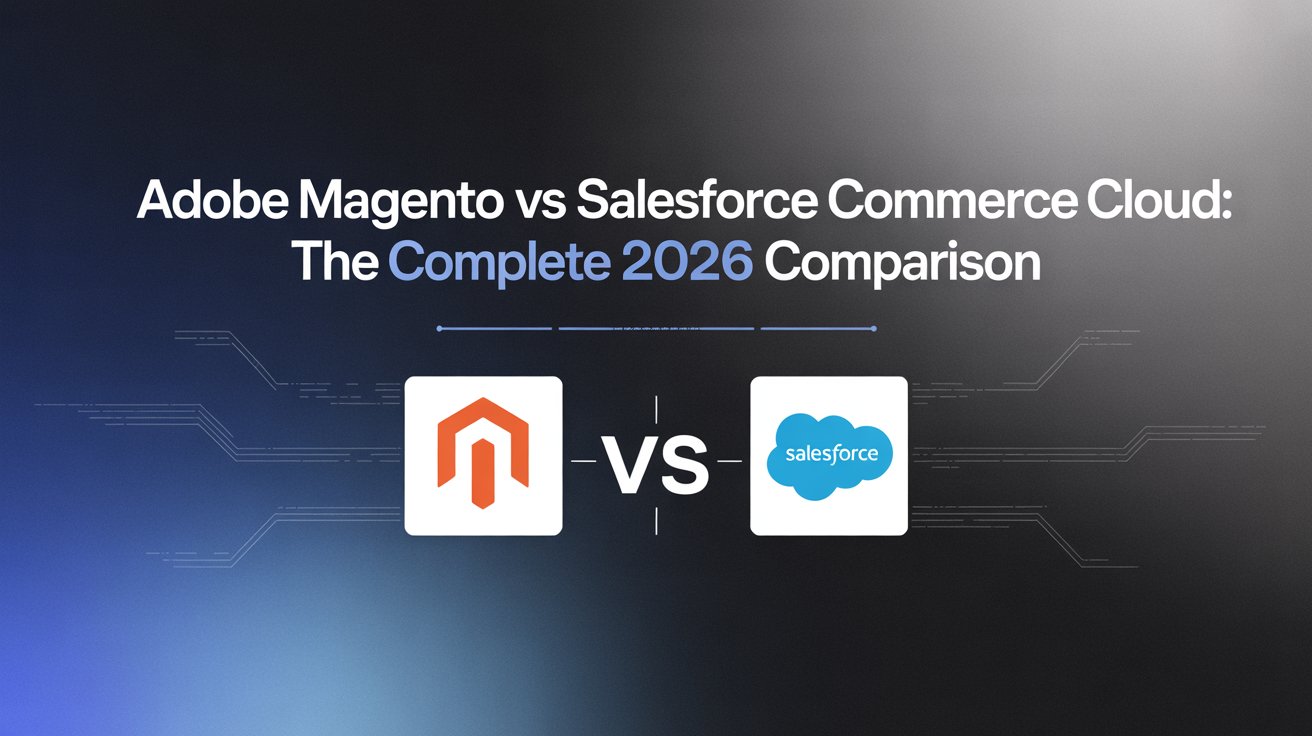
If you are evaluating Adobe Commerce (formerly Magento) against Salesforce Commerce Cloud, you already know both platforms handle enterprise eCommerce. The real question is which one matches your team, your budget, and your growth plan over the next three years.
Adobe Commerce powers over 250,000 merchants globally, including Nike, HP, and Nestlé. Salesforce Commerce Cloud serves Adidas, Puma, and L’Oréal. Both are Gartner Magic Quadrant Leaders for Digital Commerce: Adobe for 9 consecutive years, Salesforce for 10. Neither platform is wrong. Choosing the wrong one for your situation, however, is expensive to fix.
This guide covers architecture, pricing, B2B and B2C fit, AI, marketing tools, security, integrations, and migration, with a decision framework at the end.
Table of Contents
Quick Comparison: Adobe Commerce vs Salesforce Commerce Cloud
| Factor | Adobe Commerce | Salesforce Commerce Cloud |
|---|---|---|
| Deployment model | Open Source / PaaS / ACCS SaaS (June 2025) | Fully managed SaaS only |
| Licence cost at $10M GMV | $60K to $85K/year | $100K to $300K/year |
| B2B + B2C under one licence | Yes | No: separate licences required |
| Customisation depth | Full codebase access | Configuration-first |
| Extension marketplace | 5,800+ (Adobe Commerce Marketplace) | Smaller (Salesforce AppExchange) |
| AI layer | Adobe Sensei | Salesforce Agentforce (Sept 2024) |
| Native Salesforce CRM integration | Via connector or custom build | Native, no middleware needed |
| SEO control | Full: URL, metadata, schema | Moderate: platform managed |
| Security responsibility | Shared between merchant and Adobe | Fully Salesforce-managed |
| PCI DSS Level 1 certified | Cloud edition supported | Yes, built in |
| Headless support | GraphQL API, PWA Studio, ACCS | Composable Storefront |
| Support for non-technical teams | Moderate | High via Business Manager |
| Gartner Leader status (2025) | Yes, 9 consecutive years | Yes, 10 consecutive years |
| Best fit | B2B, complex catalogs, SEO-driven | B2C retail, Salesforce stack |
Adobe Magento vs Salesforce Commerce Cloud: Platform Architecture in 2026
This is the foundational difference between the two platforms. Every cost and capability question flows from it.
Adobe Commerce now offers three deployment paths:
- Magento Open Source: Free. Self-hosted. Full code access. You own everything, including security, performance, and upgrades.
- Adobe Commerce Cloud (PaaS): Hosted on AWS. Adobe manages infrastructure; your team manages deployments and customisation.
- Adobe Commerce as a Cloud Service (ACCS): Launched June 2025. A fully managed SaaS model running on microservices with edge delivery and a composable storefront. This is Adobe’s direct answer to Salesforce’s managed infrastructure model.
Salesforce Commerce Cloud offers two separate products:
- B2C Commerce (originally Demandware): Built for consumer retail, with strong merchandising, promotions, and omnichannel tools.
- B2B Commerce: Built for wholesale, manufacturing, and distribution, running on the core Salesforce platform.
Both Salesforce products are fully managed, multi-tenant SaaS. You configure; Salesforce manages infrastructure, patches, and scaling.
The licensing trap most buyers miss: Salesforce sells B2B and B2C Commerce as separate licences. If you run both channels, you pay twice. Adobe Commerce includes B2B and B2C under one licence. For businesses operating both models, this difference alone can determine the platform decision before you compare a single feature.
Adobe Commerce vs Salesforce Commerce Cloud: Pricing and Total Cost of Ownership
Most comparison pages avoid real numbers. Here they are.
Adobe Commerce pricing tiers (2026):
| Annual GMV | Adobe Commerce Licence |
|---|---|
| Up to $5M | $40,000 to $60,000/year |
| $5M to $10M | $60,000 to $85,000/year |
| $10M to $25M | $85,000 to $125,000/year |
| $25M+ | Custom pricing |
Add managed cloud hosting at $149 to $499/month. Add implementation: $50,000 to $150,000 for a mid-market store with a qualified partner.
Salesforce Commerce Cloud pricing:
- B2C Commerce: 1 to 3% of annual GMV, with a minimum annual commitment around $150,000.
- A $10M GMV retailer pays $100,000 to $300,000/year in platform fees alone.
- B2B Commerce: Custom pricing, typically higher than B2C tiers.
- Implementation: $200,000 to $500,000+ through a Salesforce partner.
Total cost of ownership over three years at $10M GMV:
Adobe Commerce cloud runs $280,000 to $420,000 all-in, covering licence, hosting, and a mid-range implementation. Salesforce Commerce Cloud runs $500,000 to $1,000,000+ over the same period, once you include the revenue share, implementation, and additional Salesforce product licences.
The gap compresses above $50M GMV, where Adobe’s tiered pricing catches up to Salesforce’s managed service value. Below $20M GMV, Adobe Commerce wins on cost in nearly every scenario.
One honest caveat: Adobe Commerce on Magento Open Source carries hidden costs that Salesforce does not. Developer salaries or agency fees, self-managed hosting, security patching, and extension licensing all accumulate. A business without in-house technical capability can find the total cost of an “open source” platform surprisingly close to a managed SaaS.
Adobe Magento vs Salesforce Commerce Cloud: B2B vs B2C Use Cases
When Adobe Commerce Wins for B2B
Adobe Commerce has native B2B capabilities built into the core platform: company accounts, custom pricing per buyer, purchase order workflows, quote management, and multi-source inventory (MSI) for complex fulfilment across multiple warehouses.
A 400-person industrial components distributor in Pune that our team deployed Adobe Commerce for handled 3,000 SKUs with customer-specific price lists across 14 company accounts. They went live in 14 weeks. Their sales team reported a 40% reduction in manual order processing within the first quarter after launch. Read full story
For B2B use cases with complex catalog structures and custom pricing logic, Adobe Commerce is the stronger starting point on both capability and cost.
When Salesforce B2C Commerce Wins
Salesforce B2C Commerce was built from the ground up for consumer retail at scale. Its Business Manager tool lets merchandising and marketing teams run campaigns, update catalogs, and configure promotions without developer involvement. For high-frequency promotional calendars, A/B testing at the storefront level, and omnichannel operations including Buy Online Pick Up In Store (BOPIS) and Click and Collect, Salesforce B2C is operationally ahead of Adobe Commerce out of the box.
When Salesforce B2B Commerce Wins
If your field sales team runs on Salesforce CRM, Salesforce B2B Commerce delivers account, order, and opportunity data as a single view without a custom middleware layer. For businesses where sales reps and eCommerce need to share data in real time, this native connection is a genuine operational advantage. The cost: B2B and B2C are separately licensed, so businesses running both channels pay for two products.
AI and Personalisation: Adobe Sensei vs Salesforce Agentforce
This is one of the fastest-moving areas of platform differentiation.
Adobe Sensei
Adobe Sensei is Adobe’s embedded AI engine. Inside Adobe Commerce it delivers:
- Product recommendations: Driven by real-time shopper behaviour and purchase history across sessions.
- Live Search: AI-enhanced site search with real-time indexing, intelligent ranking, and synonym handling.
- Intelligent merchandising: Automated product ranking based on conversion signals, revenue, and margin.
- Adobe Target integration: Personalised content blocks by segment, location, or individual behaviour.
Sensei operates as a background service. Merchandisers configure rules; Sensei optimises within them.
Salesforce Agentforce
In September 2024, Salesforce replaced Einstein Copilot with Agentforce, a system of autonomous AI agents that take action without human input. In a commerce context, Agentforce:
- Handles order tracking queries independently, without a human agent.
- Processes return requests end-to-end.
- Generates personalised product recommendations across web, email, and service channels.
- Routes and resolves customer service cases across Service Cloud and the storefront in a single workflow.
Agentforce is a more autonomous model than Sensei. For businesses already running Salesforce Service Cloud, the cross-platform AI is a genuine differentiator. For businesses using Adobe Commerce without other Salesforce products, Sensei covers the core personalisation and search use cases well.
Marketing, Merchandising, and SEO Tools
This section is often overlooked in platform comparisons. It matters most to the teams who live inside the platform every day.
Adobe Commerce: SEO Depth and Content Control
Adobe Commerce has a well-established reputation as an SEO-friendly platform, and for good reason. Built-in capabilities include:
- Full control over URL structure, canonical tags, and page metadata.
- Automatic XML sitemap generation with configurable update frequency.
- Schema markup support for product, review, and breadcrumb structured data.
- Content staging and scheduling for time-based campaigns and product launches.
- Visual Page Builder for creating promotional content without developer involvement.
For businesses where organic search is a primary acquisition channel, Adobe Commerce gives more direct control than any managed SaaS platform. The tradeoff is responsibility: you own the technical SEO implementation, and mistakes affect rankings directly.
Salesforce Commerce Cloud: Merchandising and Campaign Velocity
Salesforce Commerce Cloud is built for marketing and merchandising speed:
- Campaign management console for scheduling promotions, banners, and personalised experiences across regions.
- Built-in A/B testing at the storefront level, configurable by marketing teams.
- Native integration with Salesforce Marketing Cloud for multi-channel campaign execution without data export.
- Predictive sort ranking per user via Einstein, updated in real time.
- Dynamic content blocks personalised by customer segment, location, or browsing behaviour.
For marketing teams running frequent promotions across multiple channels, the Salesforce toolset requires less development support. The SEO control, however, is more limited than Adobe Commerce, which matters if organic traffic is a core part of your growth model.
Security, Compliance, and Infrastructure
Security posture differs significantly between the two platforms. It matters most in enterprise procurement, regulated industries, and any business where a security questionnaire is part of the vendor evaluation process.
Adobe Commerce:
- Magento Open Source (self-hosted): Merchants are fully responsible for security. This includes patching, DDoS protection, and PCI DSS compliance at the application layer.
- Adobe Commerce Cloud: Adobe manages DDoS protection, a Web Application Firewall (WAF), encryption at rest and in transit, and infrastructure hardening. Merchants manage the application layer and custom code.
- Adobe Security Scan Tool monitors storefronts for known vulnerabilities on an ongoing basis.
- Two-factor authentication and role-based access control are built in at the admin level.
Salesforce Commerce Cloud:
- PCI DSS Level 1 certified, the highest certification level for payment card data security.
- Data encrypted at rest and in transit by default.
- Multi-tenant isolation protects customer data across the shared infrastructure.
- Automated patching: Salesforce pushes security updates without merchant action.
- SOC 1, SOC 2, ISO 27001, and GDPR compliance certifications are maintained and audited annually.
For regulated industries, financial services, healthcare-adjacent retail, or any business where procurement teams run vendor security questionnaires, Salesforce Commerce Cloud’s certified compliance posture reduces procurement friction significantly. Adobe Commerce Cloud is enterprise-grade, but the merchant carries more responsibility at the application layer.
According to Gartner’s Magic Quadrant for Digital Commerce 2025, both Adobe and Salesforce are rated as Leaders. Adobe leads on “Completeness of Vision”; Salesforce leads on “Ability to Execute” for large enterprise deployments. [Verify and link current Gartner report before publishing: gartner.com/en/documents/magic-quadrant-digital-commerce]
Integration Options and Extension Marketplace
Adobe Commerce:
- 5,800+ extensions on Adobe Commerce Marketplace, covering SEO, payment gateways, marketing, analytics, ERP connectors, and loyalty platforms.
- Full API access for custom integrations with any third-party system.
- SAP, Microsoft Dynamics, Oracle, and NetSuite connectors are available via extensions or custom builds.
- ERP integrations typically require 4 to 12 weeks of development work depending on data model complexity.
- Open architecture means any developer can build a connector, which is why the marketplace is large.
Salesforce Commerce Cloud:
- Extensions through Salesforce AppExchange, significantly smaller than Adobe’s marketplace.
- Native integration with Salesforce CRM, Marketing Cloud, Service Cloud, and Experience Cloud. No middleware needed within the Salesforce platform.
- SAP and Oracle connections available via MuleSoft, which carries its own separate licence cost.
- Smaller extension library is a real constraint for businesses with niche operational requirements.
The integration gap matters most at the edges of standard use cases. If your business needs a regional payment gateway, an uncommon ERP, or a custom loyalty platform, Adobe Commerce is more likely to have an existing connector or a community-built solution. If your stack is already Salesforce-heavy, Commerce Cloud connects to it faster than any Adobe-based approach.
Migrating Between Adobe Commerce and Salesforce Commerce Cloud
A significant share of buyers on this keyword are already on one platform and evaluating a switch. Here is what that actually involves.
From Adobe Commerce to Salesforce Commerce Cloud:
- Catalogue migration for 5,000+ SKUs: expect 3 to 6 weeks with structured data mapping and validation.
- Custom modules or extensions built in Adobe Commerce need to be rebuilt or replaced in Salesforce Commerce Cloud. This drives 60 to 70% of total migration cost.
- Typical project timeline: 4 to 9 months for a mid-market store.
- Typical cost: $80,000 to $200,000 depending on customisation depth.
- Most common reason: businesses want to exit infrastructure management as they scale beyond a point where an internal dev team is cost-effective.
From Salesforce Commerce Cloud to Adobe Commerce:
- More common among businesses that outgrew Salesforce’s revenue-based pricing at lower GMV tiers, or need customisation not possible on a managed SaaS platform.
- Timeline: 4 to 8 months. Cost: $60,000 to $180,000.
- Most common reason: revenue-share pricing becomes unsustainable before the managed infrastructure value justifies it.
What most migration guides miss: Before scoping any migration, audit your custom functionality. Standard catalogue, checkout, and order management workflows migrate predictably. Bespoke promotional logic, custom pricing rules, and non-standard fulfilment workflows are what drive timelines and costs beyond initial estimates.
Adobe Magento vs Salesforce Commerce Cloud: The Decision Framework
Choose Adobe Commerce if:
- You need native B2B and B2C under one licence without paying twice.
- Your team has in-house PHP developers or works with a dedicated Adobe Commerce development partner.
- Your annual GMV is under $20M and platform cost needs to remain predictable.
- Organic search is a primary acquisition channel and you need full control over technical SEO.
- You need the 5,800+ extension marketplace to meet niche operational requirements without custom builds.
- You want to evaluate ACCS, Adobe’s new managed SaaS option from June 2025, as a path toward infrastructure-free operation while retaining Adobe’s customisation depth.
Choose Salesforce Commerce Cloud if:
- You already run Salesforce CRM, Marketing Cloud, or Service Cloud. The native data integration is worth the platform premium.
- Your GMV is above $30M and the fully managed SaaS model makes commercial sense.
- Your merchandising and marketing teams need to operate independently of developers.
- Security certifications (PCI DSS Level 1, SOC 2, ISO 27001) are a formal procurement requirement.
- Autonomous AI-driven customer service via Agentforce is a strategic priority.
- You work with a Salesforce Commerce Cloud implementation partner and want a single vendor relationship across commerce, CRM, and marketing.
There is no universal winner in the adobe magento vs salesforce commerce cloud evaluation. The right platform is the one your team can operate, your budget can sustain, and your customers benefit from within 12 months of go-live.
Final Words
If you are scoping a platform decision or planning an eCommerce platform migration, our team runs a fixed-price architecture review that delivers a platform recommendation with three-year cost projections. It takes two weeks. Contact orangemantra’s Adobe Commerce development team or Salesforce Commerce Cloud implementation team to get started.
Frequently Asked Questions
1. Is Magento the same as Adobe Commerce?
Adobe acquired Magento in 2018 for $1.68 billion. Magento Open Source is the free, community-supported version. Adobe Commerce is the paid enterprise version with managed cloud hosting, B2B modules, and Adobe Experience Cloud integrations. In June 2025, Adobe also launched Adobe Commerce as a Cloud Service (ACCS), a fully managed SaaS tier that positions Adobe as a direct competitor to Salesforce’s managed model for the first time.
2. Which platform is cheaper for a $10M GMV retailer?
Adobe Commerce is substantially cheaper at $10M GMV. Licence fees run $60,000 to $85,000/year for Adobe Commerce. Salesforce Commerce Cloud charges 1 to 3% of GMV, putting the annual platform cost at $100,000 to $300,000 before implementation. The gap narrows above $50M GMV, where Salesforce’s managed infrastructure reduces the internal team cost enough to close the difference.
3. Can Adobe Commerce handle B2B and B2C from one instance?
Yes. Adobe Commerce supports multi-store configurations from a single backend, with separate pricing rules, catalogues, and checkout flows per channel. Salesforce requires separate B2B and B2C licences, which means businesses running both channels on Salesforce pay for two products. This is one of the most under-discussed cost differences in the Adobe Magento vs Salesforce Commerce Cloud comparison.
4. How does Salesforce Agentforce differ from Adobe Sensei?
Adobe Sensei delivers AI-powered product recommendations, live search, and intelligent merchandising within the Adobe product stack. Salesforce Agentforce, launched September 2024, deploys autonomous agents that take action without human input: handling returns, answering order queries, and routing service cases across channels. Agentforce is a more autonomous model; Sensei is a more recommendation-and-search-focused model. For businesses already running Salesforce Service Cloud, Agentforce provides cross-platform AI that Sensei cannot replicate without additional integration.
5. What is Adobe Commerce as a Cloud Service (ACCS)?
Adobe Commerce as a Cloud Service launched in June 2025. It is a fully managed SaaS tier running on microservices with edge delivery and a composable storefront. It is designed for merchants who want Adobe Commerce’s customisation capabilities without managing infrastructure. ACCS positions Adobe as a SaaS-versus-SaaS competitor to Salesforce Commerce Cloud for the first time.
6. How long does a full Salesforce Commerce Cloud implementation take?
A standard B2C implementation with a qualified Salesforce partner takes 4 to 6 months for a mid-market retailer. Complex implementations with custom integrations, large catalogues, or multi-region rollouts run 9 to 12 months. Budget for 12 to 16 weeks minimum even for a straightforward launch, and factor partner costs of $200,000 to $500,000+ into your total build budget.