Can you imagine building a skyscraper without a foundation? It sounds typically impossible, right?
Every time you ask a chatbot to summarize a contract, generate marketing copy, write code, or produce a photorealistic image, the invisible force behind it is a foundation model in generative AI.
These massive, pre-trained systems are the bedrock of the modern AI revolution; the shared infrastructure that powers nearly every generative application business is being deployed at scale today.
The term may not be in every boardroom’s vocabulary yet, but the business impact certainly is. From healthcare and banking to retail and software development, generative AI foundation models are reshaping how enterprises operate, compete, and create value.
Understanding what they are, how they work, and how to leverage them is no longer a technical exercise reserved for data scientists—it is a strategic imperative for every business leader.
In this overall guide on foundation models in generative AI, we take you through everything you need to know about this topic, from core concepts and real-world examples to business applications and future trends.
Table of Contents
The Generative AI Market: By the Numbers
Before diving into the technology, consider the market’s signals. The data from the world’s most trusted research institutions confirm that generative AI is not a hype cycle, it is a structural transformation of the global economy.
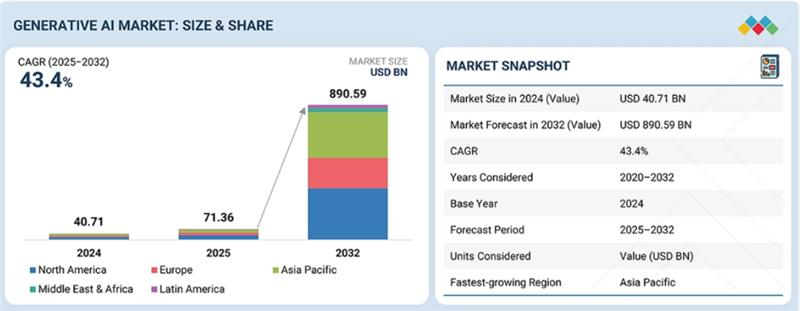
One of the reports of Markets and Markets says that “Generative AI Market by Software (Foundation Models, Model Enablement & Orchestration Tools, Gen AI SaaS), Modality (Text, Code, Video, Image, Multimodal), Application (Content Management, BI & Visualization, Search & Discovery) – Global Forecast to 2032″.
Published by MarketsandMarkets, the market for generative AI is slated to expand from USD 71.36 billion in 2025 to USD 890.59 billion by 2032, at a substantial CAGR of 43.4% over the forecast period.
What Are Foundation Models in Generative AI?
Foundation models in generative AI are large-scale deep learning models pre-trained on vast, diverse datasets — often encompassing billions of documents, images, lines of code, and more — using self-supervised learning. Unlike traditional AI systems built to perform a single task, foundation models are designed to be generalists: trained once on broad data, then adapted to a virtually unlimited range of downstream applications.
The term was first introduced by researchers at Stanford University’s Center for Research on Foundation Models (CRFM) in their landmark 2021 paper, which described these systems as models trained on broad data at scale that can be adapted, via fine-tuning, to a wide range of downstream tasks. The word ‘foundation’ was deliberate , these models are not end products but foundational layers upon which countless specialized applications can be built.
In the context of generative AI, the foundation models act like an engine beneath the applications. This is the reason why a single model like GPT-4 writes a business proposal, debug python code, analyzes financial reports, and simultaneously answers medical questions. This is not because it was programmed to perform each task but because of human knowledge during pre-training.
Foundation Models vs. Traditional AI Models
The distinction between foundation models and traditional AI is not merely technical —it is philosophical. Traditional AI models are narrow by design. A fraud detection model can only detect fraud. A sentiment classifier can only classify sentiment. Each requires its own labeled training dataset, its own architecture, and its own development lifecycle.
Foundation models break all of these constraints. Because they are pre-trained on internet-scale data and built on flexible architectures, they can be fine-tuned for any number of tasks with minimal additional data. The result is a dramatic reduction in the time, cost, and expertise required to build powerful AI applications — and a corresponding explosion in the scope of what AI can do for your business.
Foundation Models vs. Large Language Models (LLMs)
A common point of confusion is using the terms ‘foundation models’ and ‘large language models (LLMs)’ interchangeably. They are not the same. Large language models — such as GPT-4, Claude, and Meta’s Llama —are a specific type of foundation model trained primarily on text data.
Foundation models, as a broader category, include models trained on images (DALL-E, Stable Diffusion), audio (OpenAI’s Whisper), code (Codex), biological sequences (DeepMind’s AlphaFold), and multimodal data combining text, image, and more (GPT-4o, Gemini, Claude with Vision).
In short: every LLM is a foundation model, but not every foundation model is an LLM. Understanding this hierarchy is essential for enterprises selecting the right AI infrastructure for their specific use case.
How Do Foundation Models Work in Generative AI?
Understanding how generative AI foundation models work requires unpacking two distinct phases and recognizing why the two-phase lifecycle is what makes them commercially transformative.
Phase 1: Pre-Training on Massive, Unlabeled Datasets
In the first phase, a foundation model is exposed to an enormous quantity of raw, unlabeled data text from the web, books, academic papers, code repositories, image-text pairs, and more. The model does not receive explicit instructions about what to learn; instead, it uses self-supervised learning to generate its own training signals from the data itself.
For a language model, this might involve predicting the next word in a sequence — a deceptively simple objective that, at sufficient scale, forces the model to learn grammar, facts, reasoning patterns, and contextual meaning. For an image model, it might involve reconstructing masked regions of a visual input.
Phase 2: Fine-Tuning for Specific Tasks
Once pre-trained, a foundation model contains general-purpose intelligence across its learned domain. In the second phase, the model is fine-tuned on a smaller, task-specific or domain-specific dataset to specialize its capabilities for a particular application. A healthcare company might fine-tune a general LLM on annotated clinical notes. A legal firm might fine-tune it on case law and regulatory documents. A fintech company might fine-tune a vision model on financial charts and tables.
Key Characteristics of Foundation Models in Generative AI
Six defining foundation models in generative AI characteristics separate these systems from all prior approaches to artificial intelligence — and explain why they represent such a fundamental shift in what AI can accomplish.
-
Scalability
Foundation models are built to scale. They are trained on billions—and in some cases, trillions — of parameters, and their performance consistently improves with compute, data, and model size increase. This relationship between scale and capability, sometimes called ‘scaling laws,’ is one of the most remarkable and counterintuitive findings in modern AI research.
-
Multimodality
Modern foundation models are not limited to text. They can process and generate multiple data modalities simultaneously — text, images, audio, video, code, 3D geometry, and structured data.
This multimodal capability opens up entirely new categories of enterprise AI applications: a model that can accept a photograph of a damaged product and automatically generate an insurance claim, or a model that converts a verbal customer instruction into a working software module.
According to MarketsandMarkets, the multimodal AI segment, it is projected to register the highest growth rate in the generative AI market through 2032.
-
Adaptability Through Transfer Learning
Perhaps the most commercially significant characteristic is adaptability. Through transfer learning, a pretrained foundation model carries its broad knowledge into new domains and tasks with remarkable efficiency. A model trained on general web text can be fine-tuned for medical imaging analysis with a fraction of the data that a traditional AI would require.
-
Emergent Capabilities
As foundation models scale, they develop capabilities that were never explicitly programmed and cannot be predicted from smaller-scale experiments. These emergent behaviors include multi-step reasoning, few-shot learning (performing new tasks from just a handful of examples), code generation from natural language, analogical reasoning, and rudimentary causal inference.
Types of Foundation Models in Generative AI
The ecosystem of generative AI foundation models is rich and rapidly expanding. Understanding the major types — and what each is optimized for — is essential for businesses evaluating AI adoption.
Large Language Models (LLMs)
LLMs are the most widely deployed type of foundation model and the primary driver of enterprise GenAI adoption today. Trained on text corpora spanning billions of documents, they excel at natural language understanding, generation, summarization, translation, and reasoning.
Enterprise use cases include contract analysis, customer service automation, knowledge management, report generation, and email drafting. Leading examples include GPT-4 and GPT-4o (OpenAI/Microsoft), Claude 3.5 Sonnet (Anthropic), Llama 3.1 (Meta), and Mistral Large.
Vision and Image Generation Models
These foundation models are trained on large-scale image and image-text datasets, enabling them to understand and generate visual content. They power product image generation, architectural rendering, medical image analysis, defect detection in manufacturing, and creative design at scale. Notable examples include DALL-E 3 (OpenAI), Stable Diffusion 3 (Stability AI), Google Imagen, and CLIP.
Audio and Speech Models
Audio foundation models understand and generate human speech, music, and environmental sound. Their enterprise applications span real-time transcription, multilingual call center support, voice synthesis for accessibility, and AI-generated media. OpenAI’s Whisper, which demonstrates state-of-the-art performance across 99 languages, is a leading example of the category.
Code Generation Models
Trained on billions of lines of code across dozens of programming languages, these models have become transformative productivity tools for software developers. They generate functions from natural language descriptions, suggest context-aware completions, identify security vulnerabilities, write test suites, and document existing code.
Multimodal Foundation Models
Multimodal models represent the frontier of foundation model development. They accept and generate text, images, audio, and video within a unified architecture—enabling entirely new classes of applications. A multimodal model can accept a photograph and a text description together, interpret a complex diagram, narrate a video, or generate a technical illustration from a prose specification. GPT-4o, Google Gemini Ultra, and Anthropic Claude (with Vision) are the leading examples of this increasingly important category.
Examples for Foundation Models in Generative AI: The Leading Players
The landscape of generative AI foundation models examples spans text, vision, audio, code, and multimodal domains. The table below maps the most influential foundation models to their developers, types, and enterprise use cases — giving you a practical reference for AI adoption planning.
| Foundation Model | Developer | Type | Primary Enterprise Use Cases |
| GPT-4 / GPT-4o | OpenAI / Microsoft | LLM + Multimodal | Content generation, coding, data analysis, customer service |
| Claude 3.5 / Claude 4 | Anthropic | LLM + Vision | Enterprise reasoning, legal analysis, summarization, safety-critical tasks |
| Gemini Ultra / Pro | Google DeepMind | Multimodal | Search intelligence, document understanding, coding, image analysis |
| Llama 3 / 3.1 | Meta (Open-Source) | LLM | Custom enterprise deployments, on-premise AI, regulated-industry use |
| Mistral Large | Mistral AI (Open-Source) | LLM | Cost-efficient LLM for European enterprises, on-premise deployments |
| DALL-E 3 | OpenAI | Image Generation | Marketing visuals, product imagery, creative design at scale |
| Stable Diffusion 3 | Stability AI (Open-Source) | Image Generation | Branding, UI prototyping, creative content generation |
| Whisper | OpenAI | Audio / Speech | Multilingual transcription, voice-to-text, call center automation |
| Codex / GitHub Copilot | OpenAI / GitHub | Code Generation | Developer productivity, auto-completion, test automation |
| BERT / T5 | Text Understanding | Search, NLP classification, sentiment analysis, entity recognition | |
| AlphaFold 2 | DeepMind (Google) | Biological Sequence | Drug discovery, protein structure prediction, life sciences R&D |
Foundation Models vs. Generative AI — Clearing the Confusion
The terms ‘foundation models’ and ‘generative AI’ are often used interchangeably, but they describe different things at different levels of abstraction. Generative AI is the broad category of artificial intelligence systems capable of creating new content—text, images, audio, video, code, and more. Foundation models are large pre-trained base models that power modern generative AI applications.
Think of the relationship this way: generative AI is the car; the foundation model is the engine. Not every generative AI application uses a foundation model — some older generative systems were built on task-specific architectures. But every high-capability, enterprise-grade generative AI application being built today is powered by a foundation model.
Business Applications of Generative AI Foundation Models
Foundation models are not just a research breakthrough. They are delivering measurable, auditable business value across every major industry vertical. Below is an industry-by-industry view of how enterprises are deploying generative AI foundation models today.
| Industry | Foundation Model Applications | Impact Highlight |
| Healthcare & Life Sciences | Drug discovery, protein structure prediction, clinical documentation, medical image analysis, patient triage chatbots | Research and Markets: Healthcare AI projected to register fastest growth in GenAI market through 2030 |
| BFSI | Fraud detection, risk modeling, AI-driven loan origination, regulatory compliance analysis, personalized financial advice | AI-powered loan processing delivers up to 90% accuracy improvement and 70% reduction in processing time (IBM) |
| Retail & E-Commerce | Hyper-personalized recommendations, AI-generated product descriptions, intelligent customer service agents, and demand forecasting | Retailers using GenAI at scale report revenue increases of 5–15% (BCG) |
| Manufacturing & Automotive | Predictive maintenance, generative design, supply chain optimization, quality control vision systems | A leading automaker using GenAI reduced design time-to-production by the equivalent of one full year (BCG, 2024) |
| Media, Marketing & Advertising | AI content creation, ad personalization, video generation, campaign analytics, and brand voice consistency | 76% of marketers reported using GenAI for content creation in 2024 (Salesforce State of Marketing) |
| Software Development & IT | Code generation, automated testing, documentation, security vulnerability detection, and DevOps automation | Developers using AI coding tools complete tasks up to 55% faster; 90% of Google developers use AI in daily workflows (DORA, 2025) |
| Legal & Compliance | Contract review, clause extraction, regulatory research, due diligence automation, litigation support | AI-powered contract review cuts drafting time from hours to minutes in enterprise legal workflows |
Benefits of Using Foundation Models for Businesses
For enterprises evaluating whether and how to invest in generative AI, the business case for foundation models is built on six interconnected advantages:
- Faster time-to-value: By starting from a powerful pre-trained model rather than building from scratch, enterprises can shrink AI development services timelines from months or years to weeks. Fine-tuning a leading open-source foundation model on proprietary data can yield a specialized, production-ready AI system in as little as 2–4 weeks.
- Cost efficiency: Training a frontier foundation model from scratch costs hundreds of millions of dollars. Fine-tuning an existing one on domain-specific data can cost a fraction of that — making advanced AI accessible to mid-market organizations, not just hyperscalers.
- Versatility across functions: A single fine-tuned foundation model can simultaneously serve marketing for content generation, legal for contract review, operations for process automation, and customer service for intelligent support — dramatically increasing return on AI investment.
- Scalability: Foundation models handle growing data volumes and expanding use cases without requiring architectural rebuilds. As your business scales, your AI infrastructure scales with it.
- Democratization of AI: Through APIs and intuitive interfaces, foundation models allow non-technical teams to leverage sophisticated AI capabilities without requiring deep machine learning expertise. This is a fundamental shift in enterprise AI accessibility.
- Competitive differentiation: BCG research found that AI leaders — those effectively scaling foundation-model applications — can expect 60% higher revenue growth and approximately 50% greater cost reductions by 2027 than AI laggards.
Challenges and Limitations of Foundation Models in Generative AI
A credible understanding of generative AI foundation models must include an honest assessment of their limitations. These are real challenges — but they are also addressable with the right strategy and partnerships.
High Training Costs and Computing Requirements
Building a frontier foundation model from scratch demands computing resources that are financially inaccessible to all but the world’s largest organizations. However, as noted above, fine-tuning existing models dramatically reduces this barrier — and the open-source ecosystem (Llama, Mistral, Falcon) is lowering costs further by removing the need for API licensing altogether.
Data Privacy and Security Risks
When sensitive enterprise data is sent to cloud-hosted foundation model APIs for inference or fine-tuning, data privacy risks arise — particularly for organizations subject to GDPR, HIPAA, SOC 2, or other regulatory frameworks. Enterprises in regulated industries increasingly prefer on-premises or private cloud deployments using open-source foundation models to maintain full data sovereignty.
How to Choose the Right Foundation Model for Your Business
Selecting the right generative AI foundation model is as strategic a decision as selecting a cloud provider or a core enterprise software platform.
Here is a practical evaluation framework for enterprise AI leaders:
| Evaluation Criterion | Key Questions to Ask |
| Output modality | Do you need text, images, audio, code, or multimodal outputs? Choose a model architecture that matches your primary output type. |
| Capability level | Does your use case require frontier-level reasoning (GPT-4, Claude 3.5), or will a smaller, efficient model (Mistral 7B, Llama 3 8B) suffice? |
| Deployment preference | Cloud API (OpenAI, Anthropic, Google)? Self-hosted open-source (Llama, Mistral)? Private cloud? Regulated industries often require the latter. |
| Fine-tuning requirements | How much domain customization is needed? High customization favors open-source fine-tuning; lighter customization may be addressed with prompt engineering and RAG. |
| Data privacy and compliance | Is your industry subject to GDPR, HIPAA, SOC 2, or similar? On-premise or private cloud deployment may be non-negotiable. |
| Cost and latency | High-frequency, low-latency inference workloads demand cost-efficient models. Batch analytical tasks can tolerate larger, more capable models. |
| Integration complexity | Does the model expose APIs compatible with your existing data pipelines, CRM, ERP, or workflow automation platforms? |
The Future of Foundation Models in Generative AI
The evolution of generative AI foundation models is accelerating on multiple fronts simultaneously. Six major trends will define the next wave of enterprise AI infrastructure:
- Domain-Specific Foundation Models: According to the latest report by Gartner, by 2027, more than 50% of the GenAI models used by enterprises will be domain-specific, up from 1% in 2024. Vertical foundation models fine-tuned on industry data — legal AI, medical AI, financial AI — will consistently outperform general-purpose models in regulated enterprise domains.
- Agentic AI: Foundation models are increasingly powering autonomous AI agents capable of multi-step reasoning, tool use, and real-world action. BCG projects that AI agents services will account for 29% of total AI business value by 2028, up from 17% in 2025 — representing the most significant shift in enterprise AI since the introduction of LLMs.
- Multimodal Expansion: The next generation of foundation models will reason seamlessly across text, images, audio, video, and structured data within a single architecture—collapsing the boundaries between data types and enabling entirely new application categories.
- Smaller, More Efficient Models (SLMs): Not every use case requires a 1-trillion-parameter model. Small Language Models optimized for specific tasks and edge deployments are proliferating rapidly — enabling AI at the device level in manufacturing, retail, field service, and healthcare without requiring constant cloud connectivity.
- Open-Source Proliferation: Meta’s Llama series, Mistral, Falcon, and other open-source foundation models are driving commoditization of the model layer—meaning the competitive differentiation in enterprise AI will increasingly come from data, fine-tuning quality, and application design rather than raw model access.
- Physical AI and Robotics: NVIDIA’s Cosmos World Foundation Models, announced at GTC 2025, represent the extension of foundation model architecture into physical environments — enabling intelligent robots, autonomous vehicles, and industrial automation systems to reason about the physical world in real time.
Partner with a Leading Generative AI Company
Understanding foundation models in generative AI is the first step. Turning that understanding into a real, measurable competitive advantage is where orangemantracomes in.
As a trusted generative AI development company, orangemantrahelps enterprises across industries harness the full potential of generative AI foundation models—from selecting the right model architecture and fine-tuning strategy to building production-ready AI applications that deliver measurable ROI.
We have delivered transformative AI solutions across BFSI, healthcare, retail, manufacturing, legal, and technology sectors—combining deep technical expertise with a rigorous understanding of enterprise-grade security, compliance, and governance.
Our generative AI capabilities include:
- Custom generative AI application development on leading foundation models—GPT-4o, Claude, Gemini, Llama 3, and Mistral
- LLM fine-tuning and domain adaptation for industry-specific use cases with proprietary enterprise data
- Retrieval-Augmented Generation (RAG) implementation for accurate, grounded, hallucination-resistant AI outputs
- Agentic AI development—building autonomous, multi-step AI systems for complex business process automation
- Responsible AI governance, bias auditing, security assessment, and compliance-ready deployment frameworks
- AI strategy consulting—helping business leaders make informed, ROI-driven decisions about foundation model adoption
Final Takeaway
Foundation models in generative AI have fundamentally redefined what is possible with artificial intelligence. By providing a single, powerful, pre-trained base layer that can be rapidly adapted to virtually any task, they have collapsed the time, cost, and expertise barriers that once confined enterprise AI to the exclusive domain of tech giants.
Worldwide GenAI spending is set to reach $644 billion in 2025 according to the latest report by Gartner. Furthermore, the current report of PR Newswire shows that the global generative AI market is on track to surpass $109 billion by 2030. These are not projections for a distant future — they describe investments and transformations happening right now, in every industry, in every geography.
The enterprises that will lead their industries in the years ahead are not simply the ones that deploy AI — they are the ones that understand it deeply, deploy it strategically, and partner with the right expertise to build on the right foundation.
Whether you are beginning your generative AI journey or scaling from proof-of-concept to enterprise-wide deployment, the imperative is clear: the future is built on foundation models, and the time to build is now.