Most enterprise AI systems today work with one type of input: text in, text out. That works for summarisation, Q&A, and simple document extraction. But most real business problems do not arrive as clean text but as a photo of a product defect with a handwritten note.
A scanned id card alongside a filled loan form. A customer service call where the caller mentions a product number you need to cross-reference. In each case, a text-only system can handle part of the problem. A multimodal AI system handles all of it.
I have built multimodal AI systems for retail, manufacturing, and BFSI clients across India and Southeast Asia over the past three years at orangemantra. The thing most articles on this topic miss is the cost reality: processing a multimodal input with a foundation model costs roughly 3 to 8 times more per inference than a text-only call.
For low-volume applications, that gap barely matters. For a system processing 80,000 documents per month, it decides whether the project is economically viable before a single line of code is written.
This article covers what multimodal AI development actually is, where it delivers measurable results, what the architecture looks like from the inside, and where most teams go wrong before they build.
Table of Contents
What Multimodal AI Actually Means for Business in 2026
Unimodal AI processes one input type. A text model understands language. An image classifier recognises objects. A speech-to-text model converts audio to words. Each is powerful in its own domain. Multimodal AI processes multiple input types in a single inference pass. The model receives both an image and a text prompt and produces an answer that draws on both simultaneously, not separately with results merged later.
The practical difference is significant. A text-only model can answer “what is the return policy for this product?” A multimodal model can answer “this customer uploaded a photo of what they received. Is it damaged? If so, which return policy applies?” The second question cannot be answered from text alone.
Multimodal Input vs Multimodal Output: Why the Distinction Matters
Most business applications in 2026 are multimodal input with text output. The model receives an image and a text prompt and returns a text response. Multimodal output, generating images or audio alongside text, is rarer in production enterprise systems and significantly more complex to build and evaluate reliably. For most business use cases, text output from multimodal input is the architecture you are building.
Which Foundation Models Support Multimodal AI Development
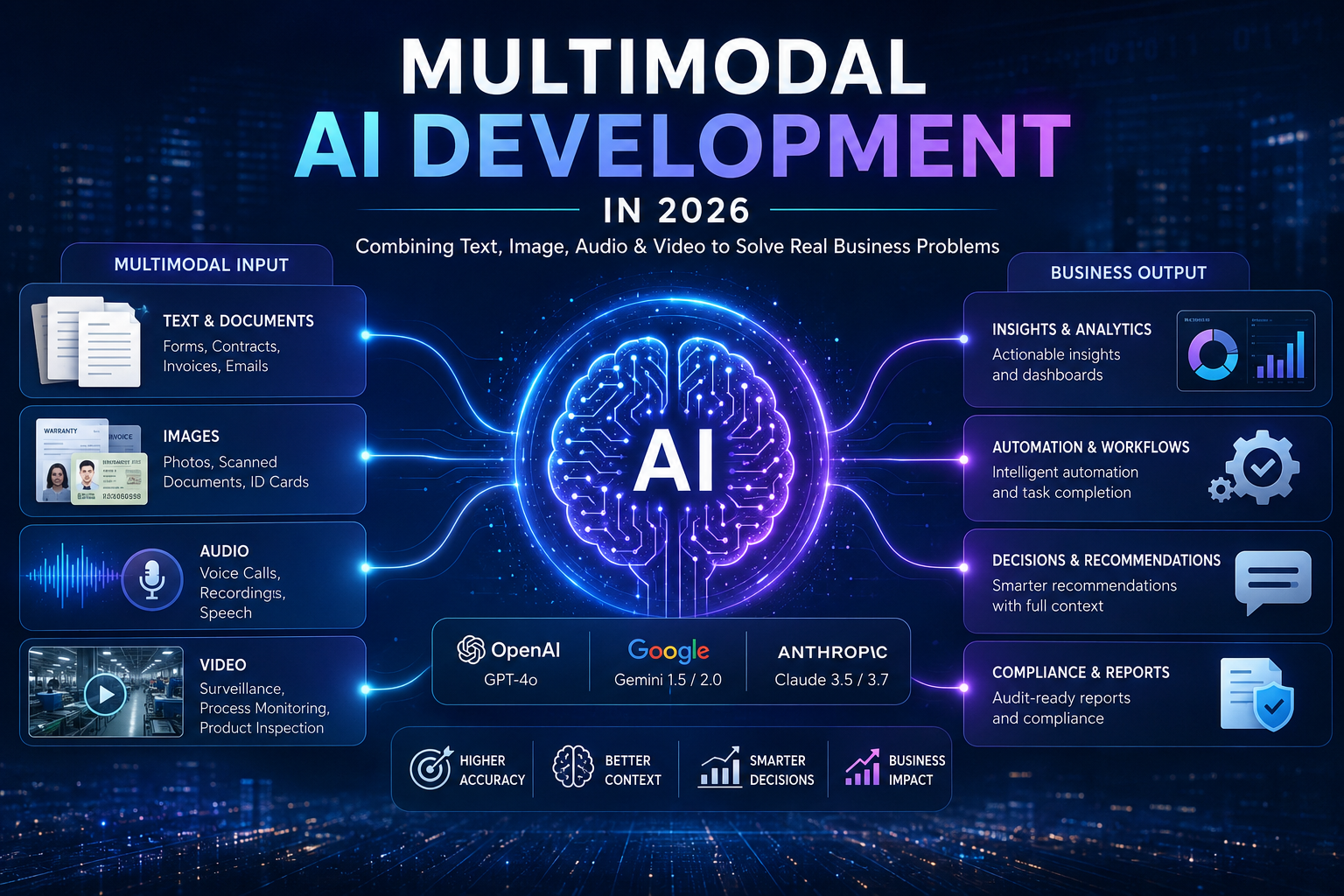
The three foundation models handling enterprise multimodal work seriously in 2026 are GPT-4o from OpenAI, Gemini 1.5 and 2.0 from Google, and Claude 3.5 and 3.7 from Anthropic. All three accept text and images. GPT-4o and Gemini handle audio and video natively.
For most business applications, text-plus-image is sufficient. Audio processing for call analytics often works better as a dedicated speech-to-text step feeding a text model: cheaper, and it produces an auditable transcript as a byproduct.
Choosing between these models is not primarily a capability question. All three are strong on standard business tasks. The real variables are cost per inference, API rate limits, and data residency requirements.
For Indian businesses operating under the Digital Personal Data Protection Act 2023, data residency is a selection criterion that most vendor comparisons ignore.
Text, Image, Audio and Video: What Each Modality Adds to Enterprise AI
Understanding what each modality contributes is how you pick the right combination for your actual problem, rather than defaulting to the most powerful model available.
Text: Still the Foundation of AI Reasoning
Text remains the most information-dense modality for business applications. Language understanding, reasoning, summarisation, and classification are all strong text-model capabilities.
If your problem can be solved with text alone, a text-only model is faster and cheaper. Adding image or audio processing to a workflow that does not genuinely need it increases cost and latency without improving output quality.
Image: Document Parsing, Visual QA and Defect Detection
Image input unlocks three high-value capabilities for business: document parsing, which means reading complex layouts, handwritten forms, scanned invoices, and ID documents; visual question answering, which means answering natural language questions about the content of an image; and quality inspection, which means identifying defects, verifying product conformance, or checking packaging.
The combination of image and text outperforms either modality alone on tasks involving visual reasoning. According to OpenAI’s GPT-4o technical documentation, models that receive an image and a question together achieve meaningfully higher accuracy than models given a text description of the same image and the same question. The model needs to see both at once.
Audio: Call Analytics and Tone Intelligence
Audio input enables real-time speech-to-text, speaker tone and sentiment detection, and call content analysis. In most enterprise builds, audio works best as a preprocessing step: transcribe using a dedicated speech model, then pass the transcript to a language model. This is cheaper than native multimodal audio inference and produces an auditable text record.
The exception is when tone itself carries information, not just what was said. A mid-size BFSI client I worked with processed 40,000 customer service calls per month. Their text-only system transcribed calls but missed tone signals that predicted churn risk. Adding audio sentiment analysis improved their churn prediction accuracy by 22% over six months.
Video: Process Monitoring and Temporal Analysis
Video is the most computationally expensive modality and the least mature for most enterprise use cases. The two areas where it earns its cost are manufacturing process monitoring, where you need to detect unsafe actions or process deviations on an assembly line in real time, and retail traffic analysis. For most businesses in 2026, video should not be the starting point for multimodal AI development. Start where the ROI is clearest and the data quality is controllable.
Multimodal AI Use Cases in 2026: What Indian and Global Enterprises Are Actually Building
These are not concept scenarios. These are applications in production or active pilot.
Retail: Visual Product Search and Catalogue Matching
A customer photographs a product they saw in a competitor’s store or on social media and wants to find the closest match in your catalogue. Text search cannot handle this. A multimodal system takes the image, identifies product category, style attributes, and colour, then queries the catalogue using that structured understanding.
We built this for a home furnishings retailer in Pune. Customers photographed items from competitor showrooms and social media posts. The system returned the three closest matches in the client’s catalogue with current pricing.
Cart conversion from the visual search feature was 34% higher than from keyword search in the first three months of deployment. The difference was not the AI model. It was eliminating the translation step between what the customer sees and what the search field accepts.
Manufacturing: Defect Diagnosis at the Point of Inspection
A technician photographs a component that failed inspection. The multimodal system receives the image and cross-references it against the maintenance manual, the component’s service history, and known failure patterns for that part. It returns a probable cause and a recommended corrective action, not just a defect classification.
For an auto components manufacturer in Pune, this collapsed a 45-minute escalation process to under four minutes. The technician was not replaced. They got faster access to the right information while standing on the shop floor, without waiting for an engineer to review the defect and pull the relevant documentation manually.
BFSI: Unified Loan Document Processing
A loan application packet typically includes a form, a scanned ID, a bank statement, and sometimes a property document. A text-only AI can process each document individually.
A multimodal system receives all of them simultaneously, extracts the relevant fields, and performs cross-document consistency checks: name spellings match, the income stated on the form aligns with the bank statement, the address on the ID matches the address on the form.
For an NBFC client in Mumbai processing MSME loans, analyst time per application dropped from 45 minutes to 8 minutes. Analysts reviewed and confirmed the model’s output rather than extracting data manually from four documents.
Over 12 months, the reduction in processing cost was material enough to support a lower minimum loan size, which opened up a previously unviable customer segment.
Healthcare: Clinical Decision Support
A physician uploads a scan alongside typed clinical notes. The multimodal system surfaces relevant clinical guidelines and highlights entries in the notes that may relate to what is visible in the image. This is decision support, not diagnosis. The distinction matters for regulatory compliance under ABDM guidelines and for clinical liability.
Every output in our healthcare builds is framed as a reference, not a recommendation. A clinician reviews every output before it affects a patient decision. If you are building multimodal AI for healthcare, build the human review step into the architecture from the start, not as an afterthought.
How to Build a Multimodal AI System: Architecture and Real Cost Numbers
Foundation Model API vs Fine-Tuned Model
For most business applications, a foundation model API is the right starting point. You pay per inference, the provider maintains the model, and you can begin building in days. GPT-4o API pricing in 2026 is approximately $0.005 per 1,000 text tokens and $0.01 to $0.02 per image depending on resolution.
A document processing application handling 10,000 documents per month with one image and 500 text tokens per document costs roughly $150 to $300 in monthly API fees. Compare that to the human labour cost of the same processing volume.
Fine-tuning a multimodal model makes sense when your domain has specialised visual patterns that general foundation models have not seen in sufficient volume. Industrial defect images with fine-grained classification requirements, histopathology images, or proprietary document formats with unusual layouts are cases where fine-tuning improves output quality meaningfully.
The cost: training runs $5,000 to $50,000 depending on dataset size and model. Add hosting cost for the fine-tuned endpoint and ongoing retraining cost when your data distribution shifts.
Data Pipeline Design for Multimodal AI Development
Preprocessing is where most multimodal projects encounter effort they did not budget for. Images need consistent sizing, format normalisation, and sometimes OCR pre-extraction before they reach the model. Audio needs noise reduction, sampling rate normalisation, and speaker diarisation.
Structured data needs to align with visual inputs in a coherent context. None of these are individually hard problems. Solving all of them reliably, at production volume, for every input variation your application encounters is where the engineering time goes.
A multimodal pipeline that works 95% of the time and fails silently on the other 5% is a worse production system than a text-only pipeline that works 99.9% of the time. Build the preprocessing layer to be reliable before you invest in model selection.
Latency: The Number Most Multimodal Architectures Ignore
A text-only inference call to GPT-4o averages 1 to 3 seconds. A multimodal call with a high-resolution image averages 4 to 12 seconds. For customer-facing applications where users expect near-instant response, you need one of three things: a smaller dedicated model for that modality, image compression in the preprocessing step, or an asynchronous processing pattern that returns results when they are ready rather than blocking the interface.
For internal business workflows, the latency bar is lower. Eight seconds to process a loan document is fast compared to the human alternative. For visual product search where a customer is waiting, eight seconds is a conversion problem.
What to Get Right Before You Start a Multimodal AI Build
Verify That Multiple Modalities Are Actually Required
The most common mistake I see in multimodal AI projects: selecting a powerful multimodal model for a problem a text-only model could solve at 10% of the cost. Before committing to a multimodal build, ask honestly whether solving the problem genuinely requires visual or audio input, or whether it can be solved with well-structured text.
If your customer support tickets always include a reference number that maps to a product image in your database, you do not need customers to upload images. You need a database lookup triggered by the reference number. That is a text query, not a multimodal inference call. Getting this distinction right before you start saves weeks of build time.
Data Quality Across Modalities Is Not Negotiable
A model receiving blurry photographs, inconsistently formatted documents, or audio with significant background noise will produce unreliable output regardless of how capable the underlying model is. Before selecting a model for any multimodal project, audit a representative sample of your actual input data.
If more than 20% of your images are low quality, low contrast, or inconsistently framed, invest in improving data collection before investing in model capability. We have paused projects at the discovery phase because the client’s image data could not support visual QA without re-running the collection process. That conversation is easier to have before the build contract is signed.
Privacy and Regulatory Risk for Image and Audio Data
Image and audio data carries higher regulatory sensitivity than text. A photograph can contain faces, location information, and identifying details. An audio recording may capture people who did not consent to being recorded or processed.
Under the Digital Personal Data Protection Act 2023, image and audio data with identifying information requires explicit consent, defined purpose limitation, and clear retention limits. Build the data governance and consent framework for your higher-sensitivity modalities before you scale the system, not after it is already in production.
Start with One Modality Combination, One Problem, One Metric
The businesses I have seen get the most value from multimodal AI started narrow: one input combination, one process step, one team’s workflow, one success metric.
The NBFC example above started as a single document type processed by a single model. The success metric was processing time per application. It was not an enterprise-wide AI programme. It was a specific fix to a specific bottleneck.
The projects that stall started with a mandate to “use AI across operations” and tried to process five document types with four modalities in the first build. Data quality issues compound, evaluation becomes impossible, and the team spends six months on infrastructure before anyone can measure whether the system works.
Pick the one process in your organisation where someone currently opens both an image and a document to make a decision. Define what a correct output looks like. Measure what it costs in human time today. Build the smallest system that automates that one step, measure the result, and expand from there.
For use case identification and build, our generative AI development services cover the full scope from scoping workshop to production deployment. For applications where image analysis is the primary requirement, our computer vision development for business practice handles the visual processing layer specifically.
For retail applications including visual product search and AI-driven customer service, our AI agents for retail team combines multimodal inputs with the decision logic that makes the system useful in production, not just in a demo.
Frequently Asked Questions About Multimodal AI Development
Which industries benefit most from multimodal AI?
Retail, manufacturing, healthcare, and BFSI see the strongest ROI because their core processes already involve multiple data types: product images, scanned documents, voice calls, and structured records. The operational test is simple. If someone in your organisation currently opens a document and an image side by side to make a decision, that workflow is a multimodal AI candidate.
Do I need to train my own multimodal model?
No, in most cases. Foundation models like GPT-4o, Gemini 1.5, and Claude 3.5 handle standard business multimodal tasks well without any training. Fine-tuning is worth the cost when your domain has specialised visual or audio patterns that general models have not seen enough of: medical imaging, fine-grained industrial defect classification, or proprietary document formats with unusual layouts.
How is multimodal AI different from computer vision?
Computer vision handles image and video understanding specifically: object detection, classification, and segmentation. Multimodal AI combines vision with language, so the system can answer questions about what it sees rather than just label it. A computer vision system tells you there is a surface crack on a component. A multimodal AI system tells you the crack matches a known failure pattern in your maintenance manual and recommends a corrective action. Our computer vision for business practice handles both, depending on what the problem actually requires.
What does a multimodal AI project cost to build?
A production application using a foundation model API with image and text inputs, a custom processing pipeline, and integration with existing systems typically takes 12 to 20 weeks and costs significantly less than fine-tuning a custom model. Monthly API costs run $100 to $2,000 depending on volume. Fine-tuned models add $5,000 to $50,000 in training cost and require a hosted inference endpoint you manage. Data preparation, cleaning and standardising inputs across modalities, is consistently underestimated and often adds 3 to 6 weeks to the project timeline.
Can multimodal AI process inputs in real time?
Yes. Real-time multimodal inference requires optimised model serving, image preprocessing that reduces file size without losing critical detail, and a queuing architecture for high-concurrency applications. Voice interfaces and visual search both run in real time in production today. Batch processing is cheaper and more reliable for use cases that do not need instant response: overnight document processing, end-of-shift quality inspection review, and daily reporting workflows.
What is the biggest risk in a multimodal AI enterprise project?
Choosing a powerful multimodal model for a problem a text-only model could solve at a fraction of the cost. The second biggest risk: underestimating data quality work across modalities. Input data that works for human review often does not meet the consistency requirements a production AI pipeline needs. Audit your actual data before selecting a model.