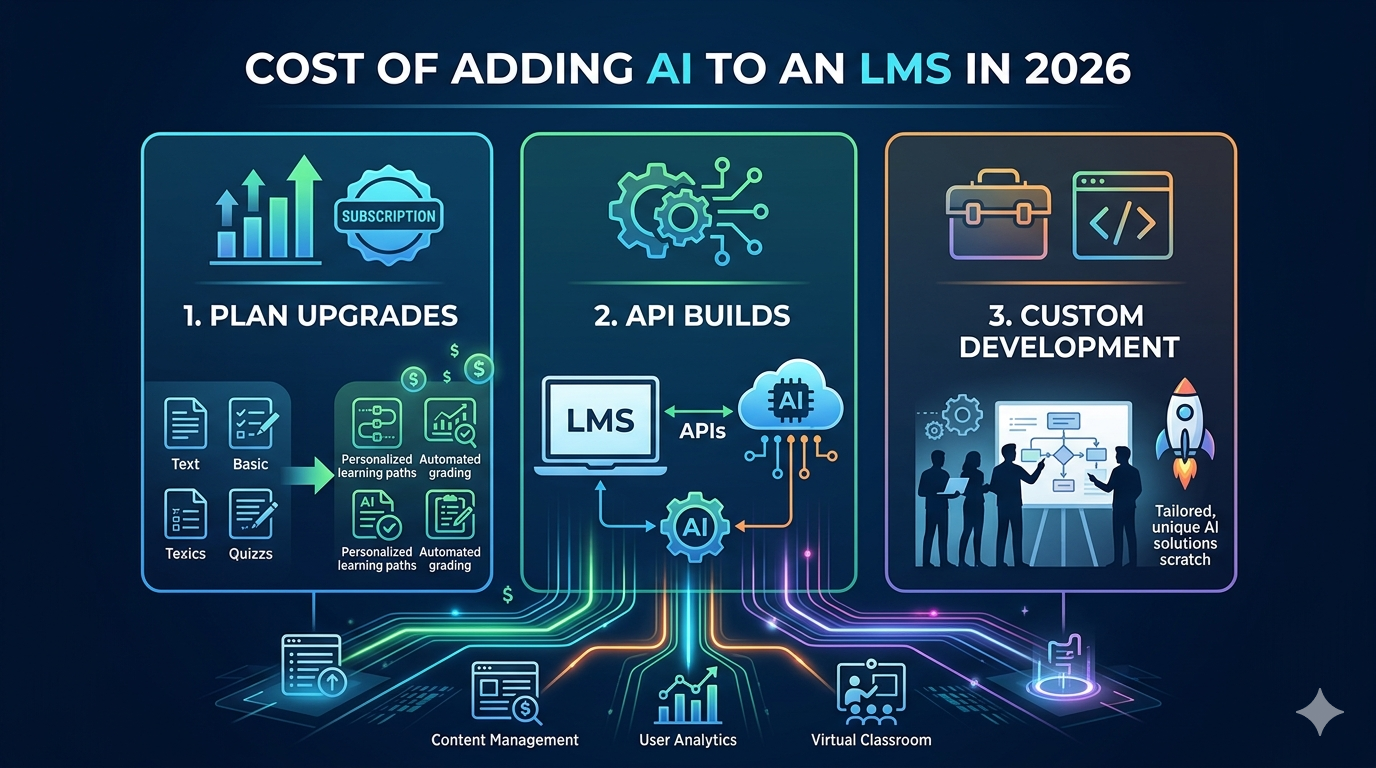
The short answer: anywhere from a few hundred dollars a year to $250,000 or more, depending on what kind of AI you are adding and how you add it. The wide range is not a dodge. It reflects four genuinely different approaches, each suited to a different situation and budget.
Before you can answer “how much,” you need to answer “which AI feature.” A chatbot that answers learner questions costs differently from a recommendation engine that predicts what a learner should study next. AI-generated video costs differently from AI-powered proctoring. This article breaks down every route with real numbers so you can match the approach to your budget.
Quick Reference Table
| Aspects | LMS Plan Upgrade | API Integration | Third-Party Tools | Custom AI Build |
|---|---|---|---|---|
| Upfront Cost | $0 to $15,000 | $8,000 to $60,000 | $0 to $5,000 | $50,000 to $250,000+ |
| Annual Running Cost | Plan difference only | $500 to $5,000 | $500 to $150,000 | 10 to 15% of build cost |
| Time to Deploy | Immediate | 4 to 8 weeks | 1 to 5 days | 16 to 24 weeks |
| Technical Complexity | None | Medium | Low | High |
| Customisation Level | Limited to platform features | High | Low to medium | Unlimited |
| Best For | Teams on enterprise LMS with AI already built in | Specific features on a defined budget | Video production or exam proctoring | Proprietary data and complex recommendation logic |
| Hidden Cost Risk | Low | API costs at scale | Per-session fees compound fast | Data preparation adds $5K to $20K |
Table of Contents
Step One: Check What Your LMS Already Includes
Before spending anything, check whether your LMS already has AI features in a plan you have not upgraded to yet.
Most enterprise LMS platforms added AI capabilities in 2023 and 2024. The features are there, but they sit behind higher pricing tiers. If your organization is on a base or legacy plan, the cheapest path to AI may simply be an upgrade.
D2L Brightspace is one of the most AI-complete LMS platforms available today. Their AI layer, called D2L Lumi, is powered by Anthropic Claude and includes over 14 distinct features: automated rubric creation, lesson summary generation, course recommendations, at-risk learner detection, and more.
D2L Brightspace pricing starts at around $7 to $15 per user per month. For 500 users, that is roughly $42,000 to $90,000 per year. The AI features are included, not separately priced.
Docebo includes AI-powered content recommendations, automated quiz generation, and their Shape tool for AI-assisted course creation in enterprise plans. Docebo pricing starts at approximately $25,000 per year for smaller deployments, scaling to $50,000 to $200,000 per year for mid-to-large organizations.
If you are already a Docebo customer on a lower tier, upgrading to unlock AI features is typically the most cost-effective route.
TalentLMS offers plans from $69 per month for 40 users. Their AI content assistant features are available in higher-tier plans. For teams already on TalentLMS, upgrading from Basic to Plus adds AI course-building tools without a separate development project.
The takeaway: If you use an enterprise LMS, check your plan features before budgeting for custom development. You may be one tier upgrade away from the AI capabilities you need.
The API Route: Add a Custom AI Feature Using OpenAI or Anthropic
If your LMS does not include the AI feature you need, or if you want something more tailored, building directly on top of an AI API is the next most affordable route. The most common application: an AI chatbot that answers learner questions, summarizes course content, or acts as a virtual study assistant embedded in your LMS.
OpenAI’s current API pricing gives you a clear cost model. GPT-4o costs $2.50 per million input tokens and $10.00 per million output tokens.
For most LMS chatbot use cases, GPT-4o mini is more than capable at a fraction of the cost: $0.15 per million input tokens and $0.60 per million output tokens.
What does that mean in practice? A learner asking 10 questions per session, each requiring 500 tokens of context and generating 300 tokens of response, uses roughly 8,000 tokens per session. At GPT-4o mini pricing, that is less than $0.001 per session.
For 10,000 monthly active learners, your monthly API cost is approximately $10 to $30. Even at 100,000 sessions a month, you are under $300 in API fees.
The API cost is not the expensive part. The build is.
A well-built AI chatbot for an LMS; including integration with your existing course content, a conversation interface embedded in the LMS, context-aware responses based on what the learner is currently studying, and admin controls for monitoring; typically costs $8,000 to $25,000 to develop. Timeline: 4 to 8 weeks.
| AI Feature | Build Cost | Monthly API Running Cost |
|---|---|---|
| AI Q&A chatbot for learners | $8,000 to $25,000 | $10 to $300 |
| AI content summarizer | $5,000 to $15,000 | $5 to $100 |
| AI-powered course search | $10,000 to $25,000 | Minimal |
| AI personalized learning paths | $20,000 to $60,000 | $50 to $500 |
| AI at-risk learner detection | $15,000 to $40,000 | Minimal |
Third-Party AI Tools You Can Plug Into Your LMS
For specific AI capabilities, a third-party subscription tool is often faster and cheaper than a custom build.
AI Video and Course Content Creation
Synthesia lets you create AI avatar videos for course content without filming anything. An instructor types a script and a photorealistic avatar presents it on screen.
Synthesia’s Starter plan costs $18 per month (billed annually), covering around 120 minutes of video per year. The Creator plan is $64 per month for 360 minutes annually. Enterprise pricing is custom.
For organizations creating new course content regularly, this replaces video production costs that typically run $1,000 to $5,000 per finished hour of professional learning video.
AI-Powered Exam Proctoring
If your LMS delivers assessments that need integrity monitoring, AI proctoring adds a surveillance layer without a human invigilator.
ProctorU charges approximately $14.75 to $30.25 per exam session depending on exam length. A one-hour exam is around $14.75. A three-hour exam is around $30.25. For an organization running 5,000 exam sessions per year, that is $73,000 to $150,000 annually – a significant line item to plan for.
Honorlock operates on institutional flat-rate pricing rather than per-session fees, typically falling between $12 and $30 per student per semester for unlimited exams within that period. For high-exam-frequency programs, Honorlock’s flat rate often works out cheaper per exam than per-session pricing.
Custom AI Development: When the Simpler Routes Do Not Fit
Some AI features cannot be delivered by a plan upgrade, an API integration, or a third-party plugin. If you need a recommendation engine trained on your own learner behavior data, an AI system that integrates with your proprietary content taxonomy, or a predictive model that identifies skill gaps across your organization, you are looking at custom AI development.
According to Gartner, global AI spending is projected to reach $2.5 trillion in 2026. Their research also notes that moving from a proof-of-concept to a production-ready AI system typically multiplies the initial investment by 3 to 5 times when you account for reliability, monitoring, and scaling requirements.
In practice, custom AI development for LMS features breaks down like this:
| Feature | Proof of Concept | Production System |
|---|---|---|
| Recommendation engine | $15,000 to $30,000 | $50,000 to $120,000 |
| Custom AI tutor / virtual coach | $20,000 to $40,000 | $80,000 to $200,000 |
| Predictive learner analytics | $10,000 to $25,000 | $40,000 to $100,000 |
| AI content generation pipeline | $15,000 to $35,000 | $50,000 to $150,000 |
Build timelines for production systems run 16 to 24 weeks. Gartner also notes that only 25% of enterprise AI initiatives deliver expected ROI. The projects that succeed are the ones with a specific, measurable outcome defined before a line of code is written.
Hidden Costs That Push AI LMS Projects Over Budget
Four costs that almost never appear in the first budget conversation:
1. Data preparation.
AI systems learn from your data. If your LMS has incomplete completion records, inconsistent content metadata, or learner data spread across multiple systems, cleaning and structuring that data typically adds 2 to 4 weeks and $5,000 to $20,000 to any project.
2. API costs at scale.
The per-token costs for GPT-4o mini look trivial at low volume. At 1 million learner interactions per month, they are not. Model your usage before committing to an API-based architecture at scale.
3. Ongoing maintenance.
AI models need to be monitored, retrained when performance drifts, and updated when the underlying API version changes. Budget 10 to 15% of build cost per year for maintenance.
4. Change management.
Learners and instructors need to understand how the AI works, what it is for, and what to do when it gives a wrong answer. Training and communication for a 5,000-learner organization typically costs $5,000 to $15,000 and is almost always missing from the initial project budget.
What to Budget: A Quick Reference
| Approach | Upfront Cost | Annual Running Cost | Best For |
|---|---|---|---|
| Upgrade existing LMS plan | $0 to $15,000 | Plan difference only | Teams on enterprise LMS with AI already built in |
| API integration (chatbot, search, summary) | $8,000 to $60,000 | $500 to $5,000 | Specific features on a defined budget |
| Third-party tools (video, proctoring) | $0 to $5,000 | $500 to $150,000 | Content production or exam integrity specifically |
| Custom AI development | $50,000 to $250,000+ | 10 to 15% of build cost | Proprietary data, complex recommendation logic |
Final Words: Start With the Feature, Not the Budget
The most common mistake in AI-for-LMS projects is starting with a budget and working backwards. That produces underbuilt systems that do not solve the actual problem.
Start instead with one specific question: what should AI do for your learners that your LMS cannot do today? Answer that clearly, then match the approach and budget to the answer.
A chatbot that reduces L&D team support tickets is a $20,000 project with a measurable payback. A full recommendation engine for a 100,000-learner platform is a $150,000 project with a longer return timeline. Both can be good investments. Neither is right for every situation.
Our generative AI development services cover AI feature builds on top of existing LMS platforms from API-based chatbots to custom recommendation engines. For organizations in education and corporate L&D evaluating AI as part of a broader platform strategy, our education industry solutions page covers the full scope.
If you want a scoping conversation before committing to a budget, our AI development services team can assess your existing LMS, your data quality, and the most cost-effective path to the AI feature you actually need.
Frequently Asked Questions About Adding AI to an LMS
Can I add AI to an open-source LMS like Moodle for free?
Moodle has a plugin ecosystem with some AI integrations, including experimental OpenAI connectors. The plugin itself may be free, but connecting it to OpenAI’s API incurs API costs, and getting a production-quality implementation working requires development time. Budget $5,000 to $20,000 for a properly built and tested AI integration on Moodle, plus ongoing API costs.
Is it cheaper to switch to an AI-native LMS or add AI to my current one?
It depends on how far your current LMS is from what you need. If you are on Docebo or D2L Brightspace and simply need to upgrade your plan, staying is almost always cheaper. If your LMS is a legacy custom system with no modern API layer, the cost of adding AI to it may exceed the cost of migrating to an AI-native platform. Get a technical assessment of your current system before deciding.
How long does it take to add AI to an existing LMS?
A plan upgrade is immediate. An API-based chatbot or content feature takes 4 to 8 weeks to build and deploy. A custom recommendation engine or predictive analytics system takes 16 to 24 weeks. Data preparation adds 2 to 4 weeks to any custom project if your existing data is not clean and structured.