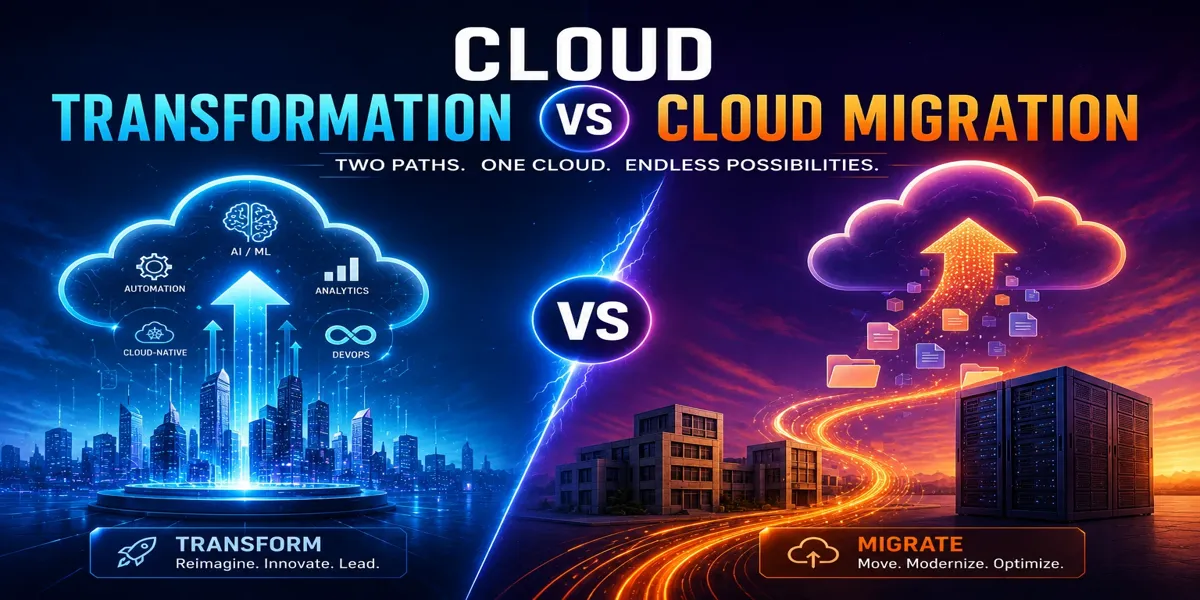
If you’re evaluating your cloud strategy and are confused between cloud transformation and cloud migration, understanding the core difference between the two is essential to choosing the right approach for your business. At first glance, they might seem interchangeable. But choosing the wrong path can lead you to wasted budgets, failed timelines, and missed business outcomes.
The scale of the opportunity is enormous. According to McKinsey, cloud adoption can unlock up to $1 trillion in business value, and companies that effectively integrate AI in cloud transformations may achieve up to 7x the ROI compared to their peers.
The global cloud migration market is projected to grow from $232.51 billion in 2024 to $806.41 billion by 2029 (CAGR of 28.24%) as per the latest report by AWS Amazon. Meanwhile, the global cloud transformation market is expected to reach USD 1.6 trillion by 2030 at a CAGR of 18%.
Despite this momentum, McKinsey estimates approximately $100 billion of wasted migration spending over three years, largely because businesses treat cloud transformation and cloud migration as the same thing. However, the two approaches serve very different purposes.
This blog breaks it down in detail, so you can make the right call for your business.
Table of Contents
What is Cloud Migration?
Cloud migration is the process of moving your organization’s existing data, applications, and IT infrastructure from on-premises systems to a cloud environment, with minimal changes to the underlying architecture. It is often described as a ‘lift-and-shift’ approach.
Key characteristics of cloud migration:
- Relocates workloads to cloud with little to no code change
- Faster to execute, typically weeks to a few months
- Primary goal: cut infrastructure costs and reduce hardware dependency
- Common approach: Rehost (Lift & Shift), replatform
- 94% of enterprises now use cloud infrastructure in some format (Gartner, 2025)
What is Cloud Transformation?
Cloud transformation is a broader, strategic shift. It goes beyond moving workloads; it involves redesigning applications, rethinking business processes, and building a cloud-native culture. The goal is to leverage the full power of the cloud such as automation, AI, scalability, and continuous innovation.
Key characteristics of cloud transformation:
- Rebuilds or refactors applications for cloud-native architecture
- Involves people, processes, and technology, not just infrastructure
- Takes months to years (phased roadmap with clear milestones)
- 78% of CIOs cite cloud transformation as the most important driver of digital business strategy
- 91% of enterprises report having a defined cloud transformation roadmap in 2026
Expert cloud consulting services help businesses build a clear roadmap from assessment to execution, ensuring every transformation decision aligns with measurable business outcomes.
Cloud Transformation vs Cloud Migration: Quick Overview
Before we go deeper, here’s a high-level side-by-side view of how both approaches compare on the fundamentals:
| Factor | Cloud Migration | Cloud Transformation |
| Definition | Moving existing workloads/data to cloud with minimal changes | Reimagining business processes and architecture using cloud-native capabilities |
| Primary Goal | Infrastructure shift and cost reduction | Business agility, innovation, and competitive edge |
| Scope | IT systems, applications, data | Technology, people, processes, and culture |
| Timeframe | Weeks to a few months | Months to years (phased approach) |
| Complexity | Low to moderate | High, involves architecture redesign |
| Risk Level | Moderate | Higher (but managed with strategy) |
| Upfront Cost | Lower investment | Higher investment, greater long-term ROI |
| Typical Approach | Lift-and-shift (rehost/replatform) | Refactor, re-architect, rebuild |
Detailed Comparative Analysis of Cloud Transformation and Cloud Migration
The table above gives you a quick answer. But to make the right decision for your business, you need to understand how these two approaches differ across every critical dimension, from architecture and cost to security, ROI, and organizational impact. Here is a detailed breakdown.
1. Strategic Intent: Tactical vs. Transformational
Cloud migration is fundamentally a tactical move. The goal is to exit aging infrastructure, reduce capital expenditure, and replicate your existing IT environment in the cloud. There is no reinvention of how you operate, just a change of location.
Cloud transformation is a strategic commitment. It asks a different question: not ‘how do we move what we have?’ but ‘how do we become a different kind of business because of the cloud?’
This includes redesigning workflows, adopting new delivery models, and unlocking capabilities like AI, real-time analytics, and autonomous scaling.
In short: migration is about doing the same things cheaper; transformation enables businesses to build capabilities that are difficult to achieve in traditional environments.
2. Architecture Change: Rehosted vs. Rebuilt
This is one of the most important technical distinctions between the two approaches.
Cloud migration architecture:
- Applications remain largely as-is, monolithic architectures stay monolithic
- Servers are replicated in the cloud (IaaS model)
- Databases are moved but not restructured
- Integrations and dependencies are lifted without redesign
Cloud transformation architecture:
- Monolithic applications are broken down into microservices
- Apps are containerized (Docker/Kubernetes) for portability and resilience
- Serverless functions replace always-on servers for cost-efficiency
- APIs and event-driven architectures replace point-to-point integrations
- Infrastructure-as-Code (IaC) enables repeatable, automated deployments
The architectural gap matters because a migrated workload still carries its original technical debt. Transformation helps reduce technical debt while building a foundation optimized for cloud-native capabilities.
3. Cost, Investment, and ROI: Short-Term Savings vs. Long-Term Value
Cost is often one of the biggest factors in the cloud migration vs. transformation discussion, but the long-term outcomes can vary significantly.
Cloud migration cost profile:
- Lower upfront, primarily tooling and services (AWS MGN, Azure Migrate, etc.)
- Average IT cost reduction of 20% post-migration (Forbes)
- Risk: 20% average cost overrun due to underestimating complexity (McKinsey)
- Long-term risk: ongoing inefficiency costs from un-optimized, migrated workloads
Cloud transformation cost profile:
- Higher upfront investment, 6 to 18 months before significant ROI
- Up to 50% reduction in operational inefficiency over 3–5 years
The calculus is straightforward: if speed and cost reduction are the immediate need, migration delivers first. If you are looking at a 3–5-year horizon and competitive differentiation matters, transformation has a significantly higher ceiling on returns.
| ROI Dimension | Cloud Migration | Cloud Transformation |
| Time to First ROI | 3–6 months (infrastructure savings) | 12–24 months (deeper business gains) |
| IT Cost Reduction | Average 20% reduction in IT costs (Forbes) | Up to 50% operational efficiency gains (2025 industry data) |
| Revenue Impact | Indirect (cost savings reinvested) | Direct, new digital products, faster delivery, new markets |
| Scalability ROI | 25% scalability improvement (Gartner) | Elastic, unlimited, auto-scales with zero manual intervention |
| AI/ML Readiness | Limited, requires further transformation | Full, cloud-native foundation supports AI workloads natively |
| Long-term Value | Diminishing, technical debt often persists | Compounding, each improvement builds on cloud-native foundation |
| McKinsey Benchmark | Baseline cloud value capture | Up to 7x ROI with AI-integrated cloud transformation |
4. Speed and Timeline: Weeks vs. Years
Cloud migration timelines vary by workload volume but are generally measured in weeks to months. A single application can migrate in a few days. A full data center might take 6–12 months, but the workloads go live incrementally.
Cloud transformation timelines are longer because the scope is deeper:
- Phase 1- Discovery and Architecture Design: 4–8 weeks
- Phase 2- Foundation Build (cloud-native infrastructure, DevOps, CI/CD): 2–4 months
- Phase 3- Application Modernization (wave-by-wave refactoring): 6–18 months
- Phase 4- Optimization and Innovation (AI, automation, FinOps): Ongoing
The key insight: Transformation is not a project with an end date; it is a continuous operating model. Organizations that treat it as a one-time project consistently underdeliver. Those that treat it as an ongoing capability are more likely to compound value over time.
5. Security Posture: Inherited vs. Redesigned
Security is where the gap between migration and transformation becomes most consequential for enterprises.
In cloud migration, security posture is largely inherited from on-premises, perimeter-based models; VPN access, and firewalls are replicated in the cloud. This reduces the attack surface slightly but does not modernize the security architecture. Misconfigurations cause 82% of cloud breaches (MerTech, 2024), and migrated environments are especially vulnerable because security was not redesigned for cloud.
In cloud transformation, security is rebuilt from the ground up using a zero-trust model:
- Identity and Access Management (IAM) with least-privilege policies
- Encryption at rest and in transit as default
- DevSecOps, security embedded in every CI/CD pipeline stage
- Automated compliance checks and policy-as-code (e.g., Open Policy Agent)
- SIEM and cloud-native threat detection (AWS GuardDuty, Azure Defender)
For regulated industries, finance, healthcare, government, cloud transformation is not just a performance choice; it is often a compliance necessity.
6. Business and Organizational Impact: IT Project vs. Enterprise Shift
Perhaps the clearest way to understand the difference: cloud migration is an IT project; cloud transformation is a business initiative.
Cloud migration impact:
- IT team reduces infrastructure overhead and vendor contracts
- Business experiences minimal disruption, same apps, same processes
- Cost savings are reinvested, but business models remain unchanged
Cloud transformation impact:
- New digital products and services become possible
- Customer experience improves through real-time personalisation and analytics
- Engineering teams ship features 60–80% faster with CI/CD and cloud-native tooling
- 50% of organisations face resistance during transformation; change management is critical
- Requires executive sponsorship, cross-functional alignment, and cultural change
A strong cloud transformation strategy addresses the people’s dimension as rigorously as the technical one. Cloud transformation consulting engagements often include change management frameworks alongside architecture planning and modernization initiatives.
7. Scalability and Performance: Better vs. Built for Scale
Both approaches improve scalability and infrastructure flexibility, but to very different degrees.
- Cloud migration: Clouds give more capacity, but scaling often requires manual intervention or simple autoscaling rules.
- Cloud transformation: Elastic, auto-scaling design. Microservices scale independently. Serverless functions respond in milliseconds with zero provisioning. Kubernetes orchestration handles traffic spikes automatically.
For workloads with variable or unpredictable demand, eCommerce, fintech, SaaS platforms, transformation-level scalability is a competitive requirement, not a luxury.
Full Comparative Breakdown Across 12 Dimensions
The table below summarizes all key dimensions in one view, making it easier for decision-makers to evaluate which approach fits their specific situation:
| Dimension | Cloud Migration | Cloud Transformation | What It Means for You |
| Strategic Intent | Tactical: move infrastructure to reduce cost and exit aging hardware | Strategic: rebuild competitive advantage using cloud capabilities | Migration = do more with less. Transformation = do things you couldn’t before. |
| Architecture Change | Minimal, app architecture largely stays the same (monolith remains monolith) | Fundamental, apps are refactored into microservices, containers, serverless | Transformation unlocks cloud-native benefits; migration often defers to technical debt. |
| Speed to Value | Fast: weeks to 3 months for initial workload migration | Slower: 6 months to 3 years depending on scope and complexity | Migration wins speed; transformation wins depth of value. |
| Cost Profile | Lower upfront; risks include 20% average cost overruns (McKinsey). Mainly OpEx shift. | Higher upfront (6–18 months of investment before ROI). Up to 7x ROI over time (McKinsey). | For tight budgets, migration is an entry point. Transformation justifies larger investments. |
| Scope of Change | IT infrastructure: servers, databases, apps moved as-is | Entire enterprise: IT + business processes + culture + organizational design | Transformation requires executive sponsorship. Migration can be IT-led. |
| Technical Depth | Rehost (lift-and-shift) or Replatform (minor adjustments). No code is rewritten. | Refactor (re-code for cloud), Rearchitect (redesign), or Rebuild (rebuild from scratch). | Transformation requires deeper engineering talent and longer planning cycles. |
| Security Posture | Security mostly inherited from on-prem; perimeter-based model often persists | Zero-trust, cloud-native security, IAM, encryption, DevSecOps, and compliance by design | Cloud transformation delivers stronger, modern security architecture long-term. |
| Business Impact | Cost savings (avg. 20% IT cost reduction, Forbes). Reduced hardware footprint. | Revenue growth, new digital products, faster time-to-market (40% faster, Forrester 2025) | Transformation changes what your business can sell, not just how IT operates. |
| Stakeholder Involvement | Primarily IT team and cloud architects | C-suite, business units, HR (change management), IT, and DevOps together | Transformation is a company initiative. Migration is an IT project. |
| Skills Required | Cloud infrastructure, migration tools (AWS MGN, Azure Migrate), networking | Cloud-native dev, DevOps, CI/CD, Kubernetes, FinOps, AI/ML integration | Cloud transformation demands broader, deeper skill investment. |
| Scalability Outcome | Improved vs. on-prem, with 25% scalability improvement reported (Gartner) | Elastic, on-demand, auto-scaling, purpose-built for unpredictable workloads | Both improve scalability; transformation is built for scale from the ground up. |
| Reversibility | Relatively easier to reverse (rollback to on-prem still feasible) | Hard to reverse, architecture, culture, and processes are fundamentally changed | Transformation is a commitment. Migration offers more flexibility early on. |
Cloud Migration Challenges You Should Know Before You Start
Cloud migration is often seen as the ‘easier’ path, but cloud migration challenges are real and can derail even well-planned projects. Around 38% of businesses struggle with cloud integration (Forbes), and 20% report unexpected costs (McKinsey). This is why many enterprises partner with experienced cloud migration services providers to reduce risk, improve planning, and avoid costly disruptions during migration.
| Challenge | Cloud Migration | Cloud Transformation |
| Data Security | Risk of data exposure during transfer; perimeter-model vulnerabilities persist | Requires end-to-end cloud-native security redesign; zero-trust architecture |
| Downtime Risk | Possible service interruption during cutover windows | Managed via phased rollout, blue-green deployments, and feature flags |
| Legacy Compatibility | Compatibility issues with older systems; may need replatforming | Requires full modernization of legacy dependencies and data models |
| Cost Overruns | Unplanned cloud spends averages 20% over budget | Larger budget scope; requires FinOps discipline from day one |
| Talent Gap | Need cloud infrastructure and migration tooling skills | Need cloud-native, DevOps, Kubernetes, and AI integration expertise |
| Organizational Change | Minimal cultural shift needed, IT-led project | Significant change management, retraining, and new operating models required |
| Integration Complexity | Existing integrations may break during rehost | Legacy integrations are rebuilt as APIs and event-driven services |
| Governance & Compliance | Compliance frameworks mapped to cloud but not redesigned | Compliance embedded in infrastructure-as-code and automated policy enforcement |
Cloud Transformation Strategy
A solid cloud transformation strategy is what separates companies that get ROI from those that get stuck in expensive, half-finished projects. An effective strategy covers:
- Discovery and audit: Map your current IT estate, applications, dependencies, data volumes, and compliance requirements.
- Business goal alignment: Every workload decision should be traced back to a measurable business outcome.
- Phased roadmap: Avoid big-bang projects. Phase workloads by complexity and business priority.
- Cloud-native architecture planning: Design for microservices, containers, and serverless from the start.
- FinOps integration: Cost governance must be embedded from day one, not bolted on later.
- Change management: 50% of firms face resistance to cloud adoption. People readiness is as critical as technical readiness.
When Should You Choose Cloud Transformation vs Cloud Migration?
The answer depends on your current situation, goals, and timeline. Here’s a practical decision framework:
| Business Scenario | Recommended Approach | Why |
| Moving off an expiring data center contract quickly | Cloud Migration | Speed is priority; minimize disruption |
| Reducing hardware and data center costs immediately | Cloud Migration | Fast ROI on infrastructure spend |
| Scaling for AI, analytics, or microservices workloads | Cloud Transformation | Needs cloud-native architecture |
| Gaining long-term competitive differentiation | Cloud Transformation | Requires business model and tech redesign |
| Modernizing legacy applications end-to-end | Cloud Transformation | Migration alone won’t fix technical debt |
| Complying with data sovereignty or new regulations | Cloud Migration (to start) | Establish cloud baseline; transform later |
| Both cost savings AND future innovation needed | Migration first → Transformation | Stage investments for max ROI at each phase |
| Greenfield digital product launch | Cloud Transformation | Build cloud-native from day one |
Many organizations find that cloud transformation vs migration is not an either/or decision; they start with migration to capture quick wins, then layer transformation on top. AI-driven development on the cloud is increasingly the reason to push toward full transformation.
The Role of AI in Cloud Transformation
AI is redefining what cloud transformation means. In 2025, 59% of organizations with AI roadmaps are increasing IT infrastructure investments; the cloud is the foundation. AI enables:
- Intelligent workload migration (automating assessment and wave planning)
- Predictive cost optimization (FinOps powered by ML)
- Faster application modernization through AI-assisted refactoring
- AIOps for proactive cloud monitoring and incident response
Companies integrating AI with their cloud transformations may achieve up to 7x the ROI vs. basic hosting (McKinsey, 2024). This is one of the key reasons businesses are increasingly investing in cloud transformation services.
AI integration services are designed to work alongside your cloud transformation, embedding intelligence at every layer of your modernized infrastructure.
What Top Businesses Get Right About Cloud Transformation vs Migration
Lessons from enterprises that have done this well point to a few consistent patterns:
- They set clear KPIs upfront: Cost savings, deployment frequency, or customer experience metrics, not just ‘moved to cloud.’
- They treat transformation as continuous: Not a one-time project. Cloud transformation consulting engagements that succeed run on 12–18-month cycles.
- They invest in cloud-native skills: Companies globally need to hire or reskill at least one million cloud developers (McKinsey).
- They manage cloud migration challenges proactively: With governance, automation, and monitoring built in from day one.
Conclusion
The debate around cloud transformation vs cloud migration comes down to one fundamental question: are you trying to move your IT, or transform your business? Migration is the starting point for most organizations, faster, lower-risk, and focused on cost efficiency. Cloud transformation is where a sustainable competitive advantage is built.
Both paths require a clear cloud transformation strategy, skilled execution, and the right partner. The $100 billion in wasted migration spend isn’t the result of bad technology; it’s the result of unclear strategy and poor sequencing. Get that right, and the cloud delivers everything it promises.
FAQ
1. Is cloud migration the same as cloud transformation?
No. Migration moves workloads to the cloud; transformation reimagines them for the cloud. One is tactical; the other is strategic. Many businesses start with migration and evolve toward transformation.
2. Do I need to migrate before I can transform?
Not always. Some workloads are best rebuilt cloud-natively without a traditional migration step. Others benefit from a migrate-first, optimise-later sequence. Your cloud transformation strategy should define which path fits each workload.
3. What are the biggest cloud migration challenges for enterprises?
Data security, legacy system compatibility, unexpected cost overruns, and talent shortages top the list consistently across industries and geographies.
4. What does cloud transformation consulting actually involve?
Cloud transformation consulting covers business case development, architecture design, migration sequencing, organizational readiness, and post-transformation optimization.