

If you’ve ever asked a vendor “how much does staff augmentation cost?” and got a vague answer like “it depends on your requirements,” you’re not alone. That answer is frustrating, and honestly, a little lazy.
The truth is that staff augmentation costs depend on several things. But those things are very well-defined, very measurable, and very easy to compare once someone lays them out clearly. That’s exactly what this guide does.
Whether you’re a startup trying to stretch your engineering budget, a mid-market company scaling a product team, or an enterprise that needs niche talent fast, this is your complete reference for understanding what staff augmentation services actually cost in 2026, what drives those costs, which pricing model fits your situation, and where most companies quietly overspend without realizing it. Let’s get into it.
Table of Contents
What Is Staff Augmentation, and Why Does Cost Vary So Much
Staff augmentation is a hiring model where you bring skilled external professionals directly into your existing team. They work under your direction, follow your processes, use your tools, and build your product, just like an in-house employee would, minus the full-time commitment.
What separates it from outsourcing is control. You manage the work. The vendor supplies talent.
Now, here’s why the cost varies so wildly across vendors: staff augmentation isn’t a single product with a fixed price. It’s a flexible model shaped by who you hire, where they’re based, what they specialize in, how long you need them, and what pricing structure you choose. Change any one of those variables, and the cost picture changes completely.
A junior frontend developer from India might cost $15–$25/hour. A senior AI/ML engineer from a US-based firm might run $180–$200/hour. Both are “staff augmentation.” Same label, completely different economics.
As per market research, the global staff augmentation market was valued at around $2.14 billion, growing at a 5.7% CAGR, and is projected to reach $3.14 billion by 2034. That growth tells you companies aren’t experimenting with this model anymore. They’re building long-term workforce strategies around it.
Key Factors That Determine Staff Augmentation Cost
There’s no single rate card that applies to every business. But there is a clear set of variables that consistently shape your final number. Once you understand these, estimating your budget gets a lot more predictable.
Here’s a breakdown of the major cost drivers:
Geographic Location
Where your augmented team is based is the single biggest lever on your staff’s augmentation cost. Developer rates across the globe vary not because of skill differences, but because of cost of living, local demand, and market maturity.
A senior developer in the US earns roughly $130,000/year as a base salary. The same profile in India earns around $6,000–$8,000/year. That gap directly flows into what vendors charge you.
For businesses looking to outsource IT resources without sacrificing quality, region selection is where the most money is either saved or wasted.
Seniority Level
Junior, mid-level, and senior developers don’t just have different experiences; they have fundamentally different costs and outputs. Here’s something counterintuitive we’ve seen in practice: hiring a senior developer at a higher rate often leads to a lower total project cost. Why? Because they write cleaner code, need less oversight, catch problems before they become expensive, and don’t need three weeks to figure out what to build.
A junior developer at $20/hour who needs daily guidance from your tech lead and takes 4 weeks to complete a task a senior would finish in 2 weeks, isn’t actually less costly when you add up the full picture.
Technology Stack and Specialization
Not all tech skills are priced equally. Standard skills, React, Node.js, PHP, and standard mobile development are widely available and competitively priced. Niche skills like AI/ML engineering, blockchain development, cloud architecture, and DevSecOps command a 25–50% premium above standard rates simply because the talent pool is smaller and demand is high.
If your project needs specialized skills, budget for that premium. It’s real, and vendors who don’t charge it are usually sourcing unqualified candidates.
Contract Duration
Short-term engagements almost always cost more per hour than long-term ones. This is because vendors build sourcing, onboarding, and transition costs into short contracts. A 3-month engagement priced at $45/hour might become $38/hour if you commit to 12 months. That 15% difference compounds significantly over time.
On-demand or rapid-scaling arrangements, where you need 5 engineers in 10 days to carry an additional premium. You’re paying for the vendor’s ability to move fast.
Vendor Type
There’s a real cost difference between lean staffing firms and full-service agencies. Lean firms typically charge 20–30% less because they offer fewer managed services. Full-service agencies layer in vetting, onboarding support, project management tooling, and account management which costs more but often pays for itself when you factor in how much your internal time is worth.
Staff Augmentation Cost Per Hour: Country-by-Country Breakdown
This section is what most people searching for staff augmentation cost actually want to see. Below is a realistic, role-level rate table for 2025–2026 based on current market benchmarks.
Note: These are vendor billing rates, meaning what you pay for the augmentation company, not what the developer earns. Vendor markup typically ranges 30–50% above the developer’s actual compensation.
Staff Augmentation Cost in the United States
The US market has the highest rates globally. That said, it also offers the strongest cultural and time zone alignment for North American businesses, which has real operational value.
| Experience Level | Hourly Rate (USD) |
| Junior Developer | $50 – $80/hr |
| Mid-Level Developer | $80 – $120/hr |
| Senior Developer | $120 – $180/hr |
| Tech Lead / Architect | $160 – $200+/hr |
Staff Augmentation Cost in India
India remains the top destination for offshore staff augmentation, and for good reason. The combination of a large English-speaking talent pool, deep expertise across modern tech stacks, and competitive rates makes it the go-to choice for businesses looking to scale cost-effectively. At orangemantra, a significant portion of our hire dedicated developers engagements are sourced from India and the output quality has consistently matched or exceeded what clients were paying 3x more for elsewhere.
Here’s what you can realistically expect to pay for Indian IT talent through a staff augmentation model:
| Role | Junior | Mid-Level | Senior |
| Frontend Developer | $15 – $22/hr | $22 – $30/hr | $30 – $45/hr |
| Backend Developer | $15 – $22/hr | $22 – $32/hr | $32 – $50/hr |
| Full-Stack Developer | $18 – $25/hr | $25 – $38/hr | $38 – $55/hr |
| Mobile Developer (iOS/Android/Flutter) | $15 – $22/hr | $22 – $35/hr | $35 – $50/hr |
| DevOps / Cloud Engineer | $20 – $30/hr | $30 – $45/hr | $45 – $65/hr |
| QA / Test Engineer | $12 – $18/hr | $18 – $28/hr | $28 – $40/hr |
| AI / ML Engineer | $25 – $40/hr | $40 – $60/hr | $60 – $85/hr |
| UI/UX Designer | $15 – $22/hr | $22 – $35/hr | $35 – $50/hr |
Specialized stacks such as Rust, Elixir, Solidity, Kubernetes, add a 30–50% premium to these figures. Domain expertise in fintech, healthcare, or regulated industries adds another 15–25%.
Staff Augmentation Cost in Eastern Europe
Eastern Europe (Poland, Romania, Ukraine) has historically been a strong option for European businesses needing a balance of quality and cost, along with time zone overlap.
| Experience Level | Hourly Rate (USD) |
| Junior Developer | $25 – $40/hr |
| Mid-Level Developer | $40 – $70/hr |
| Senior Developer | $70 – $100/hr |
Staff Augmentation Cost in Southeast Asia
Vietnam, Philippines, and Indonesia have grown significantly as talent hubs. Rates are similar to India, with strong English proficiency and a growing pool of modern-stack developers.
| Experience Level | Hourly Rate (USD) |
| Junior Developer | $15 – $25/hr |
| Mid-Level Developer | $25 – $40/hr |
| Senior Developer | $35 – $55/hr |
Staff Augmentation Cost in Latin America (Nearshore)
Latin America commands a small premium over offshore markets because of real-time time zone overlap with North America, which reduces coordination overhead significantly.
| Experience Level | Hourly Rate (USD) |
| Junior Developer | $25 – $45/hr |
| Mid-Level Developer | $40 – $70/hr |
| Senior Developer | $60 – $90/hr |
Quick Regional Comparison at a Glance
| Region | Junior | Mid-Level | Senior | Best For |
| United States | $50 – $80 | $80 – $120 | $120 – $180 | Maximum cultural alignment |
| Western Europe | $45 – $70 | $70 – $100 | $100 – $160 | EU-based projects, GDPR needs |
| Eastern Europe | $25 – $40 | $40 – $70 | $70 – $100 | European time zone + quality |
| Latin America | $25 – $45 | $40 – $70 | $60 – $90 | Nearshore for US/Canada clients |
| India | $15 – $25 | $22 – $38 | $35 – $65 | Best cost-to-quality ratio overall |
| Southeast Asia | $15 – $25 | $25 – $40 | $35 – $55 | Growing talent pool, cost parity with India |
Staff Augmentation Pricing Models: Which One Fits Your Project?
One thing that rarely gets enough attention in most cost guides is this: the pricing model you choose has as much impact on your total cost as the hourly rate itself.
Pick the wrong model and a “cheap” engagement becomes expensive fast. Pick the right one and even slightly higher hourly rates lead to better outcomes at lower total spend. At OrangeMantra, we’ve seen clients lock into fixed-price contracts for evolving projects and spend 30–40% more than they expected because scope changes hit them with renegotiation fees every few weeks. The pricing model is a structural decision, not a formality.
Here are the four models you’ll encounter:
Hourly / Time & Materials (T&M) Model
You pay for actual hours worked at a pre-agreed rate. Costs fluctuate based on how much work is done each month, but you have full flexibility to scale up, scale down, pause, or redirect.
Best for: Projects with evolving requirements, unclear scope, or early-stage products where pivoting is expected.
Watch out for: Without clear sprint goals, hourly billing can run away. Insist on weekly timesheets and output visibility.
Fixed-Price Model
A predetermined cost is agreed for a defined scope of deliverables. If the vendor finishes faster, you still pay the agreed amount. If requirements change, you pay extra, often at a premium.
Best for: Well-documented projects with stable, locked-down requirements.
Watch out for: Fixed-price contracts almost always include change-order clauses. Any scope of addition triggers additional fees. In practice, this is where hidden costs show up most aggressively. A project that “looks cheaper” on a fixed-price proposal can end up costing 20–30% more once change requests come in.
Monthly Retainer / Dedicated Resource Model
You pay a flat monthly rate for one or more dedicated developers who work exclusively on your product. Rates are typically 15–20% lower than equivalent hourly billing because the vendor has guaranteed revenue.
Best for: Long-term engagements (6+ months), products under active development, teams that benefit from continuity and context buildup.
Watch out for: You’re paying even during slower weeks. Make sure you consistently have enough work to keep dedicated resources meaningfully occupied.
Hybrid Model (Retainer + Overflow Hourly)
A fixed monthly retainer covers your core team capacity, with hourly billing for any overflow to work beyond the agreed baseline. This is the model we’re seeing gain the most traction in 2026 among growing product companies.
Best for: Businesses with a predictable base workload and occasional spikes, like a pre-launch sprint or a seasonal feature push.
| Pricing Model | Best For | Cost Predictability | Flexibility | Risk |
| Hourly / T&M | Evolving scope, MVP stage | Low | High | Overrun risk |
| Fixed Price | Locked scope, defined deliverables | High | Low | Change-order cost |
| Monthly Retainer | Long-term, ongoing development | High | Medium | Idle capacity |
| Hybrid | Mixed workload patterns | Medium-High | High | Minimal if managed well |
The Hidden Costs of Staff Augmentation
Here’s where most budgets get surprised. The quoted rate is real, but it’s not the whole number. At OrangeMantra, one of the first things we do when a new client comes to us after a bad experience elsewhere is auditing what they were actually spending vs. what they thought they were spending. The gap is almost always in these five areas.
Onboarding and Ramp-Up Time
Even a highly experienced developer needs 2–4 weeks to understand your codebase, your deployment process, your sprint rhythm, and the unwritten rules of how your team works. During that time, their productive output is significantly below full capacity.
If you’re paying $40/hour and a developer takes 3 weeks to fully ramp up at 50% capacity, you’ve effectively paid for 120 hours of half-productivity. That’s $2,400 in real cost before a single feature ships.
This isn’t a reason to avoid staff augmentation, it’s a reason to account for it, and to choose vendors who can shorten that ramp-up through proper pre-vetting and documentation support.
Internal Management Overhead
Your augmented team doesn’t run itself. Sprint planning, code reviews, architecture discussions, feedback cycles, all of these take up your senior team’s time. Budget roughly 2–4 hours per week per augmented resource in management overhead from your internal team.
If your CTO or lead developer is worth $150/hour in value (at a $300K annual comp equivalent), that’s $300–$600/month in internal cost per external resource. For a team of 3 augmented developers, that’s nearly $2,000/month in overhead that won’t show up on the vendor invoice.
Tools and Access Provisioning
External team members need tool access: GitHub Enterprise, Jira, Figma, Confluence, Slack, your cloud infrastructure, and in some cases, the security provisions to give external contractors access to those systems. License costs, VPN provisioning, and enhanced authentication protocols add up, especially at scale.
Legal and Compliance Costs
NDAs, IP assignment agreements, contractor classification compliance (especially if you’re US-based), and data protection obligations under GDPR or similar frameworks all have a cost. Whether it’s your legal team’s time or an attorney reviewing contracts, factor this in particular for your first engagement with a new vendor.
The Conversion Fee Trap
If an augmented developer becomes indispensable and you want to hire them full-time, some vendors charge a conversion fee, typically 10–20% of the developer’s first-year salary. For a $70,000/year developer, that’s a $7,000–$14,000 bill you didn’t expect. Ask about this before you sign.
The 1.3x Rule: As a practical budgeting heuristic, take whatever hourly rate is quoted to you and multiply it by 1.3 to get a more realistic picture of your true cost per hour, once overhead is factored in. It’s not perfect, but it saves you from budget surprises.
Cost Comparison for Staff Augmentation vs. In-House Hiring vs. Outsourcing
People debate these three models like it’s a matter of opinion. It’s not, it’s a math problem. The right answer changes based on your situation, but the comparison should always be done on total cost, not just surface-level rates.
The True Cost of a Full-Time Hire
When a business hires a senior developer at $120,000/year base salary, the actual cost to the company is significantly higher once you add:
- Employer taxes and benefits: 30–45% added to base salary
- Recruitment cost: $7,000–$28,000 per senior hire (agency fees, internal HR time, interview cycles)
- Onboarding: $5,000–$10,000 per hire in productivity loss and training
- Equipment, software, and workspace: $3,000–$8,000/year
A $120,000/year developer realistically costs $165,000–$185,000/year all-in. And hiring typically takes 35–90 days, which has its own opportunity cost.
Staff Augmentation in Comparison
For the same senior developer profile sourced from India through staff augmentation services, you might pay $45–$55/hour. At a 40-hour week, 50-week year, that’s $90,000–$110,000/year. No benefits, no recruitment cost, no equipment to spend, and you can start in 1–2 weeks rather than 2–3 months.
Math makes a compelling case, especially for roles you need for 6–18 months, or roles that require specialized skills you might not need permanently.
Outsourcing in Comparison
Full outsourcing, where you hand a project to a vendor and they deliver it sounds appealing for budget predictability. And it can work well for clearly defined, self-contained projects.
The problem is what it costs when things go wrong. Scope change fees, knowledge drain when the project ends, quality variance you can’t directly influence, and the management layer that sits between you and the actual work, these add up. Outsourcing often carries a 20–30% risk premium built into the price precisely because the vendor takes on delivery responsibility.
| Dimension | Staff Augmentation | In-House Hiring | Full Outsourcing |
| Time to Start | 1–2 weeks | 35–90 days | 4–12 weeks (contract setup) |
| Direct Cost | Medium | High | Medium-High |
| Hidden Costs | Moderate | High | High (scope changes) |
| Control | High | Full | Low |
| Best For | Skill gaps, scaling, 6–18-month needs | Core long-term roles | Defined, self-contained projects |
| Knowledge Retention | High | Full | Low (leaves with vendor) |
For businesses that want to hire developers without the overhead of full-time employment or the loss of control that comes with outsourcing, staff augmentation sits in an extremely practical middle ground.
How to Calculate Your Actual Staff Augmentation Budget
Rather than leaving you with just rate tables, here’s a practical formula to estimate your real project cost:
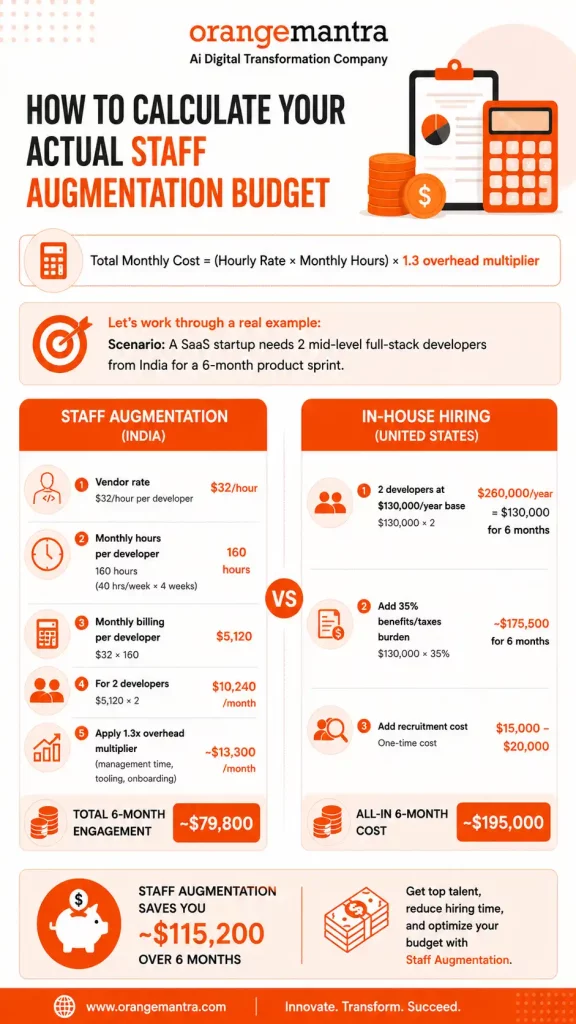
The staff augmentation route in this scenario is approximately 59% cheaper for the same output, with no long-term hiring commitment.
Of course, the numbers shift depending on your region’s choice, the seniority level you need, and how well you manage the engagement. But the framework is the same.
When Staff Augmentation Costs You More
We’d be doing you a disservice if we only showed you the cases where staff augmentation wins. There are real situations where it will cost you more than alternatives and going into those situations blind is how budgets blow up.
You don’t have internal technical leadership
Staff augmentation requires someone on your side to direct the work. If your team lacks the technical capacity to define requirements, review code, and provide architecture guidance, augmented developers will produce output but not necessarily the right output. Without direction, you’ll spend weeks re-doing work that didn’t meet standards; no one communicated clearly.
Your requirements change every week
Rapidly shifting requirements are expensive in any model, but they’re particularly punishing T&M engagements where every rethought feature is billable for hours. If your product direction isn’t stable enough to give developers clear, consistent goals, the hours rack up fast.
You’re choosing on rate alone
A $20/hour developer who needs constant guidance, misses requirements, and introduces bugs that your senior engineer spends 6 hours debugging is not cheaper than a $38/hour developer who works independently and ships clean code. Rate and value are not the same number. This is the single most common budgeting mistake we see.
The engagement is very short-term
For a 2–3 week task, the onboarding time alone may consume most of the productive output. Very short engagements don’t give the cost model room to work. In those cases, freelancers or an internal sprint may actually be faster and cheaper.
How to Reduce Staff Augmentation Costs Without Compromising Quality
The good news is that there are real, practical ways to bring your staff augmentation cost down without downgrading the talent you work with.
- Choose the right region for your time zone and budget: India and Southeast Asia offer the best cost-to-quality ratio for most use cases. If you need real-time overlap with North America, consider Latin America. Don’t pay Western European rates for talent you could source equally well from India.
- Commit to longer engagements: Most vendors will negotiate better rates for 6–12-month commitments vs. month-to-month. A 10–15% rate reduction for a 12-month contract on a $40,000/month engagement saves $48,000–$72,000/year.
- Use the dedicated team model for ongoing work: If you have consistent, predictable workloads, dedicated resources on retainer cost less per hour than rolling T&M billing.
- Pre-define scope clearly before signing: The more clearly you define what needs to be built before engaging a vendor, the less time is spent in clarification cycles, re-briefing, and rework. Every hour of your developer’s time spent figuring out what to build is a billable hour without an output.
- Batch roles to unlock volume discounts: Most vendors offer 8–15% discounts when you’re augmenting 10 or more resources. If you’re growing a team, consolidating through one vendor gets you better rates and easier management.
- Ask about what’s included in the rate upfront: A rate that includes onboarding support, NDA/IP assignment, and a replacement guarantee is worth more than a lower rate that doesn’t. Get a full itemized breakdown before comparing proposals.
Questions to Ask a Staff Augmentation Vendor Before Signing
Most vendors look similar on paper. The real differences come out in the answers to these questions, and how comfortably and transparently they answer them.
What is included in the quoted rate? Does it cover onboarding, tooling, NDA, IP assignment, and background checks, or are those billed separately?
What is your replacement policy? If a developer doesn’t work out in the first 30 days, what happens? Do you replace them at no cost?
Is there a conversion fee? If you want to hire the developer full-time after the engagement, what do you charge for that?
How do you vet your developers? Ask specifically about technical assessments, code samples, or previous work you can review.
What are the exit terms? What notice period is required? Are there early-termination penalties?
How is intellectual property handled? Is everything built under your engagement automatically assigned to your company?
What does your reporting look like? Will you see weekly timesheets? Sprint-level output reports?
A vendor who answers all of these without hesitation is a vendor who has nothing to hide in their pricing structure.
Why India Leads the Global IT Outsourcing Market
India deserves its own mention beyond the rate tables, because the cost advantage here isn’t just about the numbers, it’s about the combination of factors that make the economics work at scale.
The average IT professional in India earns around $6,000–$8,000/year, compared to $130,000/year in the US. That gap creates the rate differential you see above. But what makes India particularly compelling for companies looking to outsource IT resources is what comes alongside those rates:
- A talent pool of over 5 million software developers, growing annually
- Deep expertise across modern stacks: React, Node.js, Python, Java, Flutter, AWS, Azure, Kubernetes
- Strong English proficiency of the technical communication barrier is minimal
- An established ecosystem of professional IT services companies with decades of delivery experience
- Flexible IST time zone (UTC+5:30) that allows 4–6 hour overlap with European business hours and end-of-day syncs with US teams
India isn’t the cheapest option in every single role or stack, but it consistently delivers the best overall value across quality, cost, communication, and availability. That’s a different calculation than rate-per-hour alone.
For businesses specifically looking to build India-based development teams through a transparent, structured engagement model, our staff augmentation services are built around exactly this.
Conclusion
Staff augmentation cost isn’t a single number, it’s a system of variables. Get the region right, pick the pricing model that matches your project type, account for the hidden costs the vendor invoice won’t show, and you’ll find this model delivers real, measurable savings alongside the speed and flexibility that traditional hiring simply can’t match.
The businesses that overpay staff augmentation aren’t unlucky, they just didn’t ask enough questions before signing. They picked the cheapest rate without thinking about total cost. They chose fixed-price contracts for evolving products. They skipped the vendor vetting process and paid for it in rework.
The businesses that make staff augmentation work well treat it as a strategic decision, not a procurement transaction. They pick the right region for their budget and time zone needs, choose vendors who are transparent about pricing structure, and invest the first few weeks properly, so their augmented team hits the ground running.
If you’re at the stage of evaluating vendors or building a budget proposal, the best next step isn’t another blog post, it’s a real conversation about your specific team needs, your tech stack, your timeline, and what a realistic cost looks like for your situation.
Frequently Asked Questions
How much does staff augmentation cost per hour?
It depends heavily on location and seniority. In India, rates range from $15–$85/hour depending on the role and experience level. In the US, the same range is $50–$200/hour. For most businesses doing offshore augmentation, the realistic working range for productive mid-to-senior developers is $25–$55/hour.
Is staff augmentation cheaper than hiring full-time?
For most short-to-medium term needs (6 months to 2 years), yes significantly so. Full-time hiring carries recruitment costs, benefits overhead, and employer tax obligations that add 30–45% to base salary. Staff augmentation avoids all of that. For permanent, core roles, full-time hiring often makes more strategic sense over a 3–5 year horizon.
What is the average project cost for IT staff augmentation?
According to Clutch data, the average IT staff augmentation engagement costs between $50,000–$199,999 per project. The wide range reflects the variety of team sizes, durations, and seniority levels involved.
What is the best pricing model for staff augmentation?
For most growing businesses: the monthly retainer or hybrid model. It delivers predictable costs, typically includes a rate discount vs. hourly billing, and creates the continuity that makes augmented teams perform at their best. T&M is better for early-stage, exploratory projects. Fixed price works only when your requirements are truly locked down.
Are there hidden costs in staff augmentation contracts?
Yes, and they’re common enough that you should always ask about them explicitly. The main ones: onboarding time (2–4 weeks of reduced productivity), internal management overhead, tool licensing, legal and IP provisioning, and conversion fees if you want to hire the developer permanently. Using the 1.3x multiplier rule on your quoted rate gives you a more realistic budgeting baseline.
How much does staff augmentation cost in India compared to other countries?
India consistently offers the lowest rates globally for comparable skill levels. A senior full-stack developer in India bills at $38–$55/hour. The same profile in Eastern Europe is $70–$100/hour, in Latin America $60–$90/hour, and in the US $120–$180/hour. For most offshore use cases, India delivers the best cost-to-output ratio.