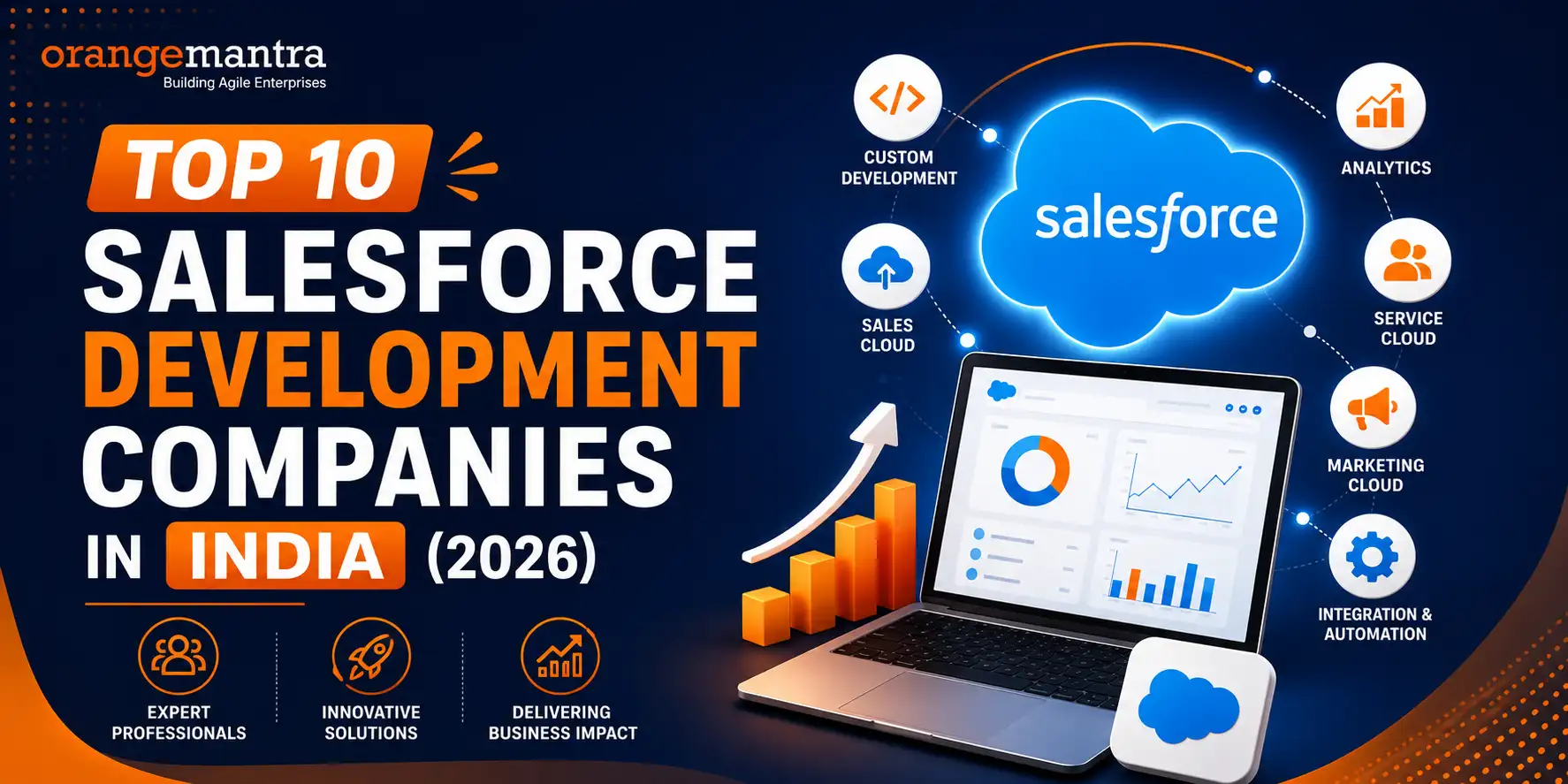
You’ve decided Salesforce is the answer to your CRM challenges, but now you’re stuck with an even bigger problem: finding Salesforce development companies in India. You’ve seen the horror stories—projects that drag on for months, consultants who vanish mid-implementation, budgets that balloon beyond recognition, and systems that nobody on your team actually wants to use.
You need a partner who understands your business context, delivers on time, communicates clearly across time zones, and builds solutions that your team will actually adopt. This comprehensive guide cuts through the noise to identify the top 10 Salesforce development companies in India for 2026, giving you the honest assessment you need to make a confident decision. We’ve evaluated technical capabilities, client feedback, industry specializations, and engagement models to bring you this definitive ranking.
With 25% market share in CRM, Salesforce is one of the most preferred and used platforms by enterprises. There is no doubt Salesforce is one of the best CRM solutions for businesses of all scales.
Given the complexity of Salesforce implementation for enterprises and the cost associated, it’s important to get the right expertise for the first time only.
In this guide, I have taken a 360-degree overview of major IT companies offering Salesforce development.
Hopefully, you will be able to select the right Salesforce implementation partner using this guide. Without any delay, let’s start with what Salesforce development companies are.
Table of Contents
What Are Salesforce Development Companies?
Salesforce development companies are specialized technology partners that design, build, customize, and maintain Salesforce CRM implementations for businesses.
Unlike general software development agencies, these firms employ certified Salesforce architects, developers, and consultants who understand the platform’s declarative and programmatic capabilities inside out. They bridge the gap between Salesforce’s out-of-box functionality and your unique business requirements through custom Apex code, Lightning components, integrations with third-party systems, and workflow automation.
Top 10 Salesforce Development Companies in India (2026)
Quick Comparison Table
| Company | Core Expertise | Best For | Engagement Model |
|---|---|---|---|
| Orangemantra | Custom Salesforce solutions, AI integration | Mid-to-large enterprises needing complex implementations | Dedicated teams, Fixed-price projects |
| Tech Mahindra | Enterprise Salesforce implementations, Industry Cloud | Global enterprises with multi-region requirements | Staff augmentation, Managed services |
| Persistent Systems | Salesforce consulting, Migration services | Companies transitioning from legacy CRM systems | Time & materials, Fixed-price |
| Grazitti Interactive | Marketing Cloud, Pardot expertise | B2B marketing teams scaling automation | Project-based, Retainer |
| Apphienz | Lightning components, Custom development | Tech startups needing rapid deployment | Agile sprints, Hourly |
| CodeScience | Salesforce CPQ, Revenue Cloud | B2B companies with complex quoting needs | Fixed-price, Dedicated teams |
| Cyntexa | AI-powered Salesforce solutions, Einstein | Enterprises leveraging AI and analytics | Project-based, Staff augmentation |
| Girikon | Salesforce Commerce Cloud | E-commerce businesses | Time & materials, Managed services |
| Kcloud Technologies | Multi-cloud Salesforce integrations | Companies using multiple Salesforce clouds | Retainer, Project-based |
| Simplus (Infosys) | Salesforce CPQ, Implementation services | Enterprise CPQ implementations | Fixed-price, Managed services |
1. orangemantra
Orangemantra stands out as India’s premier Salesforce development partner for enterprises that refuse to compromise on technical excellence. With a team of 50+ certified Salesforce professionals including 12 Technical Architects and 8 Application Architects, we’ve delivered 200+ implementations across financial services, healthcare, manufacturing, and technology sectors since 2015. Our approach combines deep Salesforce platform knowledge with industry-specific best practices, ensuring solutions that align with your business processes rather than forcing you to adapt to generic configurations.
- LinkedIn Page: https://www.linkedin.com/company/orangemantra/
- Location: Gurugram, Haryana
- Experience: 24+ Years
- Core Expertise/USP: AI Digital Transformation Company
- Rating: Google Business- 4.3/5, Clutch- 4.9/5
- Notable Clients: Nestle, IKEA, TVS, BCG, DLF, FURLENCO, Haldiram’s
- Solutions Worked On: Mobile Apps, Robotics, eCommerce, ERP, CRM, Web Portals, DAMs, AI, HRMS, CRM, CMS, DMS, SaaS, IoT,
- Clients/Timezone Served: India, North America, Europe, APAC, Middle East & Africa, Australia
What sets us apart is our “Implementation + Optimization” model—we don’t just build and disappear. Every project includes a 6-month optimization phase where we monitor adoption metrics, gather user feedback, and continuously refine the solution. Our Salesforce consulting services begin with a comprehensive discovery process that maps your current state, identifies gaps, and designs a phased roadmap that delivers incremental value rather than forcing big-bang deployments. We’re also one of the few Indian firms with proven expertise in Salesforce’s Einstein AI capabilities, having implemented predictive lead scoring, automated case classification, and intelligent forecasting for multiple clients.
2. Tech Mahindra
Tech Mahindra brings the scale and process maturity of a global IT services giant to Salesforce implementations. With over 2,000 Salesforce-certified professionals worldwide and multiple Salesforce practice centers across India, they handle enterprise-grade implementations for Fortune 100 companies. Their strength lies in managing complex, multi-country Salesforce rollouts with standardized delivery methodologies, change management frameworks, and dedicated project management offices.
- Core Strength: Enterprise-scale implementations with robust governance, risk management, and compliance capabilities, especially for regulated industries like banking and healthcare.
- Best For: Large multinational corporations requiring standardized Salesforce deployments across multiple geographies with strict compliance requirements.
- Budget Tier: $80-$150/hour; minimum project sizes typically $200,000+ given their enterprise focus.
- Key Clients: Major banks, telecommunications providers, and manufacturing conglomerates across North America and Europe.
- Clutch Rating: 4.6/5 based on corporate client feedback.
Tech Mahindra’s Salesforce practice integrates with their broader digital transformation services, making them ideal for organizations undertaking comprehensive technology modernization initiatives where Salesforce is one component of a larger ecosystem transformation.
3. Persistent Systems
Persistent Systems has built a reputation for smooth legacy system migrations to Salesforce, helping companies escape outdated CRMs like Siebel, Microsoft Dynamics CRM, and custom-built solutions. Their 500+ Salesforce consultants specialize in data migration strategies that preserve historical information while cleaning up years of accumulated data quality issues. They’ve developed proprietary migration frameworks and data validation tools that significantly reduce implementation timelines.
- Core Strength: Complex data migration projects with minimal business disruption, including parallel run strategies and phased cutover approaches.
- Best For: Established enterprises moving from legacy CRM systems to Salesforce while maintaining business continuity.
- Budget Tier: $70-$130/hour; fixed-price migration projects starting at $75,000.
- Key Clients: Manufacturing firms, distribution companies, and professional services organizations with decades of customer data.
- Clutch Rating: 4.5/5 with particular praise for their migration expertise.
Persistent’s methodology includes extensive user training and change management support, recognizing that technical migration success means nothing if users don’t adopt the new system. Their salesforce integration services ensure seamless connectivity between Salesforce and existing enterprise applications.
4. Grazitti Interactive
Grazitti Interactive dominates the Salesforce Marketing Cloud and Pardot implementation space in India. While many Salesforce partners focus on Sales Cloud and Service Cloud, Grazitti has built deep expertise in marketing automation, lead nurturing, and customer journey orchestration. Their team includes certified Marketing Cloud consultants, email developers, and marketing automation specialists who understand both the technical platform and marketing strategy.
- Core Strength: Marketing Cloud implementations that deliver measurable improvements in lead conversion rates, campaign ROI, and marketing-sales alignment.
- Best For: B2B marketing teams at SaaS companies, technology firms, and professional services organizations scaling their demand generation efforts.
- Budget Tier: $60-$110/hour; Marketing Cloud implementations starting at $40,000.
- Key Clients: Fast-growing B2B SaaS companies and marketing agencies managing client campaigns on Salesforce Marketing Cloud.
- Clutch Rating: 4.7/5 with strong feedback on their marketing automation expertise.
Grazitti’s approach combines technical implementation with marketing strategy consulting, helping clients design nurture campaigns, scoring models, and attribution frameworks that leverage Marketing Cloud’s capabilities. They’re particularly strong at integrating Marketing Cloud with Sales Cloud for closed-loop reporting.
5. Apphienz
Apphienz caters to the startup and high-growth company segment, offering rapid Salesforce implementations with modern Lightning Experience interfaces and mobile-first design. Their agile development approach delivers working solutions in 6-8 week sprints rather than 6-month waterfall projects. With a team of 80+ developers focused exclusively on Lightning components and modern Salesforce architecture, they build sleek, user-friendly interfaces that drive adoption.
- Core Strength: Rapid deployment of Lightning Experience solutions with excellent UX/UI design and mobile responsiveness.
- Best For: Startups and growth-stage companies (Series A to Series C) needing quick Salesforce implementations without enterprise complexity.
- Budget Tier: $50-$95/hour; minimum engagements around $25,000.
- Key Clients: Technology startups, venture-backed companies, and digital-first businesses across North America and Europe.
- Clutch Rating: 4.8/5 with praise for speed and modern design.
Apphienz’s Lightning component library accelerates development by reusing proven UI patterns across projects. Their developers stay current with Salesforce’s latest innovations, quickly incorporating new platform features into client solutions. For companies seeking a salesforce development company that moves at startup speed, Apphienz delivers.
6. CodeScience
CodeScience has carved out a specialized niche in Salesforce CPQ (Configure, Price, Quote) and Revenue Cloud implementations. Complex quoting scenarios—multi-tier pricing, volume discounts, subscription billing, usage-based pricing—are their bread and butter. Their consultants understand both the technical CPQ configuration and the business logic behind sophisticated pricing strategies, contract amendments, and renewal processes.
- Core Strength: Complex CPQ implementations for B2B companies with intricate pricing models and approval workflows.
- Best For: Manufacturing companies, distribution businesses, and B2B SaaS firms with complex product catalogs and pricing rules.
- Budget Tier: $85-$140/hour; CPQ implementations typically $60,000-$150,000.
- Key Clients: Enterprise software companies, industrial equipment manufacturers, and wholesale distributors.
- Clutch Rating: 4.6/5 particularly for CPQ expertise.
CodeScience’s methodology includes extensive pricing rule documentation, approval workflow design, and sales team training. They recognize that CPQ success depends on balancing pricing flexibility with governance controls, ensuring sales teams can respond to customer needs without undermining profitability.
7. Cyntexa
Cyntexa positions itself at the intersection of Salesforce and artificial intelligence, specializing in Einstein AI implementations that deliver predictive insights and automated decision-making. Their data scientists and Salesforce developers collaborate to build Einstein models for lead scoring, opportunity forecasting, customer churn prediction, and next-best-action recommendations. Beyond Einstein, they integrate third-party AI services with Salesforce for advanced use cases.
- Core Strength: AI-powered Salesforce solutions leveraging Einstein and external machine learning models for predictive analytics.
- Best For: Data-driven enterprises looking to embed AI into sales, service, and marketing processes.
- Budget Tier: $75-$135/hour; AI implementation projects starting at $55,000.
- Key Clients: Financial services firms, healthcare providers, and e-commerce companies using predictive analytics.
- Clutch Rating: 4.7/5 with strong feedback on their AI expertise.
Cyntexa’s approach begins with data quality assessment—AI models are only as good as the data they’re trained on. They help clients clean historical data, establish data governance practices, and build feedback loops that continuously improve model accuracy. Their Salesforce consulting services extend beyond implementation to include ongoing model refinement and performance monitoring.
8. Girikon
Girikon specializes in Salesforce Commerce Cloud (B2C and B2B) implementations for companies building digital commerce experiences. Their expertise spans storefront design, payment gateway integration, inventory management, order fulfillment, and personalization engines. With a team that includes both Salesforce Commerce Cloud developers and e-commerce strategists, they build shopping experiences that convert browsers into buyers.
- Core Strength: End-to-end Commerce Cloud implementations from storefront design through order fulfillment and customer service integration.
- Best For: Retail brands, consumer goods companies, and B2B distributors launching or upgrading digital commerce platforms.
- Budget Tier: $70-$125/hour; Commerce Cloud projects typically $80,000-$200,000.
- Key Clients: Fashion retailers, consumer electronics brands, and B2B wholesale platforms.
- Clutch Rating: 4.5/5 with particular praise for e-commerce expertise.
Girikon understands that Commerce Cloud success requires more than technical implementation—it demands conversion optimization, personalization strategy, and seamless integration with marketing automation. They help clients leverage Commerce Cloud’s AI-powered product recommendations, abandoned cart recovery, and customer segmentation capabilities.
9. Kcloud Technologies
Kcloud Technologies excels at multi-cloud Salesforce implementations where businesses need Sales Cloud, Service Cloud, Marketing Cloud, and other Salesforce products working together seamlessly. Their architects design unified data models, cross-cloud automation, and consolidated reporting that gives leadership a single view of customer interactions across touchpoints. They’re particularly strong at integrating Salesforce clouds with external systems like ERP, accounting, and inventory management platforms.
- Core Strength: Multi-cloud Salesforce architectures with robust integration and data synchronization across Salesforce products and external systems.
- Best For: Mid-to-large enterprises using multiple Salesforce clouds and requiring unified customer views across sales, service, marketing, and commerce.
- Budget Tier: $75-$130/hour; multi-cloud implementations starting at $70,000.
- Key Clients: Omnichannel retailers, telecommunications companies, and financial services firms managing complex customer journeys.
- Clutch Rating: 4.6/5 with strong feedback on integration capabilities.
Kcloud’s integration framework uses MuleSoft, Dell Boomi, and native Salesforce integration tools depending on complexity and volume requirements. Their salesforce integration services ensure data flows reliably between systems while maintaining security and compliance requirements. They also provide salesforce managed services for ongoing monitoring and optimization of integrated environments.
10. Simplus (Infosys)
Simplus, acquired by Infosys in 2020, brings together Simplus’s Salesforce CPQ expertise with Infosys’s global delivery capabilities and industry solutions. They’re particularly strong in complex quote-to-cash implementations that span CPQ, billing, revenue recognition, and financial reporting. Their consultants understand both Salesforce configuration and the financial processes that underpin revenue operations in subscription businesses and complex B2B sales.
- Core Strength: Quote-to-cash implementations integrating Salesforce CPQ with billing, revenue recognition, and ERP systems.
- Best For: Enterprise B2B companies and subscription businesses needing comprehensive revenue operations solutions.
- Budget Tier: $90-$160/hour; enterprise implementations typically $150,000+.
- Key Clients: Software companies with subscription revenue models, telecommunications providers, and manufacturing firms with complex contract structures.
- Clutch Rating: 4.5/5 based on enterprise client feedback.
Simplus’s methodology emphasizes process standardization and best practice adoption, drawing on their experience across hundreds of CPQ implementations. They help clients balance customization with maintainability, ensuring solutions remain upgradeable as Salesforce releases new features.
How to Choose the Right Salesforce Development Partner in 2026
Selecting a Salesforce development company requires evaluating capabilities beyond marketing promises and certification counts. Here’s a framework for making an informed decision:
Evaluate Industry-Specific Experience
Generic Salesforce expertise isn’t enough—you need a partner who understands your industry’s unique challenges, regulatory requirements, and business processes. A firm that’s implemented Salesforce for healthcare providers understands HIPAA compliance, patient consent management, and provider networks in ways that a general implementation partner doesn’t. Similarly, financial services implementations require knowledge of KYC/AML requirements, wealth management workflows, and regulatory reporting that only comes from industry experience.
Assess Technical Architecture Capabilities
Complex Salesforce implementations require architects who can design scalable, performant solutions that integrate with your existing technology stack. During evaluation, ask about their approach to:
- Data Architecture: How do they design object relationships, handle large data volumes, and ensure data quality? Poor data architecture decisions haunt organizations for years, causing performance problems and limiting future flexibility.
- Integration Strategy: Request their methodology for integrating Salesforce with ERP, marketing automation, customer support, and other enterprise systems. Do they have experience with your specific integration tools (MuleSoft, Dell Boomi, Informatica)? How do they handle real-time vs. batch integration requirements?
- Security and Compliance: For regulated industries, verify their experience implementing field-level security, sharing rules, and audit trails that meet your compliance requirements. Ask about their approach to data residency requirements for international implementations.
- Scalability: How do they ensure solutions perform well as data volumes and user counts grow? Request specifics about governor limit management, bulk data processing strategies, and performance testing methodologies.
Examine Their Development and Delivery Methodology
Implementation methodology significantly impacts project success. Evaluate whether partners use agile, waterfall, or hybrid approaches—and more importantly, why they’ve chosen that methodology for your project type.
Agile methodologies work well for projects with evolving requirements or when you want to deliver incremental value. Expect two-week sprints, regular demos, and continuous stakeholder involvement. This approach requires dedicated client participation but delivers flexibility.
Waterfall methodologies suit projects with well-defined requirements and minimal expected changes. They provide predictability and fixed-price certainty but offer less flexibility to adapt based on user feedback.
Evaluate Post-Implementation Support and Optimization
Salesforce implementation isn’t a one-time project—it’s the beginning of an ongoing optimization journey. The best Salesforce consulting services partners provide post-launch support that helps you maximize your investment over time.
Ask about their approach to user adoption monitoring, feedback collection, and iterative improvements. Do they provide salesforce managed services for ongoing administration, user support, and system optimization? What’s their process for handling Salesforce’s three annual releases and ensuring your customizations remain compatible?
Evaluate their training and enablement approach. Will they provide role-based training for different user personas? Do they create documentation and process guides? How do they support your team in becoming self-sufficient over time?
Consider the partnership’s longevity potential. While you want to avoid vendor lock-in, the best outcomes come from partnerships that extend beyond initial implementation. Look for firms with high client retention rates and multi-year relationships—these indicate they deliver ongoing value rather than just completing projects.
Conclusion
Choosing the right Salesforce development company in India for 2026 requires looking beyond certifications and marketing promises to evaluate real technical capabilities, industry experience, and partnership approach. The firms profiled here represent the best options across different specializations—from enterprise-scale implementations to agile boutique partners, from CPQ experts to Marketing Cloud specialists. Your ideal partner depends on your specific needs: project complexity, budget constraints, industry requirements, and desired engagement model.
Remember that Salesforce implementation is just the beginning—ongoing optimization, user adoption support, and continuous improvement determine long-term success. The best partnerships extend years beyond initial go-live, evolving your Salesforce environment as your business grows. Ready to start your Salesforce journey with a partner who truly understands your business? Explore our comprehensive Salesforce consulting services and schedule a discovery consultation to discuss your specific requirements.
Frequently Asked Questions
Q1: How much does Salesforce development cost in India compared to other countries?
Salesforce development costs in India typically range from $50-$150 per hour depending on the firm’s expertise and project complexity, compared to $150-$300+ per hour in the United States and $100-$200 per hour in Eastern Europe. However, hourly rates tell only part of the story. Total project costs depend on scope, complexity, timeline, and the partner’s efficiency. A more experienced (and expensive) partner often delivers faster and with fewer post-launch issues, potentially lowering total cost of ownership despite higher hourly rates.
For typical implementations, expect: Small business Sales Cloud implementations ($25,000-$50,000), mid-market multi-cloud projects ($75,000-$150,000), and enterprise implementations with custom development ($150,000-$500,000+). CPQ implementations range from $60,000-$200,000 depending on complexity. Marketing Cloud projects typically start at $40,000. These are ballpark figures—your actual costs depend on specific requirements, integrations, data migration complexity, and customization needs.
Q2: How do I verify a Salesforce development company’s actual experience and capabilities?
Start by checking their Salesforce Partner status on Salesforce.com’s partner directory. Look for designations like Consulting Partner, ISV Partner, or specialized badges (Marketing Cloud, CPQ, Industries).
Review their certification profile—not just the quantity of certified professionals, but the types of certifications. Technical Architect and Application Architect certifications indicate deep platform expertise.
Request detailed case studies that include the specific challenges addressed, solutions implemented, and measurable business outcomes. Generic case studies with vague results are red flags. The best firms provide client references you can contact directly.
Check third-party review platforms like Clutch, G2, and GoodFirms for verified client feedback. Pay attention to negative reviews and how the company responded—this reveals their approach to client relationships and issue resolution.
Finally, request a technical consultation or discovery session before committing. This lets you evaluate their questioning approach, technical depth, and communication style.
Q3: What’s the difference between a Salesforce implementation partner and a Salesforce ISV partner?
Salesforce implementation partners (Consulting Partners) specialize in configuring, customizing, and implementing Salesforce for end customers. They provide services like requirements gathering, configuration, custom development, data migration, training, and ongoing support. Their deliverable is a configured Salesforce environment tailored to your specific business needs. Most companies in this article are implementation partners.
Salesforce ISV (Independent Software Vendor) partners build packaged applications that run on the Salesforce platform and are sold through Salesforce’s AppExchange marketplace. They create products that extend Salesforce’s capabilities—things like advanced reporting tools, integration platforms, industry-specific solutions, or productivity enhancements. ISV partners focus on product development rather than custom implementations.
Q4: Can Indian Salesforce development companies effectively serve international clients across different time zones?
Yes, Indian Salesforce development companies successfully serve international clients across North America, Europe, Australia, and Asia-Pacific. Leading firms have adapted their operations specifically for global delivery through several practices:
- Overlapping work hours: Many firms maintain teams working in shifts that overlap with client time zones. For US clients, this often means team members working Indian evenings to overlap with US business hours for meetings and real-time collaboration.
- Follow-the-sun development: For time-sensitive projects, firms structure teams across multiple geographies to provide nearly 24-hour development coverage. Work progresses continuously as teams in different time zones hand off tasks.
- Communication infrastructure: Top partners invest heavily in collaboration tools (Slack, Microsoft Teams, Zoom), project management platforms (Jira, Asana), and documentation practices that facilitate asynchronous communication when real-time collaboration isn’t possible.
- On-site presence: Many larger Indian firms maintain offices or representatives in key international markets (US, UK, Australia) for relationship management, requirements gathering, and on-site support during critical project phases.
Q5: Should I choose a large global firm or a specialized boutique Salesforce partner?
This decision depends on your specific needs, project complexity, and organizational preferences:
Choose larger firms (Tech Mahindra, Persistent, Infosys) when:
- You’re a large enterprise requiring implementations across multiple countries
- You need robust governance, change management, and compliance capabilities
- Your project is part of a broader digital transformation involving multiple technologies
- You require dedicated project management offices and standardized delivery methodologies
- You value brand recognition and financial stability in your partner relationships
Choose specialized boutique firms when:
- You need deep expertise in specific Salesforce clouds or industry verticals
- You want direct access to senior consultants rather than junior staff
- Your project requires innovative thinking and custom solutions rather than standardized approaches
- You prefer agile, flexible engagement models over structured methodologies
- Cost efficiency is important and you don’t need the overhead of global delivery infrastructure