
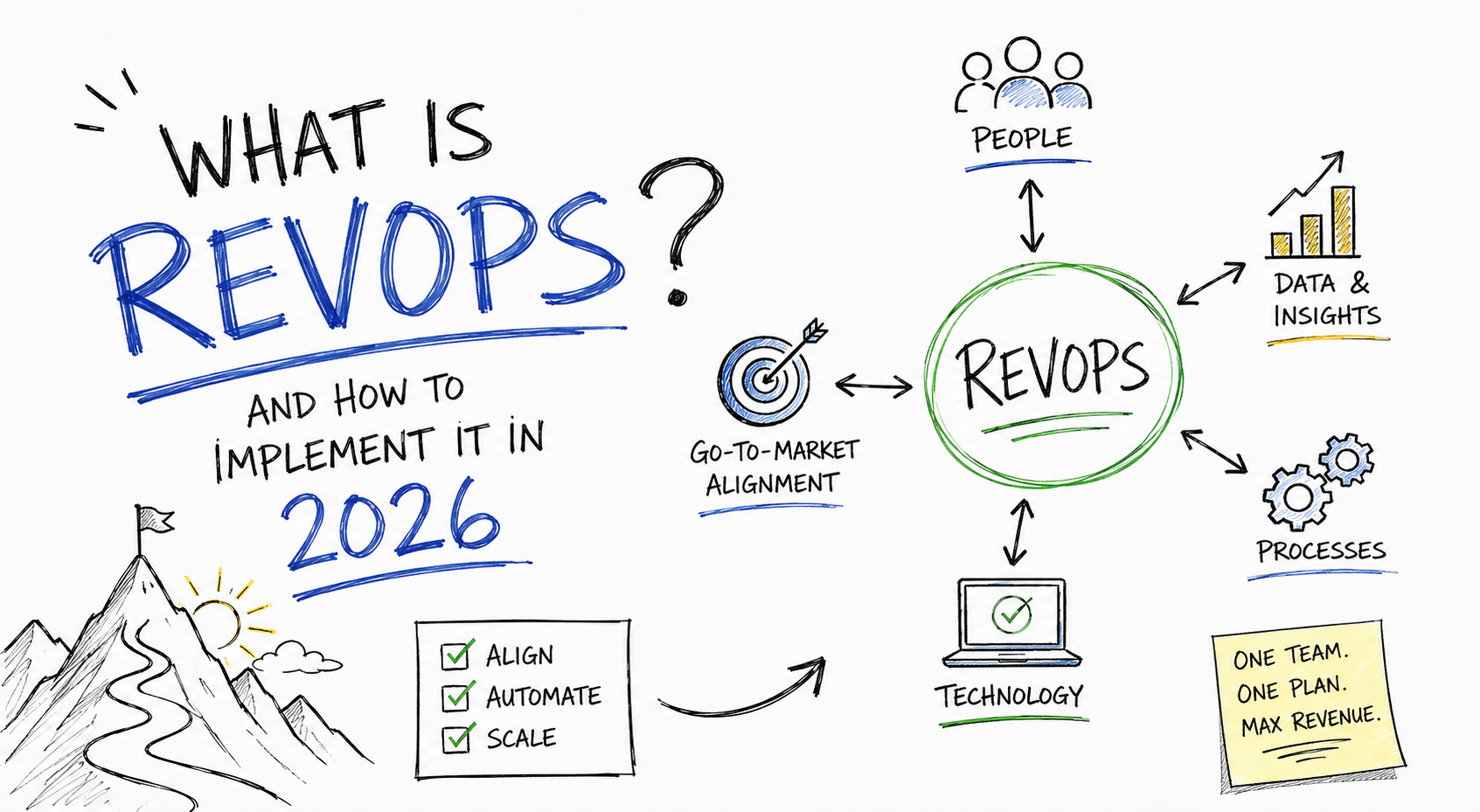
RevOps, short for Revenue Operations, is one team and one system that runs the operational side of marketing, sales, and customer success together instead of in three different island. The point of it is to make revenue predictable through real sales and marketing alignment.
The first RevOps function I rebuilt was for a B2B software client whose pipeline reports never matched their finance numbers. Sales forecast $4M for the quarter. Finance booked $2.6M. Nobody could explain the gap in under a week.
The problem was actually three disconnected systems, two different definitions of a “qualified lead,” and no single owner of the data. This guide covers what RevOps actually is, how it differs from sales operations, how to tell if you need it, the exact sequence I use to implement it, the metrics it should own, and what it costs in 2026.
Table of Contents
What is RevOps? Revenue Operations Defined
RevOps is not a tool you buy. It is not one analyst moved into the sales team. It is an operating function that owns the process, data, and systems behind every stage of revenue, from first touch to renewal and across the full customer lifecycle.
Most working revenue operations models stand on four parts:
People. A single owner, with shared targets across marketing, sales, and customer success, and leadership buy-in above them.
Process. One agreed funnel, from lead to renewal, with the same stage definitions every team uses.
Data. One source of truth, so the number sales sees matches the number finance books.
Technology. An integrated stack, where the CRM, marketing automation, and analytics tools actually talk to each other.
Get one pillar wrong and the others wobble. Clean data on top of a broken process still produces clean reports of the wrong thing. That is why RevOps is a function (not a purchase).
RevOps vs Sales Operations vs Marketing Operations: What is the Difference?
People use these terms interchangeably, and that confusion is part of the problem RevOps solves. Sales operations supports one team. Marketing operations supports another. RevOps owns the operational layer across all three revenue functions at once.
| Function | Whom it serves | What it owns | Primary goal |
|---|---|---|---|
| Marketing operations | Marketing team | Campaign data, lead scoring, martech stack | Generate and qualify demand |
| Sales operations | Sales team | Pipeline, forecasting, sales tooling | Close deals efficiently |
| Customer success ops | Post-sale team | Onboarding, renewals, health scores | Retain and expand revenue |
| RevOps (revenue operations) | All three, together | Shared data, process, and technology across the funnel | Predictable revenue across the customer lifecycle |
If you already have strong sales ops and marketing ops but they pull in different directions, you do not need to scrap them. RevOps sits above them and gives them one shared definition of success.
What is RevOps and Do You Actually Need it?
Not every company does. If you have one small go-to-market team, a single product, and under roughly $1M to $2M in annual recurring revenue, a full revenue operations function is usually premature. You can run on a tidy CRM and a weekly call.
You need RevOps when these signs show up together:
Your sales forecast and your finance numbers disagree, and nobody can reconcile them fast. Leads go cold in the handoff between marketing and sales. Each team reports its own version of the same metric. You are running five or more revenue tools that do not share data cleanly. New reps take months to trust the pipeline.
The market is moving this way for a reason. Gartner predicted that by 2025, 75% of the highest-growth companies in the world would deploy a RevOps model, up from under 30%. Forrester’s research on aligned revenue teams points the same direction, putting the revenue-growth gap between aligned and siloed organisations at around a third.
Be honest about timing, though. If your core problem is that you do not have enough leads yet, RevOps will not fix that. It makes an existing revenue engine run cleaner. It does not build you one.
How to Implement RevOps in 2026: A Step-by-step Framework
This is the part most guides skip. Here is the order I work in, and why the order matters. Treat it as a RevOps framework you run top to bottom, not a menu you pick from.
Step 1: Audit the funnel and the stack first.
Spend two to three weeks mapping how a lead actually moves from marketing to closed to renewed, and listing every tool that touches it. You are looking for where data is entered twice, where it drops, and where two teams disagree on a definition. Do not buy or change anything yet.
Step 2: Pick one source of truth and clean it.
This is almost always the CRM. Decide that one system holds the real numbers, then fix the data inside it: dedupe records, standardise fields, and kill the stale pipeline that inflates forecasts. This step is unglamorous and it is where most projects stall, so you can bring a CRM development company to handle the migration and field cleanup properly rather than leave it to reps between calls.
Step 3: Agree on one funnel and one definition of “qualified.”
Get marketing, sales, and customer success in a room and define every stage in writing. A lead is qualified when it meets X, not when a rep feels good about it. This single agreement removes most of the forecast gap I described at the top.
Step 4: Instrument the data and build one revenue dashboard.
Once the stages are agreed, wire the reporting so everyone reads off the same board. One number for pipeline, one for win rate, one for forecast. If you want a sense of what good looks like, this breakdown of how a sales dashboard makes a business data-driven is a useful reference.
Step 5: Automate the handoffs.
Now that stages and data are clean, automate the moments where revenue leaks: lead routing, alerts when a deal stalls, and the marketing-to-sales handoff. We did exactly this when we built an enterprise lead management system for a retail giant, where the routing logic mattered more than any single tool.
Step 6: Set a forecasting and review cadence.
RevOps is not a project that ends. Lock a weekly pipeline review and a monthly forecast review, both reading off the same dashboard, so the system stays honest as the business changes.
Follow these in order. Teams that jump to Step 5 and automate on top of dirty data just move the mess around faster.
The RevOps Metrics and KPIs That Actually Matter
A revenue operations function is judged on numbers, so it has to own the right ones. These are the RevOps metrics and KPIs I track from the first month:
Pipeline and conversion. Win rate, average deal size, and sales cycle length tell you whether the funnel is healthy.
Acquisition cost. Customer acquisition cost (CAC) and cost per acquisition show what you actually pay to win a customer.
Retention and expansion. Churn rate, net revenue retention, and customer lifetime value (CLV) show whether revenue sticks after the sale.
Recurring revenue health. Annual recurring revenue (ARR), monthly recurring revenue, and days sales outstanding track the predictability finance cares about.
The reason RevOps matters here is simple. All four groups read off one source of truth, so marketing, sales, and customer success argue about decisions, not about whose number is right.
What a RevOps Tech Stack and Setup Actually Costs
Once you have decided to do this, the next question is budget. Costs split into tools and implementation.
A RevOps tech stack centres on a CRM as the system of record, plus marketing automation, a reporting or analytics layer, and integration tooling to keep them in sync.
For a mid-market company that stack runs $2,000 to $8,000 per month depending on seat count and which platforms you standardise on. That is software only.
On implementation, the work in Steps 1 to 5 is where the real spend sits. A focused RevOps setup, audit through automation, usually runs $25,000 to $80,000 depending on how messy the current data is and how many systems you are integrating.
Working with an experienced offshore partner brings that to roughly $15,000 to $45,000 for the same scope, depending on complexity. The variable that moves the number most is data quality, not headcount.
Budget for the cleanup. Almost everyone underestimates how much time Step 2 takes.
Where RevOps Implementations Break First
In my experience, RevOps rarely breaks at the strategy level. It breaks at the plumbing.
The first failure point is integration. Your CRM, marketing tool, support platform, and finance system each hold a slice of the truth, and getting them to sync reliably is harder than any slide deck admits. When the sync silently fails, the dashboard everyone trusts goes quietly wrong.
The second is automation reliability. A lead-routing rule that misfires for two weeks costs real pipeline before anyone notices. These workflows need the same monitoring and rollback discipline you would put on production software, which is why I lean on a dedicated DevOps and automation team to build the integration and reliability layer underneath the RevOps process, not just the reports on top.
Treat the data pipeline as production infrastructure and most of the common RevOps failures disappear.
Where to Start with Revenue Operations
If your forecast and your finance numbers disagree and nobody can explain why, you have a RevOps problem, and the fix is a sequence, not a tool. Start with the audit in Step 1 this week.
You do not need new software to do it, just an honest map of how revenue actually moves through your business.
FAQ
Is RevOps just a rebrand of sales ops?
No. Sales operations supports the sales team only. RevOps owns the operational layer across marketing, sales, and customer success together, with one shared view of revenue. The scope is wider and the goal is alignment, not just sales efficiency.
How long does it take to implement RevOps?
A focused setup for a mid-market company takes roughly three to four months from audit to working automation. The audit and CRM cleanup take the most time. Companies with cleaner data move faster.
What tools do you need for a RevOps tech stack?
At minimum, a CRM as your source of truth, a marketing automation platform, and a reporting or analytics layer, joined by integration tooling. The specific brands matter less than whether they sync cleanly and feed one dashboard.
What metrics should a RevOps team own?
The core set is win rate, customer acquisition cost (CAC), churn rate, customer lifetime value (CLV), and annual recurring revenue (ARR). The goal is one agreed definition of each, read from a single source of truth.
Can we outsource RevOps, or do we have to hire a team?
Both work. Many companies outsource the setup, the audit, CRM work, integration, and automation, then hire one internal owner, often reporting to a chief revenue officer, to run the cadence afterwards. That keeps the heavy build cost down without losing internal ownership.
How is RevOps different from DevOps?
They share a philosophy, breaking silos and automating handoffs, but apply it to different domains. DevOps aligns development and operations to ship software reliably. RevOps aligns the revenue teams. The technical discipline behind both, integration and automation, is genuinely similar, which is why the same engineering rigor helps.