
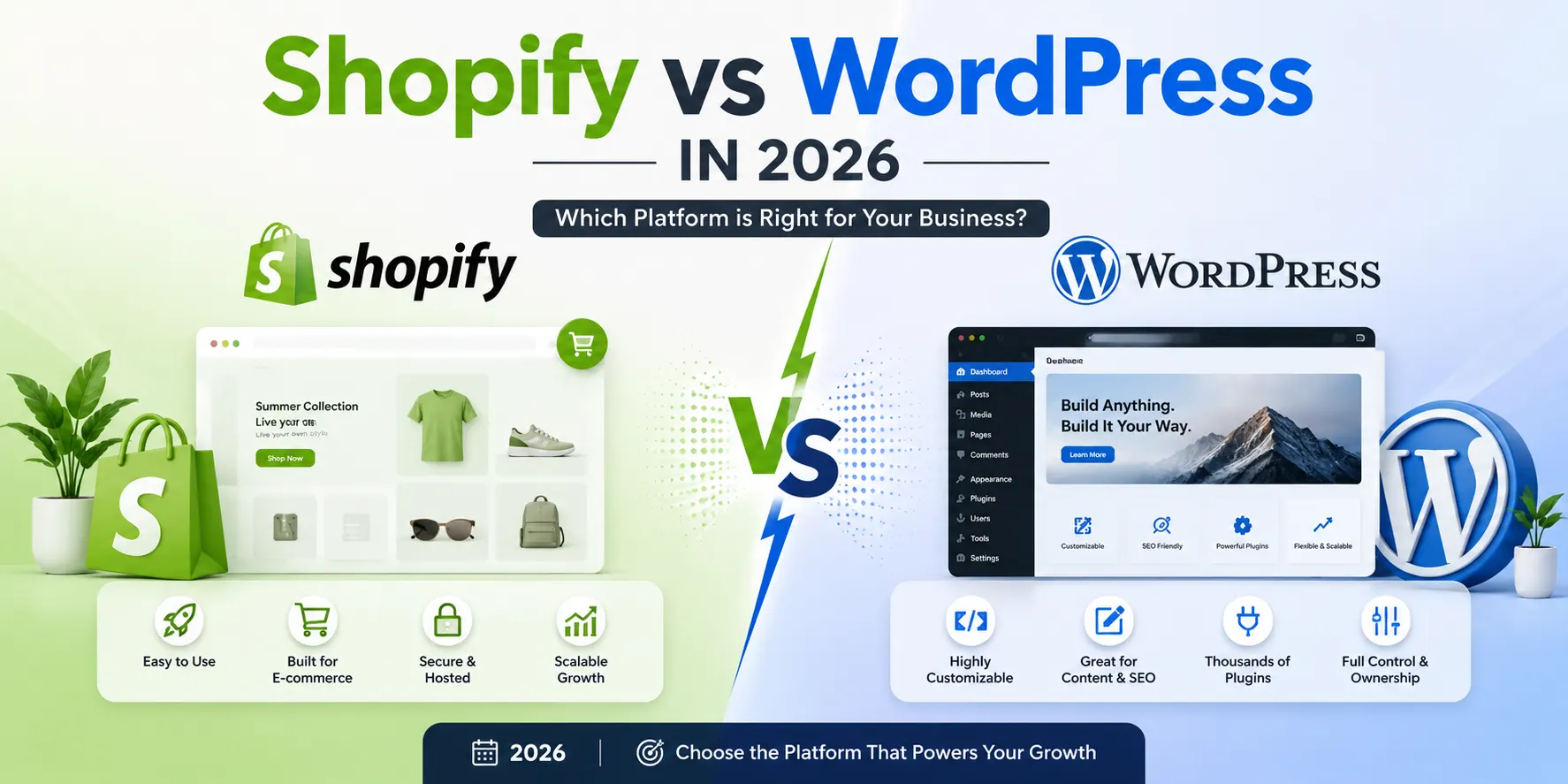
Choosing the best platform for your online business in 2026 is more than just a technical decision. It has a direct impact on your revenue, scalability, customer experience, SEO visibility, and long-term operating costs. For businesses seeking to launch, the argument between Shopify and WordPress continues to dominate talks among entrepreneurs. Both platforms are robust, globally trusted, and capable of supporting thriving online stores.
According to Statista, Shopify powers over 5.5 million live stores globally, holding a 14% market share of the global e-commerce platform market. Shopify focuses on simplicity and integrated commerce infrastructure, but WordPress provides unparalleled ownership and flexibility. The difficulty for businesses is not deciding which platform is “better” in general. The actual question is which platform best fits your growth strategy, technical resources, SEO objectives, and customer experience expectations.
In this detailed Shopify vs. WordPress comparison for 2026, we break down both platforms across various factors. So, you can confidently choose the right platform for your business. Let’s explore what both offer the best in their domain.
Table of Contents
How are Shopify and WordPress growing in 2026?
Before comparing features, it’s vital to note how fundamentally different these two systems are.
Shopify is a fully hosted eCommerce platform created exclusively for online sales. Its responsibilities include hosting, security, checkout systems, payment integrations, inventory management, and infrastructure maintenance. Businesses may swiftly build online businesses without worrying about server administration issues.
In contrast, WordPress is an open-source content management system. WordPress powers 43.5% of all websites globally, holding roughly 62.8% to 65.2% of the entire CMS market. It transforms into a fully flexible eCommerce platform with WooCommerce to handle enterprise-level markets. Unlike Shopify, WordPress allows businesses to own and control their website infrastructure.
The Shopify vs. WordPress debate often comes down to one central difference:
- Shopify prioritizes convenience and operational simplicity.
- WordPress prioritizes flexibility and customization freedom.
That single distinction shapes almost every comparison category.
Shopify vs. WordPress: Which is Best in 2026?
Here are the differentiating factors between the two for your ecommerce store.
| Feature/Business Factor | Shopify | WordPress |
| Platform Type | Fully hosted eCommerce platform | Open-source CMS with eCommerce plugin |
| Best For | Fast-growing online stores and D2C brands | Content-heavy and highly customized businesses |
| Ease of Setup | Quick and beginner-friendly | Requires technical setup and configuration |
| Hosting & Security | Included within the platform | Managed separately by the business |
| Customization Flexibility | Moderate, app-based customization | Extremely flexible and fully customizable |
| SEO Capabilities | Strong built-in SEO features | Advanced SEO control with plugins |
| Blogging & Content Marketing | Basic blogging functionality | Industry-leading content management |
| Maintenance Responsibility | Shopify handles updates and maintenance | Business manages updates, backups, and security |
| Scalability | Automatic infrastructure scaling | Depends on hosting and optimization quality |
| Performance Optimization | Built-in speed optimization | Requires manual optimization |
| eCommerce Features | Native commerce-focused ecosystem | Plugin-driven commerce functionality |
| Payment Integrations | Built-in and streamlined | Flexible but plugin-dependent |
| App & Plugin Ecosystem | Controlled app marketplace | Massive plugin ecosystem |
| Development Complexity | Lower technical dependency | Higher technical involvement |
| Ownership & Control | Platform-controlled infrastructure | Full ownership and backend control |
| Ideal Business Size | Startups to enterprise retail brands | SMBs to enterprise content-driven businesses |
| Long-Term Operational Costs | Predictable subscription pricing | Variable based on customization needs |
| Security Management | Managed by Shopify | Requires proactive management |
| Time-to-Market | Faster store launch | Longer development timeline |
| Recommended For | Businesses prioritizing simplicity and speed | Businesses prioritizing flexibility and SEO depth |
Shopify vs. WordPress: Ease of Setup
You cannot overlook the ease of setup for businesses entering digital commerce for the first time. Time-to-market directly affects the unlocking of revenue channels, which is extremely critical for startups and fast-moving retail brands.
The whole ecosystem of Shopify is simple and easy to use. Hosting, SSL certificates, payment gateways, checkout systems, mobile optimization, and security updates are already packaged. For this main reason, many startups hire Shopify developers only when they want to have customizations beyond the basics of the store, rather than for a simple store setup.
But WordPress is a completely different thing. Running a WordPress eCommerce store will require you to select hosting separately, configure plugins, manage backups, and keep optimization running. These steps will not only give you more capability but will also require you to have technical skills for handling these things. WordPress developers are usually hired by businesses as WordPress stores need to be well-configured and maintained regularly to work efficiently.
Shopify is better suited for companies that want a simpler model of working and a more rapid roll-out.
Design Flexibility and Customization Options
Design flexibility is where WordPress continues to dominate in 2026.
With WordPress, businesses gain access to thousands of themes, plugins, page builders, and custom development possibilities. Nearly every visual or functional aspect of the website can be modified. It makes WordPress valuable for brands that want unique customer experiences or complex website structures.
WordPress development services also allow enterprises to create deeply customized workflows tailored to specific operational needs. Shopify has improved considerably in customization over recent years. Modern Shopify themes are visually polished, mobile responsive, and optimized for conversion. However, Shopify still operates within a more controlled ecosystem.
Shopify vs. WordPress SEO: Which Platform Performs Better?
While businesses can customize themes and use apps for extended functionality, deeper backend flexibility remains limited compared to WordPress. Advanced customization frequently requires Shopify Liquid expertise and API integrations. The decision ultimately depends on how much customization your business genuinely requires.
Plugins like Rank Math and Yoast SEO give businesses granular SEO control. WordPress also excels for content-heavy businesses that rely on blogs, resource hubs, educational content, and long-form SEO strategies.
This is especially important in industries where informational search traffic drives conversion opportunities. However, Shopify has significantly improved its SEO capabilities in 2026.
Modern Shopify stores now offer:
- Fast loading speeds
- Mobile optimization
- Secure infrastructure
- Structured data support
- Integrated SEO settings
- Excellent Core Web Vitals performance
For many eCommerce brands, Shopify delivers more than enough SEO functionality. Brands focused primarily on streamlined product selling frequently prefer Shopify.
eCommerce Features & Selling Capabilities
When comparing WordPress vs. Shopify SEO for pure eCommerce functionality, Shopify has a strong advantage in native commerce infrastructure.
Shopify was built specifically for online selling. Its ecosystem includes:
- Inventory management
- Multi-channel selling
- Cart recovery
- Payment integrations
- Product management
- Order tracking
- Tax calculation
- Shipping management
- Point-of-sale systems
- Subscription selling
- Marketplace integrations
Everything is integrated into a centralized dashboard. This operational simplicity becomes extremely valuable as businesses scale. WordPress can support enterprise eCommerce experiences, but many advanced features depend on plugins and third-party integrations. This creates greater flexibility but also increases management complexity.
For businesses requiring customized checkout flows, B2B pricing models, or unconventional customer journeys, WordPress may offer more adaptability. But for businesses focused on launching efficient online stores, Shopify development services often provide a faster path to operational success.
Security and Maintenance Requirements
Security remains a major concern for online businesses in 2026.
Data breaches, payment vulnerabilities, and downtime can damage both revenue and customer trust. This is one area where Shopify provides enormous operational advantages.
Shopify handles:
- Hosting security
- PCI compliance
- SSL certificates
- Platform updates
- Server maintenance
- Performance optimization
- Infrastructure scaling
Businesses do not need dedicated technical teams for routine maintenance. Poorly maintained WordPress websites become vulnerable over time. This is why professional WordPress development services are often essential for businesses running high-traffic or revenue-critical stores. For companies prioritizing stability and reduced maintenance overhead, Shopify offers clear advantages.
Performance and Scalability in 2026
Website speed and scalability directly influence customer retention and conversion rates. Shopify’s hosted infrastructure provides consistent performance optimization at scale. If a business processes 100 orders per month, Shopify automatically manages traffic spikes, server scaling, and performance stability.
This makes Shopify highly attractive for growing D2C brands, retail startups, and businesses expecting seasonal demand surges. WordPress performance depends largely on hosting quality, caching configuration, optimization practices, and plugin management. A well-optimized WordPress store can absolutely deliver exceptional performance. However, achieving that level of optimization typically requires experienced technical oversight.
Businesses often hire WordPress developers to optimize speed, database efficiency, and CDN integration.
Shopify vs. WordPress: Pricing Comparison
Pricing comparisons between Shopify and WordPress can be misleading because both platforms structure costs differently. Shopify follows a subscription-based pricing model.
Monthly costs generally include:
- Hosting
- Security
- Core eCommerce functionality
- Checkout systems
- Maintenance
- Basic integrations
This creates predictable operational costs. However, businesses may still incur additional costs for:
- Premium themes
- Paid apps
- Third-party integrations
- Transaction fees
- Advanced customization
WordPress itself is technically free. But businesses must pay for:
- Hosting
- Domain registration
- Premium plugins
- Security tools
- Maintenance
- Performance optimization
- Developer support
In reality, the total cost of ownership varies depending on project complexity.
Small businesses may initially find WordPress cheaper. But as customization and scaling needs increase, development and maintenance costs can rise significantly. Businesses evaluating Shopify vs. WordPress should focus less on starting price and more on long-term operational efficiency.
Content Marketing and Blogging Capabilities
Content remains one of the strongest drivers of organic business growth.
This is an area where WordPress still maintains a substantial advantage.
WordPress was originally built as a publishing platform, and its blogging capabilities remain unmatched.
Businesses investing heavily in:
- SEO-driven blogs
- Educational content
- Industry publications
- Editorial strategies
- Resource hubs
- Thought leadership content
The platform offers advanced content categorization, editorial workflows, author management, and publishing flexibility. Shopify’s blogging functionality has improved, but it still feels secondary to the commerce experience. For businesses where content marketing is central to lead generation, WordPress often becomes the stronger strategic choice.
Which Platform Is Better Between Shopify And WordPress for Businesses?
The answer depends entirely on business goals.
Shopify is typically better for:
- D2C brands
- Fast-scaling retail startups
- Businesses prioritizing operational simplicity
- Companies without large technical teams
- Brands focused primarily on online selling
- Businesses needing faster launch timelines
WordPress is usually better for:
- Content-heavy businesses
- SEO-driven brands
- Enterprises requiring advanced customization
- Businesses combining multiple digital experiences
- Companies needing full infrastructure ownership
- Organizations with internal technical resources
Neither platform is universally superior. The real winner depends on how your business operates.
Final Verdict: Shopify or WordPress in 2026?
The Shopify vs. WordPress debate in 2026 is ultimately about choosing between simplicity and flexibility.
If your business needs a fast eCommerce platform with lower maintenance overhead, Shopify is often the smarter operational choice. It allows businesses to focus on growth, marketing, and customer experience instead of technical infrastructure.
If your business requires aggressive SEO control, WordPress provides unmatched flexibility and ownership.
Expert Opinion
In 2026, the Shopify vs. WordPress decision is less about which platform is “better” and more about which one aligns with your business maturity, operational bandwidth, and growth priorities. Shopify continues to dominate for brands that need speed and a streamlined eCommerce ecosystem with minimal technical management. WordPress remains the stronger choice for businesses prioritizing SEO depth, content marketing, and advanced customization flexibility. The most successful businesses are not choosing platforms based on popularity alone. They are choosing systems that reduce operational friction, support scalability, and align with their long-term digital commerce strategy.
Conclusion
Companies without dedicated technical resources benefit from Shopify’s managed ecosystem. Businesses with strong development teams or highly customized operational requirements often gain more value from WordPress. Ultimately, both platforms are capable of powering successful global businesses. The key is not choosing the platform with the most features. It is choosing the platform that aligns best with your business model and long-term growth strategy.
Whether you plan to hire Shopify developers for a scalable eCommerce store or a highly customized digital experience. The right platform should support your business growth without creating unnecessary operational friction.