Last-mile delivery is the most expensive, most failure-prone, and most customer-visible part of any supply chain.
According to McKinsey’s Future of Delivery research, last-mile logistics accounts for 53% of total shipping cost. Yet it is also the one segment where technology is making the fastest measurable impact right now.
I have worked on logistics technology builds for retail, grocery, and B2B distribution clients. The strategies below are not theoretical. Each one comes with a data point and a real implementation outcome. Not every strategy fits every operation. I will tell you which type of business each one is built for.
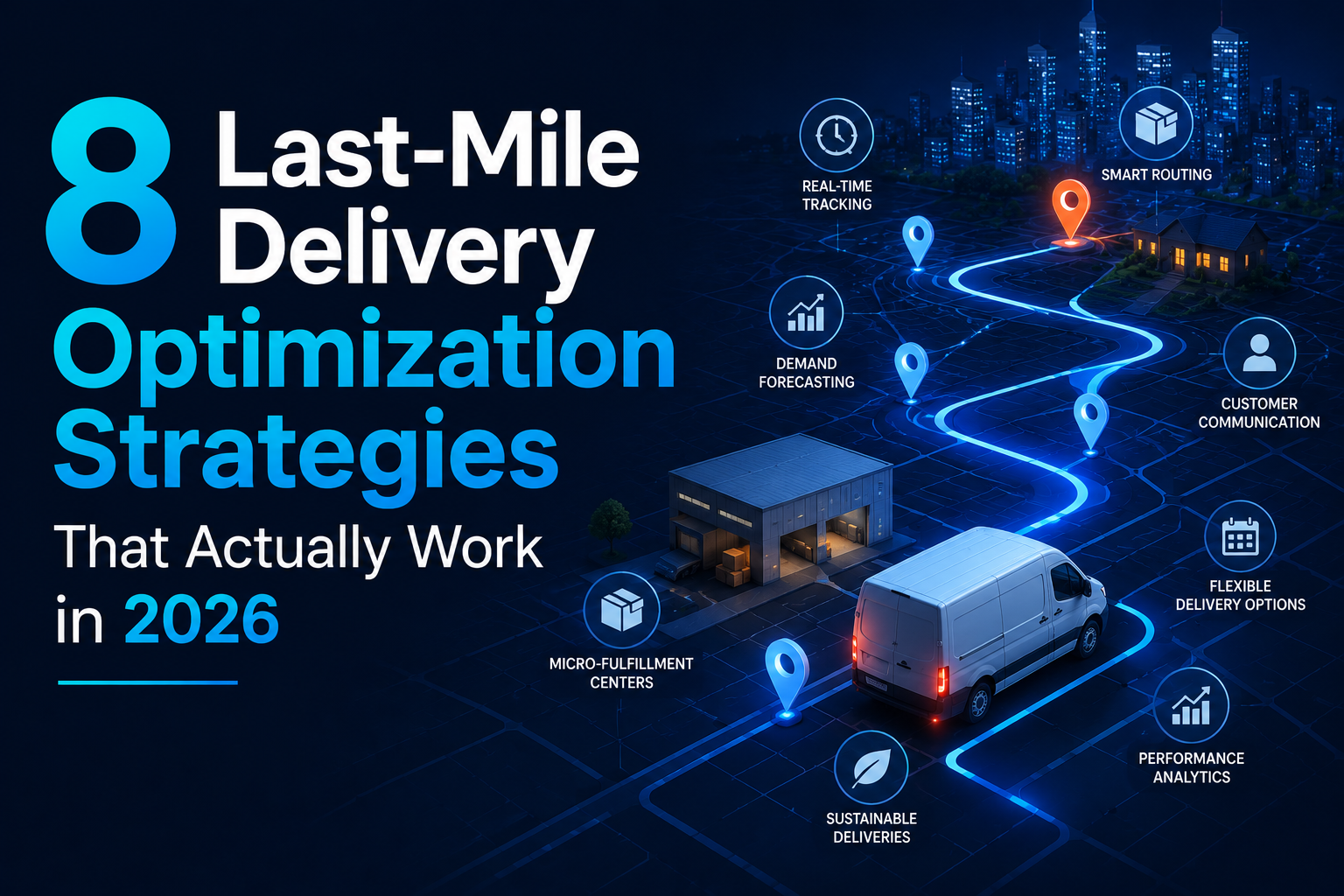
8 Last-Mile Delivery Optimization Strategies That Actually Work in 2026
Without any sermon, lets start directly.
| Strategy | Primary Benefit | Best For | Key Stat |
|---|---|---|---|
| AI Route Optimization | Fuel and time savings | 10+ vehicles, 50+ daily stops | UPS saves $400M/year via ORION |
| Micro-Fulfilment Centres | Shorter delivery distance | Urban grocery and FMCG, 200+ orders/day | 10x faster picking vs manual |
| Predictive Delivery Windows | Fewer failed attempts | B2C residential delivery | 30% reduction in failed attempts |
| Dynamic Slot Pricing | Better route density | Grocery, subscription, meal kits | Sub-£6 delivery cost at Ocado scale |
| Parcel Lockers | Eliminates residential failure | Urban eCommerce, especially Europe | 30 parcels in 5 min vs 30 door attempts |
| Real-Time Tracking | Fewer customer service contacts | Any brand where LTV matters | 30% fewer inbound contacts |
| Gig Delivery Networks | Peak demand capacity | Seasonal retailers | 12% higher on-time during peak |
| Returns ML Prediction | Reduces return-driven redelivery | Fashion, footwear, electronics 15%+ return rate | 15 to 25% return rate reduction |
1. AI-Powered Route Optimization That Updates in Real Time
Static route planning – assigning drivers a route at the start of the day and leaving them to it – is the single biggest source of delivery inefficiency in most operations I have assessed.
The problem is not the initial route. It is everything that changes after it is set: traffic incidents, failed first-attempt deliveries, late driver starts, and new same-day orders. Static routes cannot respond to any of these. Drivers improvise, which introduces inconsistency and cost.
AI route optimization tools recalculate routes continuously based on real-time inputs. Route4Me, OptimoRoute, and Circuit all do this for SMB and mid-market operations. Enterprise implementations typically use Google Maps Platform Routes API or HERE Technologies’ routing engine as the backbone.
The data is clear: UPS’s ORION routing system – arguably the most documented real-world example – saves UPS an average of 6 to 8 miles per driver per day. Across their US fleet of 66,000 drivers, that translates to over $400 million in annual fuel savings.
You do not need UPS scale to see meaningful returns. A regional operation with 20 drivers saving 5 miles per driver per day saves approximately 36,500 miles per year, which at $0.67 per mile (current IRS mileage rate) is about $24,000 annually.
Best for: Any operation with 10 or more delivery vehicles and a volume of 50 or more daily stops per vehicle.
2. Micro-Fulfilment Centers to Cut Distance to the Customer
The distance a package travels in the last mile directly determines its cost. The shorter the distance, the cheaper and faster the delivery. Micro-fulfilment centers (MFCs) – small, automated warehouse facilities positioned inside or near urban population centers – reduce that distance by holding fast-moving SKUs close to where customers actually are.
Walmart’s micro-fulfilment strategy, using Symbotic automation installed in existing store backrooms, allows them to fulfil online grocery orders from a location that is already within 10 miles of most of their customers. According to Walmart’s own reporting, automated MFC picking is up to 10 times faster than manual picking.
The investment is significant: a basic automated MFC installation runs $1 million to $5 million depending on size and automation level. But for high-frequency delivery operations in dense urban markets, the unit economics work.
Reduced delivery distance reduces fuel cost, driver time per delivery, and failure rates from traffic. For grocery and fast-moving consumer goods, the same-day delivery promise becomes operationally viable rather than a loss leader.
Best for: Grocery, pharmacy, and FMCG retailers with dense urban customer bases and daily delivery volume above 200 orders per fulfilment zone.
3. Predictive Delivery Time Windows That Reduce Failed Attempts
A failed delivery attempt (the driver arrives, no one is home) costs an average of $17 in the US according to research from the Capgemini Research Institute. That is before counting the redelivery attempt, the customer service contact, and the potential return and refund.
The fix is not faster delivery. It is more accurate delivery time windows. Customers who know their package will arrive between 2 pm and 4 pm are far more likely to arrange to be home or at a secure collection point than customers who are told “your package will arrive today.”
Predictive ETA systems use machine learning on historical delivery patterns, driver performance data, and real-time traffic to narrow the delivery window for each stop from a full day to a 1 to 2 hour bracket.
Amazon has trained customers to expect 2-hour windows. The technology that powers this is accessible to smaller carriers and retailers today through APIs from EasyPost and similar platforms that include delivery prediction tooling.
According to Capgemini’s research, offering a precise 2-hour delivery window reduces failed delivery rates by approximately 30% compared to day-only estimates. For an operation with 500 daily deliveries and a 15% failed delivery rate, that translates to 22 fewer failed attempts per day.
Best for: Any B2C delivery operation where residential delivery is a significant proportion of volume.
4. Dynamic Delivery Slot Pricing to Manage Peak Demand
Most retailers offer delivery slots on a first-come, first-served basis. The result: popular time slots (evenings and weekends) fill immediately, forcing costly route fragmentation. Off-peak slots go unfilled, leaving driver capacity wasted.
Dynamic pricing for delivery slots changes the incentive. Charge more for peak slots, offer discounts or free delivery for off-peak. Customers who have flexibility will shift. Customers who genuinely need a specific time will pay for it. Both outcomes improve operational efficiency.
Ocado, the UK’s online-only grocery platform, has used slot pricing for years with demonstrable route density improvements. Their delivery cost per order is consistently lower than physical-store grocery retailers running delivery, despite being purely online, partly because of how they manage slot demand.
According to Ocado’s technology partner platform Ocado Group, route efficiency improvements from demand management contribute directly to keeping delivery costs below £6 per order at scale. For retailers launching or scaling delivery, slot pricing should be built into the platform from day one rather than retrofitted later.
Best for: Grocery, meal kit, and subscription box operations with regular recurring delivery demand.
5. Parcel Lockers and Alternative Delivery Points to Eliminate Residential Failure
Not every delivery needs to go to the customer’s front door. Parcel lockers like secure, weather-protected collection points in convenient locations; give customers a reliable alternative that eliminates the failed delivery problem entirely.
In Germany, DHL’s Packstation network has over 12,000 locker locations. In the UK, Amazon Locker is available in over 4,000 locations. Usage data from both networks consistently shows that customers who adopt lockers have significantly lower delivery failure rates than those receiving home delivery.
The operational benefit for the carrier is real: a driver delivering 30 packages to one locker location in 5 minutes is far more efficient than 30 individual residential attempts with an average 2 to 3 minutes per door.
For retailers, integrating parcel locker options at checkout is now a competitive expectation in Germany, France, and Scandinavia. Pitney Bowes’ Parcel Shipping Index shows continued growth in parcel locker adoption across all major European markets through 2024.
Best for: Any eCommerce operation with significant delivery volumes in urban Europe. Lower adoption in the US, but growing in dense metro areas.
6. Real-Time Delivery Tracking with Proactive Exception Management
Customers who can track their delivery in real time generate 30% fewer inbound customer service contacts, according to Convey’s Delivery Experience Report. That is not a trivial number. Customer service contacts for delivery queries are expensive to handle and disproportionately damage customer satisfaction when they indicate a problem.
The more impactful half of this strategy is the “proactive exception management” piece. When a delay is detected like traffic, a vehicle breakdown, a high-volume day, the system alerts the customer before they notice and offers resolution options. Rescheduling, a collection alternative, or an apology credit.
This proactive communication converts a negative delivery experience into a neutral or positive one. Research from Narvar’s State of Returns report shows that customers who receive proactive delay notifications have higher repurchase rates than customers who receive no notification, even when the delivery is late. Transparency consistently outperforms silence in customer satisfaction measurement.
Best for: Any eCommerce brand where customer lifetime value is a key metric. The ROI is in retention, not operational efficiency.
7. Crowd-Sourced and Gig Delivery Networks for Demand Spikes
Traditional carrier contracts have fixed capacity. Peak periods like Black Friday, the December holiday season, summer for outdoor goods retailers generate demand that exceeds that capacity, leading to delays and cost surcharges. Crowd-sourced and gig delivery networks offer burst capacity without a permanent cost base.
Platforms like Shipt, Roadie, DoorDash Drive, and Gophr in the UK connect retailers to a network of independent drivers who can be activated for specific time windows.
The per-delivery cost is typically 20 to 40% higher than contracted carrier rates. The value is in paying that premium only for the incremental volume, rather than maintaining carrier capacity for peak demand that exists for only 6 to 8 weeks per year.
According to Roadie’s own platform data, retailers using hybrid contracted-plus-gig delivery models see on-time delivery rates 12% higher during peak periods than those relying exclusively on contracted carriers. The capacity flexibility more than offsets the cost premium for most operations.
Best for: Seasonal retail with clearly defined peak demand windows. Not suitable as a primary delivery model due to cost.
8. Machine Learning on Returns Data to Reduce Return-Driven Redelivery
Returned items and the redelivery attempts they generate are a hidden last-mile cost. A customer who returns a product and reorders a replacement requires two last-mile delivery events for one retained revenue unit.
Machine learning models trained on return patterns can predict, at the point of order, which items are likely to be returned based on factors like product category, customer return history, order size, and seasonal demand signals.
This prediction enables proactive intervention: showing more detailed sizing guides to high-return-risk customers before they complete checkout, offering video demonstrations of complex products, or flagging fulfillment teams to include specific documentation.
Optoro’s research on eCommerce returns shows that organizations using predictive return management reduce return rates by 15 to 25% for targeted product categories. At an average return cost of $27 per item in the US (including return shipping, processing, and restocking), a 20% reduction on 5,000 monthly returns saves approximately $27,000 per month.
Best for: Fashion, footwear, electronics, and any category with return rates above 15%.
Conclusion – Last-Mile Optimization is Not One Decision but a Stack
The organizations that have genuinely improved last-mile efficiency have not found a single solution. They have layered these strategies according to their specific failure points: route optimization for efficiency, predictive ETAs for failure rate, lockers for urban density, dynamic slot pricing for demand management, and returns prediction for cost reduction.
Before investing in any of these, audit where your last-mile cost and failure is actually coming from. One hour of analysis on your delivery data will tell you which of these eight strategies will move the needle fastest for your operation.
Our logistics industry solutions team builds the data infrastructure and optimization layers that support each of these strategies. For organizations building or rebuilding delivery management systems, our custom web application development practice covers the full build from route optimization API integration to customer-facing tracking interfaces.