NFT commerce is not the speculative market it was in 2021. The platforms generating real revenue in 2026 are not built around digital art and speculation.
They are built around three specific business problems that conventional ecommerce cannot solve: proving the provenance and authenticity of physical luxury goods, giving buyers genuine ownership of digital products they can resell, and creating loyalty tokens that customers actually control.
According to Chainalysis blockchain market data, enterprise and brand-led NFT applications now make up the most stable and growing segment of NFT adoption, as speculative trading volumes have normalised.
The infrastructure has caught up. Gas fees on Polygon are low enough to run high-volume retail transactions at fractions of a cent. Wallet UX has improved to the point where buyers can transact without knowing what a private key is.
I have built NFT commerce systems for fashion, luxury, and events clients at orangemantra over the past two years. This article covers what the technology looks like in production, which use cases are working, and what you need to get right before you build.
Table of Contents
What NFT Commerce Actually Means for Business in 2026
NFT commerce uses blockchain tokens to prove and transfer ownership of digital or physical goods. The token is a smart contract entry on a blockchain. What it represents is defined entirely by the brand that issues it.
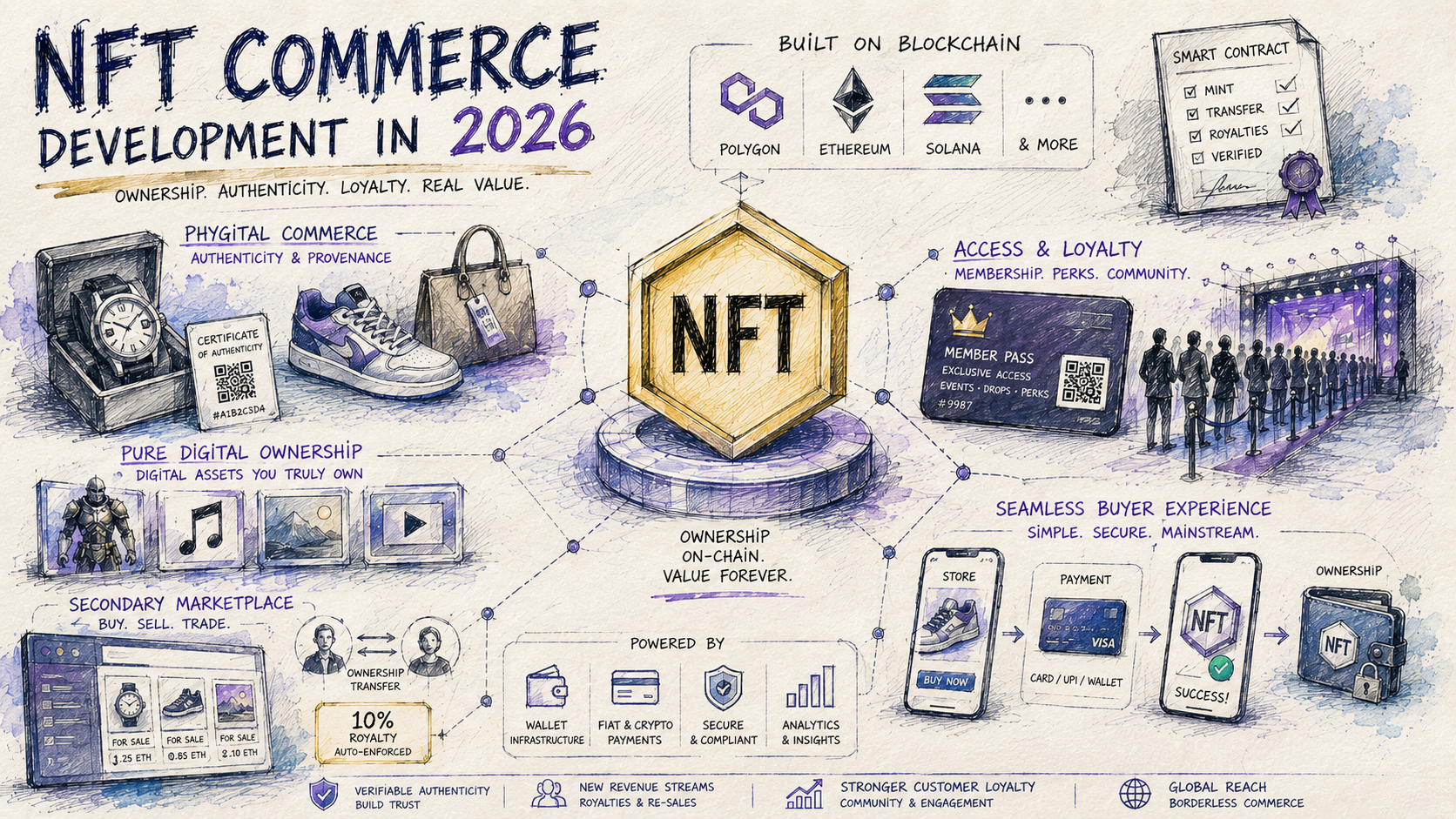
Three distinct models have emerged in commercial use:
Pure digital commerce sells digital goods with genuine, transferable ownership. An in-game item, a music track, or a digital collectible exists on-chain and can be resold, traded, or transferred by the buyer. The brand collects a royalty on every secondary sale. This is not possible with conventional digital products, where the platform owns the item and the buyer holds only a licence.
Phygital commerce pairs a physical product with an on-chain certificate of authenticity. When the product changes hands, the NFT transfers with it. A luxury watch, a limited-edition sneaker, or a signed jersey carries permanent, verifiable provenance. The brand can see where every product has been.
Access-based commerce uses NFTs as membership or loyalty tokens. Holding the token grants access to exclusive drops, events, or experiences. The token can be sold if the holder no longer wants the membership, which creates a secondary market the brand benefits from through royalties.
Why 2026 Is Different from the 2021 NFT Hype
Three things have changed since the 2021 peak that make NFT commerce viable for mainstream brands today.
Transaction costs on Ethereum Layer 2 networks like Polygon have dropped by over 99% compared to Ethereum mainnet in 2021. A transaction that cost $50 to $200 in gas fees three years ago now costs fractions of a cent. This makes retail-volume NFT commerce economically practical.
Custodial wallet infrastructure has crossed a consumer UX threshold. Buyers can now purchase an NFT with a credit card and an email address, with no understanding of seed phrases or private keys required. The wallet is managed by the platform and can be migrated to self-custody later if the buyer wants it.
Enterprise demand has replaced speculative demand. Fashion brands, sports leagues, luxury houses, and event organisers are building NFT infrastructure because it solves specific commercial problems, not because blockchain is a trend.
Core Components of an NFT Ecommerce Platform
ERC-721 vs ERC-1155: Choosing the Right Token Standard
ERC-721 creates unique, one-of-one tokens. Each NFT has a distinct identity and cannot be replicated. This is the right standard for limited-edition drops, certificates of authenticity, and any product where individual uniqueness matters to the buyer.
ERC-1155 creates semi-fungible tokens. You can mint 10,000 copies of the same item under a single contract, with each copy identical until one is used or modified. This is the right standard for event tickets (1,000 seats for the same event), gaming items (100 copies of the same weapon), and loyalty points that can be spent in fractions.
Most production NFT commerce platforms use both standards. The choice depends on what you are selling, not which standard is technically superior.
Wallet Connection and Buyer Onboarding
The biggest barrier to NFT commerce adoption is wallet friction. Requiring buyers to install MetaMask, fund it with ETH, and manage seed phrases eliminates the majority of mainstream consumers before they reach checkout.
The answer is custodial wallet infrastructure. The platform creates and manages a wallet on behalf of each buyer. The buyer registers with an email address and pays by credit or debit card. The NFT is minted to their managed wallet. At any point, the buyer can export the NFT to their own self-custody wallet. This architecture brings NFT commerce into the same UX territory as a standard ecommerce checkout.
Payment Rails and On-Chain Royalty Enforcement
A production NFT ecommerce platform needs two payment rails: crypto for Web3-native buyers paying in ETH or MATIC, and fiat for mainstream buyers paying by card. Both rails need to feed into the same order management system.
Royalty enforcement is where NFT commerce creates economics that conventional resale markets cannot match. Smart contracts encode a royalty percentage, typically 5% to 10%, on every secondary sale. Every time the NFT changes hands on any compatible marketplace, the original brand receives the royalty automatically. No invoice, no collection process, no reliance on a third-party platform honouring the agreement.
NFT Commerce Use Cases Generating Real Revenue in 2026
Fashion and Luxury: Limited Drops with Provenance Tracking
A luxury fashion brand launches a run of 500 jackets. Each jacket comes with an ERC-721 NFT minted at point of sale, containing the item’s manufacture date, materials, and serial number. When the owner resells the jacket, they transfer the NFT with it. The next buyer can verify the entire ownership history on-chain. The brand collects a royalty on every secondary transaction.
We built a version of this for a premium accessories brand in Valencia. Counterfeiting was costing the brand an estimated 15 to 20% of potential revenue in their mid-price segment. Within nine months of launch, we had verified 8,000 secondary market transactions through their NFT-gated catalogue, each generating both provenance data and royalty income for the brand. The anti-counterfeit value was the headline. The royalty income was the number that justified the build budget.
Gaming: In-Game Asset Ownership and Cross-Platform Portability
In traditional gaming, in-game items are owned by the publisher. If the game shuts down, the items disappear. With NFT-based asset ownership, in-game items exist on-chain and can be sold, traded, or transferred across compatible games. This creates real digital asset economies with functioning secondary markets, which increases player engagement and platform stickiness.
Events and Ticketing: Dynamic NFT Tickets That Change After Purchase
An NFT ticket is not just a QR code. It can change state based on events: seat upgrades, VIP access additions, or post-event attendance verification. Dynamic metadata allows the ticket to become a collectible after the event, with the venue, date, and seat number stored permanently on-chain.
Scalping is addressed directly. Smart contracts can restrict resale to specific platforms, cap the maximum resale price, or route all secondary sales through the official channel with the organiser capturing a percentage of each transaction.
NFT Commerce Platform Tech Stack and Build Timeline
Choosing the Right Blockchain for NFT Ecommerce Development
Three blockchains dominate enterprise NFT commerce development in 2026:
Polygon is the practical default for most ecommerce use cases. Transaction fees are below $0.01, it is EVM-compatible so Ethereum developers can build without learning new tooling, and it is widely supported by wallets and marketplaces. Polygon is the right starting point for high-volume retail NFT applications.
Ethereum mainnet is appropriate for high-value luxury and art applications where chain prestige and liquidity matter to buyers. Gas fees remain higher, but for a product priced at $5,000 or above, the cost is proportionally small and the chain’s credibility is a genuine purchase signal for sophisticated buyers.
Solana offers high throughput and very low fees but uses Rust as its programming language, which increases development complexity and narrows the talent pool. It is strongest for gaming applications where transaction speed is a core product requirement.
Backend, Frontend and Integration Points for a Tokenized Ecommerce Build
The backend of a standard NFT commerce platform uses Node.js or Go for smart contract interaction and API layer. Metadata including token name, description, image, and custom attributes is stored on IPFS or Arweave for decentralised, permanent storage. Centralised databases should not hold the canonical metadata for NFTs you intend to transfer to buyers.
The frontend uses React with Web3 wallet libraries (ethers.js or wagmi) for wallet connection and transaction signing. For custodial wallet flows, the wallet interaction happens server-side and the frontend behaves like a standard ecommerce UI.
Integration points include the existing ecommerce stack (Shopify, Magento, or custom), ERP for inventory and fulfilment tracking, and loyalty systems if the NFTs function as membership or points tokens. The integration layer is where most project timelines expand beyond initial estimates.
Realistic build timeline: 10 to 16 weeks for a production-ready NFT commerce platform with smart contracts, storefront, dual payment rails, and ERP integration. A white-label solution deploys faster but limits what you can do with secondary market logic, royalty customisation, and branded buyer experience.
What to Get Right Before You Build an NFT Commerce Platform in India
1. Legal and Regulatory Clarity Under Indian VDA Rules
Under India’s Finance Act 2022, NFTs are classified as Virtual Digital Assets. Gains from the transfer of NFTs are taxed at 30%, with 1% TDS deducted at source on qualifying transactions. The GST treatment of NFT sales is still developing and varies based on whether the NFT represents a service, a digital product, or a physical good.
NFTs are not banned in India and are not currently classified as securities under SEBI’s framework, but the regulatory landscape is actively evolving. If your platform involves royalties, secondary market transactions, or anything resembling fractional ownership of an underlying asset, take legal advice specific to your use case before launch. Generic blockchain legal opinions are not sufficient.
For platforms with international reach, the US SEC’s treatment of certain NFT drops as potential securities is the most material regulatory risk for high-value collections. Structure the token and its associated rights with counsel before you start the build, not after the smart contracts are deployed.
2. IP Rights, Gas Fee Strategy and Custody Decisions
The most common buyer confusion in NFT commerce: what does the buyer actually own? Purchasing an NFT does not transfer copyright. The buyer owns the token and whatever rights are explicitly licensed with it. The intellectual property stays with the creator. Every NFT commerce platform needs clear, accessible terms explaining exactly what the buyer receives: the token, any physical item, the usage rights, and what the royalty structure means if they resell.
Gas fee strategy is a product decision, not just a technical one. For custodial wallet platforms, the brand typically absorbs gas costs and builds them into the product price. For self-custody platforms, buyers pay gas directly. Make this explicit in your pricing model before launch.
The one strategic mistake most brands make when launching NFT commerce: going live without a secondary market strategy. If buyers cannot easily resell their tokens on a credible marketplace, the ownership narrative falls apart. Decide where secondary sales happen, what the royalty rate is, and how you will communicate this to buyers before the first token is minted.
Final Words: Why NFT Commerce Development is a Specific Infrastructure Choice
NFT commerce is worth building when you have a specific problem that blockchain ownership solves better than any conventional alternative. That means counterfeiting at scale, the absence of creator economics on digital resales, scalping in ticketing, or loyalty programmes that buyers cannot trust because the brand can change the rules at any time.
The infrastructure is mature enough to build on today. Gas fees are no longer a barrier for retail use cases. Wallet UX has improved to where mainstream buyers can transact without understanding the underlying technology. The legal framework in India, while still developing, gives enough clarity to operate within, provided you engage the right legal counsel from the start.
What determines whether an NFT commerce platform succeeds is not the blockchain you choose or the token standard you deploy. It is whether you have a clearly defined use case, a secondary market strategy, and a buyer experience that makes ownership feel real and not theoretical.
Our blockchain development services cover NFT platform builds from smart contract architecture through storefront, payment integration, and marketplace launch. For brands building digital commerce beyond conventional platforms, our custom eCommerce development team handles the full commerce layer alongside the blockchain infrastructure. For NFT marketplace models with multiple sellers, our multi-vendor marketplace development practice covers the multi-seller architecture specifically.
Frequently Asked Questions About NFT Commerce Development
Do buyers need a crypto wallet to buy NFTs on my platform?
Not necessarily. Modern NFT commerce platforms support custodial wallets where the platform manages the wallet on the buyer’s behalf. The buyer registers with an email address and pays by card. The NFT is held in a managed wallet they can transfer to their own self-custody wallet at any point.
What blockchain should I build my NFT commerce platform on?
For most ecommerce use cases in 2026, Polygon is the practical choice: low transaction fees, EVM-compatible, and widely supported by wallets and marketplaces. Ethereum mainnet is better for high-value luxury or art applications where chain prestige matters to buyers and the higher gas cost is proportionally small.
How long does it take to build an NFT commerce platform?
A production-ready platform with smart contracts, storefront, wallet connection, and payment rails takes 10 to 16 weeks depending on complexity. White-label solutions deploy faster but limit what you can do with secondary sales logic, royalty structures, and branded buyer experience.
Can I sell physical products with NFTs?
Yes. This is phygital commerce. The NFT acts as a certificate of authenticity tied to the physical product. When the product changes hands, the NFT transfers with it. The model is used in luxury fashion, collectibles, and high-value consumer goods where proving provenance across the supply chain has direct commercial value.
Is NFT commerce legal in India?
NFTs are classified as Virtual Digital Assets under Indian tax law, subject to 30% tax on transfer gains and 1% TDS on qualifying transactions. They are not banned. The regulatory framework is still evolving, so take legal advice specific to your use case — particularly if your platform involves secondary market royalties or anything that could be interpreted as fractional asset ownership.