Modern customers expect more than generic promotional emails and one-size-fits-all marketing campaigns. They want personalized experiences, timely recommendations, and seamless interactions across every digital touchpoint. This growing expectation has pushed businesses to adopt advanced marketing automation platforms that can manage customer journeys intelligently.
One platform that continues to lead this transformation is Salesforce Marketing Cloud. Designed to help businesses create personalized and omnichannel marketing campaigns, it enables organizations to engage customers more effectively.
In this blog, we’ll explore what Salesforce Marketing Cloud is, its key features, benefits, use cases, and why partnering with an experienced Salesforce development company can maximize your investment.
Table of Contents
What is Salesforce Marketing Cloud?
Understanding Salesforce Marketing Cloud starts with recognizing its role within the broader Salesforce ecosystem.
Salesforce Marketing Cloud is a cloud-based digital marketing platform to plan, execute, automate, and optimize customer engagement campaigns across multiple channels. It combines user data, artificial intelligence, automation, analytics, and personalization capabilities into a single platform.
Salesforce Marketing Cloud empowers marketers to create cohesive customer journeys, unlike traditional marketing tools. Organizations using Salesforce experience an average ROI of nearly 300% by lowering costs and enhancing efficiency. And that too across email, SMS, social media, mobile applications, websites, and digital advertising platforms.
The platform empowers businesses to:
- Build personalized customer experiences
- Automate marketing workflows
- Segment audiences intelligently
- Analyze campaign performance
- Improve customer retention
- Increase conversion rates
- Deliver real-time engagement
By centralizing user interactions and marketing activities, firms can create meaningful relationships that drive long-term business growth.
Core Benefits of Salesforce Marketing Cloud for Businesses
Organizations across industries continue investing in Salesforce Marketing Cloud because of its measurable business benefits.
Enhanced Customer Personalization
Today’s customers expect brands to understand their preferences.
Salesforce Marketing Cloud uses customer data and AI-powered recommendations to create personalized interactions across every touchpoint. This level of personalization increases customer satisfaction, engagement, and loyalty.
Native CRM Data Integration
Within the broader Salesforce ecosystem, the sync between Salesforce Marketing Cloud services and your core Sales or Service Cloud environment is seamless. A customer service agent can view a customer’s active marketing journeys right inside their service panel without cross-department communication gaps.
AI-Powered Optimization (Einstein AI)
The platform features built-in machine learning models that analyze historical consumer behavior. It automatically calculates Send Time Optimization and scores customer engagement risk to catch potential churn before it happens.
Strict Security and Enterprise Governance
For Salesforce consulting services in heavily regulated industries, the architecture ensures strong data security. It also guarantees full compliance with GDPR, CAN-SPAM, and HIPAA standards.
Better Customer Journey Management
Customers rarely follow a linear buying process. Salesforce Marketing Cloud enables businesses to design customer-centric journeys. It adapts dynamically based on customer behavior, ensuring each interaction remains relevant and valuable.
Seamless Integration Across Business Systems
One major advantage of Salesforce Marketing Cloud in Salesforce is its ability to integrate with other Salesforce products such as Sales Cloud, Service Cloud, and Salesforce Commerce Cloud services. This unified ecosystem provides a complete view of customer interactions, improving collaboration and enhancing customer experiences.
What Salesforce Marketing Cloud Is Used For?
Understanding what Salesforce Marketing Cloud is used for in practice helps businesses assess where it would create the most value in their specific context.
Email marketing at scale
It is the most widely deployed capability. Email Studio allows marketers to build emails using Content Builder’s drag-and-drop interface. It sets previews across devices and clients, sets up A/B tests, manages subscriber lists, and deploys campaigns to segments of any complexity. This goes significantly beyond basic email service providers draws on any data connected to SFMC.
Customer journey automation
Right through Journey Builder is where SFMC’s power becomes most visible. Journey Builder provides a visual canvas where marketers map the sequence of touchpoints. It is where a customer will experience based on behaviour, segment membership, and the decisions they make along the way. This logic, built visually once, executes automatically at scale.
SMS and mobile push
Mobile Studio covers both directions of mobile communication. The outbound messages are sent through MobileConnect and MobilePush, and inbound message handling for two-way SMS interactions. For businesses where time-sensitive mobile communication is operationally important, this capability is frequently the primary driver of SFMC investment.
Advertising intelligence
This connects CRM data to digital advertising campaigns. Rather than targeting advertising purely on behavioural signals from the ad platform, SFMC’s Advertising capability allows businesses to find lookalike audiences based on their actual customer data, suppress existing customers from acquisition campaigns, and coordinate advertising with the email and SMS journeys running in parallel.
Web personalisation
Through Marketing Cloud Personalization (formerly Interaction Studio), it listens to what visitors do on your website and adapts the content and messaging based on their behaviour. A returning customer who previously viewed specific product categories sees different content than a first-time visitor.
Understanding How Salesforce Marketing Cloud is Structured: The Architecture of Builders & Studios
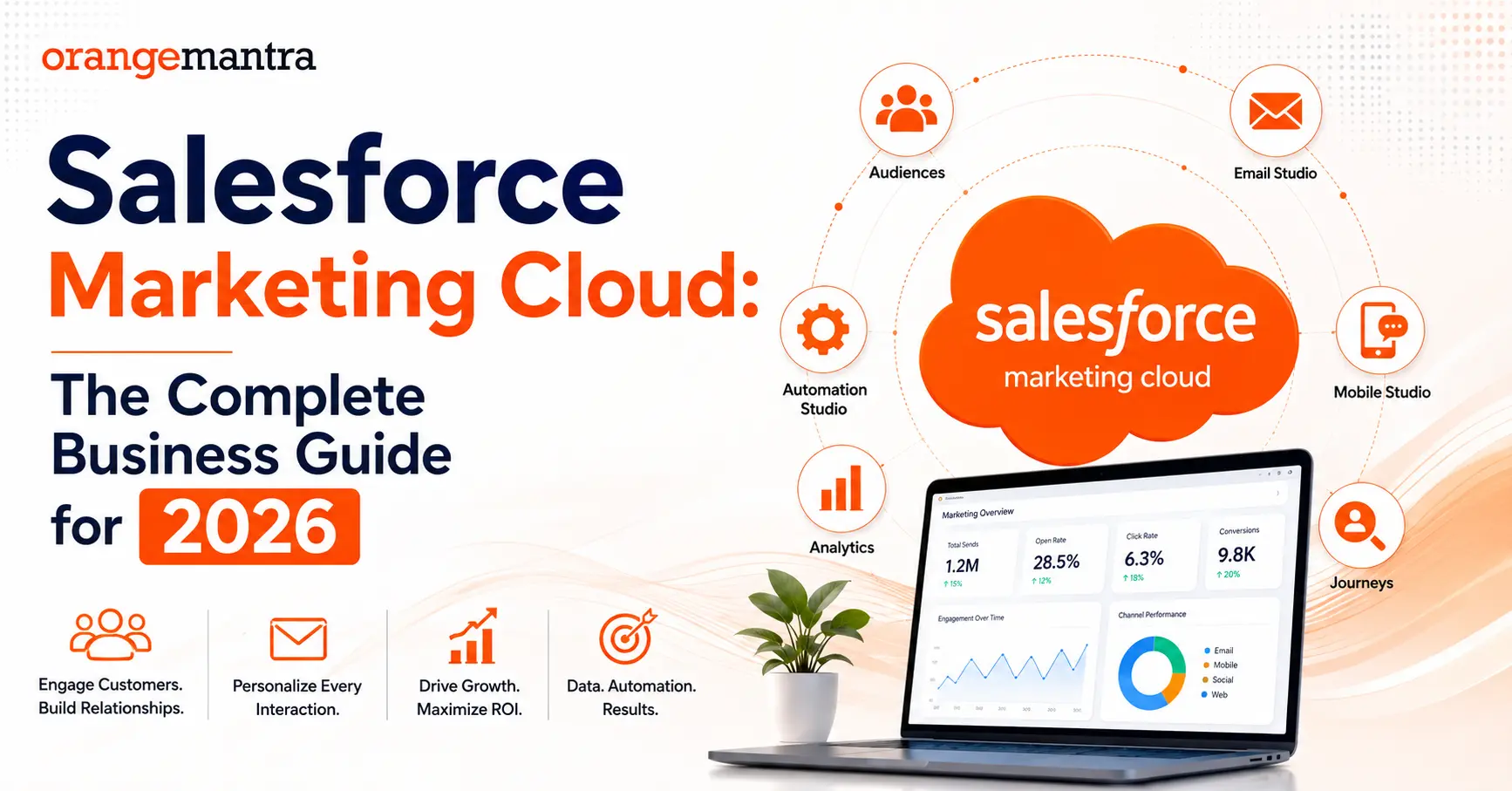
One of the reasons Salesforce Marketing Cloud has gained widespread adoption is its extensive suite of tools designed to address different aspects of customer engagement.
Journey Builder: Creating Personalized Customer Experiences
Journey Builder serves as the heart of Salesforce Marketing Cloud.
It allows marketers to design automated customer journeys based on customer actions, preferences, demographics, and behaviors.
For example, when a customer downloads an eBook, Journey Builder can automatically send a welcome email, recommend related content, schedule follow-up communications, and notify sales representatives when the lead reaches a certain engagement threshold.
This capability helps businesses deliver highly relevant experiences without manual intervention.
Email Studio: Advanced Email Marketing Automation
Email remains one of the highest-performing digital marketing channels.
Email Studio enables organizations to create, personalize, automate, and optimize email campaigns at scale. Businesses can segment audiences, perform A/B testing, schedule automated campaigns, and track engagement metrics. Salesforce Marketing Cloud’s dynamic content capabilities ensure customers receive messages tailored to their specific interests.
Mobile Studio: Engaging Customers on Their Preferred Devices
Mobile Studio allows businesses to communicate through SMS, push notifications, and group messaging. With consumers spending time on mobile devices, promotional offers, appointment reminders, and personalized recommendations are delivered. The result is increased engagement and stronger customer relationships across mobile channels.
Advertising Studio: Connecting Marketing and Advertising
Advertising Studio helps businesses unify their marketing and advertising efforts. Organizations can use customer data to create highly targeted advertising campaigns across platforms. Such as social media networks and digital advertising channels. This Salesforce CRM integration service enables businesses to reach the right audience while reducing wasted advertising spend.
Social Studio: Managing Social Media Engagement
Social Studio enables businesses to monitor, publish, schedule, and analyze social media activities. Marketers can track user conversations, monitor brand sentiment, identify emerging trends, and engage with audiences. Marketing Cloud in Salesforce capability helps organizations maintain consistent messaging while improving customer responsiveness.
Advanced Data Engineering: The Role of DMP and Intelligence
In enterprise marketing, execution is only as good as the underlying audience intelligence. Modern marketing departments rely on specialized platform modules to manage large volumes of data securely and effectively.
Audience Segmentation via Salesforce Marketing Cloud DMP
When managing large digital budgets, target audience accuracy is everything. The Salesforce Marketing Cloud DMP (Data Management Platform) serves as an advanced data-ingestion tier. It collects, anonymizes, matches, and aggregates vast pools of third-party consumer data across different channels.
- Business Impact: It helps corporate teams define precise customer lookalike models. It prevents wasted ad spend on existing users and delivers highly relevant messages across open web ad networks.
Unified Analytics via Salesforce Marketing Cloud Datorama
Data transparency is often a significant bottleneck for marketing teams. Especially those who can spend dozens of hours manually downloading CSV spreadsheets from Google Analytics, Meta Ads, and email engines just to build an executive report.
The Datorama Salesforce Marketing Cloud (now rebranded as Marketing Cloud Intelligence) addresses this by serving as an AI-driven data engine. It uses pre-built connectors to pull performance metrics from global ad networks, web engines, and internal databases into a unified dashboard.
The Strategic Value of Combining DMP and Datorama
Individually, DMP Salesforce Marketing Cloud and Datorama deliver significant value. Together, they create a powerful data ecosystem that enables truly intelligent marketing operations.
The DMP helps businesses understand who their audiences are and how they behave. Datorama measures how effectively marketing campaigns engage those audiences and contribute to business outcomes.
This combination creates a continuous optimization cycle:
- Customer data is collected and unified.
- Audiences are segmented based on behavior and intent.
- Personalized campaigns are launched.
- Performance data is analyzed in real time.
- Insights are used to refine targeting and messaging.
- Campaign effectiveness continuously improves.
Implementation Strategies: Working with a Salesforce Development Company
Deploying an enterprise marketing platform requires balancing business strategy with technical precision. To unlock its full potential, most organizations collaborate with an expert partner to guide the implementation.
Phase 1: Custom Data Architecture and System Ingestion
A Salesforce Marketing Cloud development partner helps map out your exact data flows. They configure data extensions, primary user keys, and connect enterprise databases to the platform. This step ensures clean data synchronization across the entire business ecosystem.
Phase 2: Customized Studio and Cloud Configuration
The integration team configures your sending domains, sets up SAP (Sender Authentication Packages) to protect email deliverability rates, and creates reusable content templates within Content Builder. This foundation allows your operational marketing teams to launch campaigns quickly and efficiently.
Phase 3: Workflow Automation and Integration Loops
The Salesforce development company configures advanced automation scripts using SQL within Automation Studio. This allows the platform to perform complex data queries, update internal segment lists, and trigger precise operational journeys for backend business changes.
Finding Trusted Support: Navigating Salesforce Marketing Cloud in Salesforce Help
As teams scale their operations, accessing ongoing platform support is critical to maintaining momentum. The primary resource for technical guidance, system updates, and troubleshooting is Salesforce Marketing Cloud in Salesforce Help.
This centralized portal gives your internal administrators and marketing managers direct access to:
- Step-by-Step Implementation Documentation: Detailed guides for setting up advanced platform configurations, tracking scripts, and external system integrations.
- Trailblazer Community Forums: An active global network where enterprise administrators share answers to complex real-world workflows and custom coding challenges.
- Direct Developer Ticket Support: A streamlined pipeline to log high-priority tickets directly with Salesforce engineering teams, ensuring rapid resolution of server issues or configuration bottlenecks.
Industries Benefiting from Salesforce Marketing Cloud
The versatility of Salesforce Marketing Cloud makes it suitable for organizations across multiple sectors.
Retail and Ecommerce
Retailers use Marketing Cloud to personalize product recommendations. They recover abandoned carts, launch promotional campaigns, and increase customer retention.
Healthcare
Healthcare organizations leverage automated communications for appointment reminders. This is especially true for wellness campaigns, patient engagement, and educational outreach.
Financial Services
Banks and financial institutions use personalized communications to improve customer acquisition. The marketing cloud Salesforce helps with onboarding and cross-selling opportunities while maintaining regulatory compliance.
Education
Educational institutions engage prospective students and strengthen alumni relationships through targeted campaigns.
Travel and Hospitality
Travel companies create personalized travel offers, booking reminders, loyalty campaigns, and post-trip engagement programs that improve customer satisfaction.
Conclusion:
Salesforce Marketing Cloud has evolved significantly from its ExactTarget origins into a platform. For enterprise businesses and growth-stage companies with the customer data volume and marketing sophistication to leverage its capabilities. SFMC remains the most commercially complete marketing automation platform available. For businesses that deploy it properly, it is measurable in campaign performance, customer lifetime value, and the marketing team’s ability.
FAQs
What is Salesforce Marketing Cloud used for?
Salesforce Marketing Cloud is a digital marketing platform used to manage customer journeys, email campaigns, social media engagement, and personalized messaging. It helps businesses deliver targeted communication across multiple channels using customer data and automation.
How does Salesforce Marketing Cloud improve customer engagement?
It improves engagement by using real-time customer data to create personalized journeys. Businesses can send the right message at the right time through email, SMS, ads, and push notifications, which increases customer interaction and conversion rates.
Who should use Salesforce Marketing Cloud?
Salesforce Marketing Cloud is ideal for enterprises, eCommerce brands, BFSI companies, and marketing teams that want to automate campaigns, manage large customer databases, and deliver personalized omnichannel marketing at scale.
What are the key features of Salesforce Marketing Cloud?
It includes features like journey builder, email studio, audience segmentation, automation tools, analytics dashboards, and AI-powered insights through Einstein AI to optimize marketing performance and decision-making.
Why do businesses need Salesforce Marketing Cloud developers?
Salesforce Marketing Cloud developers help businesses set up, customize, and optimize the platform. They ensure smooth integration with CRM systems, build automated workflows, and create data-driven campaigns that improve ROI and marketing efficiency.