
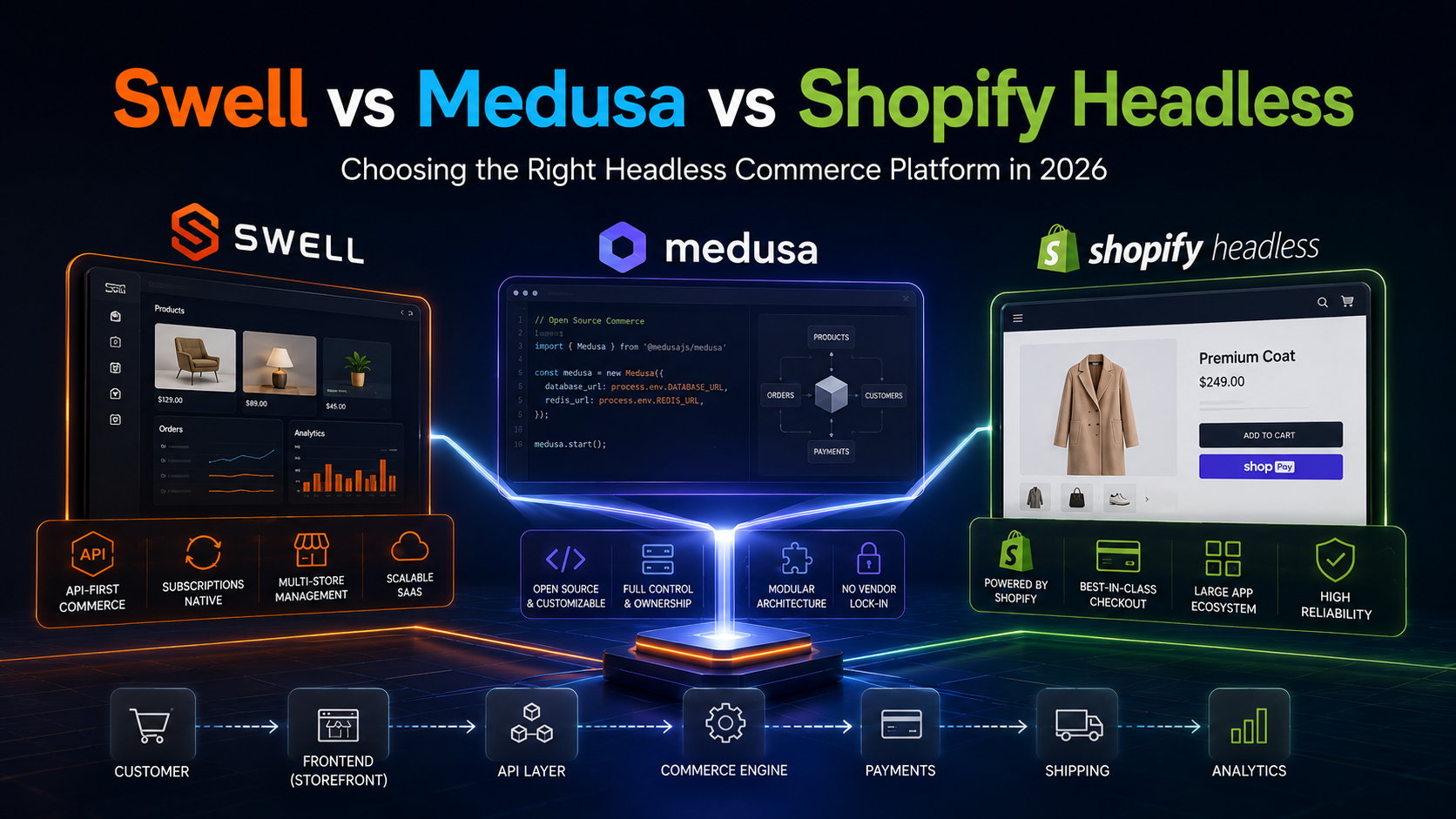
Shopify wants you on Hydrogen. Medusa.js wants you to own your infrastructure. Swell quietly occupies the middle ground that neither talks about. After building production storefronts on all three, here is the comparison the vendor documentation will not give you.
Headless commerce stopped being a trend in 2022. In 2026 it is a standard architectural pattern for any brand that needs frontend flexibility without rebuilding its commerce backend every time a designer has a new idea.
The question is not whether to go headless. The question is which headless platform costs you the least in the wrong places.
The three platforms in this comparison each represent a genuinely different philosophy. Swell is API-first SaaS: someone else manages the backend, you control the frontend. Medusa.js is fully open source: you own every layer, every decision, and every outage.
Shopify Headless via Hydrogen is managed SaaS with a React frontend layer bolted on. Each of these is the right answer for a specific kind of team. None of them is the right answer for everyone. This article tells you which one is which.
| Swell Commerce | Medusa.js | Shopify Hydrogen | |
|---|---|---|---|
| Hosting | Managed SaaS | Self-hosted | Managed (Shopify) |
| Best For | Subscription & multi-store brands | Engineering-heavy orgs | Lean teams on Shopify infra |
| Checkout | Fully custom | Fully custom | Limited by Shopify |
| Subscription Support | Native, built-in | Build from scratch | Via third-party apps |
| Ecosystem / Integrations | Limited — build most | Build everything | Largest pre-built library |
| Frontend Framework | Any (Next.js, Nuxt, etc.) | Any | React / Remix (Hydrogen) |
| DevOps Required | No | Yes | No |
| Time to Launch | 8–14 weeks | 12–20 weeks | 6–12 weeks |
| 3-Year TCO (Mid-Market) | Medium | Lowest (infra only) | Highest (licensing + fees) |
| Vendor Lock-in Risk | Medium | None | High |
| PCI Compliance | SaaS-handled | Your responsibility | Shopify-handled |
| Ideal Team Profile | Full-stack, API-comfortable | Backend + DevOps | Frontend / React-focused |
Table of Contents
Why This Headless Platform Decision is Different in 2026
Three years ago, “going headless” was the goal. Today, the headless market has matured enough that the implementation cost gap between a good headless decision and a poor one can mean 6 months of avoidable engineering work and a running cost that either compounds as an advantage or bleeds margin every month.
The decision used to be: SaaS or self-hosted? Frontend framework or platform theme? Those are still relevant questions but they are downstream of the more important one: what does your team actually have the capacity to own?
Shopify’s Hydrogen framework requires comfort with React and Remix. Medusa.js requires a team that can run and maintain its own infrastructure, handle security patching, and build integrations that Shopify merchants get from the app store. Swell requires neither, but it also gives you neither the ecosystem depth of Shopify nor the total control of Medusa.
The four criteria that should drive the decision are: hosting control (do you want to manage servers?), total cost of ownership (licensing plus build plus ongoing maintenance), ecosystem maturity (are the integrations you need already built?), and frontend flexibility (how much do you need to deviate from what the platform provides by default?). Map your real answers to those four criteria and the platform choice largely makes itself.
Swell Commerce: The Honest Assessment
Swell is the platform most eCommerce teams have not heard of and several wish they had found earlier. It is API-first by design, not by retrofit. Every capability – products, carts, accounts, subscriptions, multi-store management – is exposed through a clean REST and GraphQL API from day one.
There is no theme engine to work around, no liquid templating layer to fight with, and no artificial separation between what the API exposes and what the admin controls.
What Swell Commerce Gets Right for Headless Builds
Subscription commerce is native. This is the feature that pushes a specific category of brand toward Swell and away from the alternatives. Shopify’s subscription support depends on third-party apps with their own API rate limits, pricing, and reliability surface area.
Medusa.js requires building subscription logic from scratch or integrating a third-party service. Swell handles subscriptions, billing intervals, pause and resume, and dunning management as core platform features.
For a subscription box brand or a DTC business with a replenishment model, this eliminates a meaningful layer of integration complexity.
Multi-store from one backend. Swell’s architecture supports multiple storefronts drawing from the same product catalogue, inventory pool, and order management layer.
Each storefront has its own frontend, its own domain, and its own configuration, but they share a single backend. For brands running a B2C store and a B2B portal, or managing multiple regional storefronts, this avoids the data duplication problem that comes from running separate Shopify stores.
Developer experience is clean. The Swell SDK is straightforward, the API documentation is clear, and the local development workflow does not require significant environment setup. Teams familiar with Next.js or Nuxt.js can be productive on a Swell project within a day or two.
Where Swell Falls Short
The ecosystem is thin. Shopify has thousands of apps for everything from loyalty programmes to ERP connections to review widgets. Swell has a fraction of that.
Most integrations need to be built through Swell’s API rather than installed from a marketplace. That is not a dealbreaker for engineering-led teams, but it means a longer initial build and more integration maintenance responsibility.
Swell is also a commercial SaaS product. You do not own the infrastructure. If Swell’s pricing changes or the product direction shifts, migration is a project.
These are the same trade-offs you accept with Shopify, but teams choosing Swell over Medusa.js on cost grounds should understand they are choosing a smaller vendor, not eliminating vendor dependency.
The Swell verdict: The right choice for mid-market brands with subscription models, multi-store requirements, or clean API needs who want headless without managing servers. Not the right choice for teams that need a deep pre-built integration ecosystem or require total platform ownership.
Medusa.js: The Honest Assessment
Medusa.js development services represents a genuine philosophy rather than just a technical option. The premise is that eCommerce infrastructure should be open source, self-hosted, and fully owned by the business running it.
No licensing fees, no rate limits imposed by a vendor, no features withheld behind a pricing tier. The Medusa.js GitHub repository has accumulated more than 25,000 stars, which signals a real and active developer community. The plugin architecture is modular: payment providers, fulfilment services, CMS integrations, and notification services are all swappable through a consistent interface.
What Medusa Gets Right for Engineering-Led Teams
Zero vendor lock-in is real. Your codebase is yours. Your data lives in your database. Your infrastructure is configured by your team.
There is no API rate limit imposed by a SaaS platform, no feature flag that unlocks above a pricing tier, and no vendor decision to deprecate an endpoint that breaks your integration. For large enterprises and businesses with serious data governance requirements, this is not a philosophical preference. It is an operational requirement.
Cost at scale is genuinely lower. A Medusa.js deployment costs the infrastructure: compute, database, storage, CDN. There is no Shopify percentage fee, no Swell monthly subscription. At significant transaction volumes, the savings compound meaningfully. The running cost is your hosting bill and your engineering time.
Customisation depth is unlimited. Need a non-standard pricing model? Build it. Need fulfilment logic that no Shopify app handles? Build it.
Medusa’s codebase is designed to be forked, extended, and modified without fighting the platform’s abstractions. For products that are genuinely novel in their commerce model, Medusa removes the ceiling entirely.
The Infrastructure Burden Nobody Talks About in Medusa Comparisons
Here is what the Medusa enthusiast posts consistently leave out: you are now a software company, not just an eCommerce business.
Every security vulnerability in a Medusa dependency needs to be patched by your team. Every database performance issue is your problem. Every uptime incident is your on-call engineer’s problem.
The PCI DSS compliance scope is broader because you own the infrastructure that payment data touches. The CI/CD pipeline, monitoring, log management, backup strategy – all of it needs to be built and maintained by your team indefinitely.
Teams at companies with existing DevOps practices and a dedicated security function can absorb this cost. Teams that are primarily product and commercial people with a small engineering function will spend more on operations than they save on licensing fees.
This is not a criticism of Medusa.js. It is a factual description of what self-hosting means at production scale.
The Medusa verdict: The right choice for engineering-heavy organisations that need total control, cannot accept vendor lock-in, and have the infrastructure capability to run their own services reliably. The wrong choice for any team without dedicated DevOps capacity – the hidden operational cost will exceed the licensing savings.
Shopify Headless (Hydrogen): The Honest Assessment
Shopify Hydrogen is Shopify’s answer to a problem Shopify created: brands wanted headless flexibility, but Shopify’s liquid theme engine was blocking the frontend development patterns they needed. Hydrogen is a React-based framework built on Remix, designed to deliver a custom frontend while keeping the backend on Shopify’s infrastructure; meaning Shopify’s checkout, Shopify’s app ecosystem, and Shopify’s uptime record.
What Hydrogen Actually Solves
The checkout is genuinely best in class. This is not marketing language. Shopify has spent years and significant engineering investment on checkout conversion optimisation, payment method support, address validation, and fraud detection. The checkout passes PCI compliance out of the box.
It supports Shop Pay, which has publicly reported accelerated checkout rates, and it handles the cross-browser, cross-device complexity that every custom checkout builder eventually discovers is harder than it looks. If checkout performance is the most important variable for your business, staying on Shopify’s infrastructure is a strong argument.
The app ecosystem is unmatched. Loyalty platforms, review systems, subscription managers, ERP connectors, email marketing tools – the integrations that take weeks to build on Medusa or Swell often exist as tested, maintained Shopify apps. For a team that needs to move quickly, this pre-built integration depth is a genuine competitive advantage in time to market.
Infrastructure management is zero. Shopify’s Oxygen hosting handles deployment, CDN, and scaling without your team touching a server. For teams that want headless frontend flexibility without the infrastructure overhead of self-hosting, Hydrogen on Oxygen is the cleanest option currently available.
What Shopify Still Will Not Let You Do
Shopify’s checkout is also its most visible constraint. Checkout Extensions have improved significantly since 2022, but there are things you cannot do: replace the checkout with a completely custom flow, add arbitrary payment methods outside approved integrations, or store payment credentials in your own vault.
If your business model requires non-standard checkout behaviour — multi-cart, complex B2B approval workflows, or custom payment terms — Shopify’s checkout will eventually be the ceiling you hit.
Shopify’s API rate limits are also a real operational consideration at scale. High-volume catalogue updates, complex inventory syncs, and real-time pricing updates can exhaust rate limits and require architectural workarounds that add engineering cost and maintenance burden.
The Hydrogen verdict: The right choice for brands that want a fully custom frontend but need Shopify’s checkout reliability, app ecosystem, and zero infrastructure management. The wrong choice for brands whose commerce model requires checkout behaviour Shopify’s extensions cannot support, or for businesses where Shopify’s pricing structure is a meaningful cost at their transaction volume.
How to Actually Choose Between Swell, Medusa and Shopify Headless
All three platforms are technically capable. The decision comes down to four variables that only your team can answer honestly. Here is a direct comparison across the criteria that matter in production.
| Criteria | Swell Commerce | Medusa.js | Shopify Hydrogen |
|---|---|---|---|
| Hosting | Managed SaaS | Self-hosted, full control | Managed, Shopify infra |
| Subscription support | Native | Build from scratch | Via third-party apps |
| Ecosystem depth | Limited, build most | Build all | Largest pre-built |
| Checkout flexibility | Fully custom | Fully custom | Limited by Shopify |
| Dev team needed | Full-stack, API focus | Backend + DevOps | React-focused frontend |
| Time to first launch | 8 to 14 weeks | 12 to 20 weeks | 6 to 12 weeks |
| 3-year TCO (mid-market) | Medium | Lowest (infra only) | Highest (licensing + fees) |
Pick Swell if your primary requirements are subscription commerce, multi-storefront management, or a clean API without infrastructure burden, and your team is comfortable building integrations rather than installing apps.
Pick Medusa.js if your engineering team has DevOps capability, your commerce model is genuinely non-standard, or your data governance requirements make SaaS platforms unacceptable. Accept from the start that you are owning the infrastructure work.
Pick Shopify Hydrogen if Shopify’s checkout performance, app ecosystem, and zero infrastructure overhead are worth the pricing structure and checkout customisation constraints. This is the right call for brands that are primarily a marketing and product organisation with a lean engineering team.
We built a Swell Commerce storefront for a US-based subscription wellness brand that had outgrown Shopify’s subscription app dependencies. The build took 11 weeks.
Their multi-region storefront, custom subscription tiers, and pause-and-resume flows ran on Swell’s native subscription layer rather than a third-party app stack that had been breaking on every Shopify upgrade cycle. Subscription churn attributed to checkout and billing errors dropped by 40% in the three months after launch.
Conclusion: The Headless Platform Decision is Not Only a Technology Decision
The most expensive headless commerce mistake in 2026 is not picking the wrong platform. It is picking the right platform for the wrong team.
A Medusa.js deployment run by a team without DevOps experience will cost more in operational incidents than any Shopify Plus subscription. A Shopify Hydrogen build for a brand whose business model requires checkout customisation that Shopify’s extensions cannot support will hit a ceiling at exactly the moment scale demands the most.
A Swell build for a team that needs 40 pre-built integrations will spend most of its engineering time building what Shopify provides out of the box.
The right question is not which platform is technically better. All three are capable. The right question is which platform matches the shape of your team and the specific problems you need to solve.
Two to three weeks of architecture scoping before any development begins is the best investment you can make. It is considerably cheaper than a replatform 18 months into a build that went in the wrong direction.
Our Medusa.js development services team handles self-hosted builds for organisations that need full code ownership and non-standard commerce models. For brands staying within the Shopify ecosystem with a custom frontend, our headless Shopify development practice covers Hydrogen architecture and Checkout Extensions builds.
For Swell and fully custom headless backends, our custom eCommerce development team scopes and delivers the build.
Frequently Asked Questions About Headless Commerce Platform Comparison
Is Swell Commerce suitable for large enterprise eCommerce?
Swell works well for mid-market and growing enterprise brands, particularly those running multiple storefronts or subscription models. For very large catalogues with complex B2B pricing rules, OroCommerce or Adobe Commerce are better fits. Swell’s multi-store architecture is a genuine strength but its ecosystem depth shows limitations once you need 30-plus third-party integrations.
Does Medusa.js work with Shopify integrations?
Medusa.js has its own plugin ecosystem and can connect to third-party tools via custom integrations, but it does not natively support Shopify’s app store. If your current stack depends on specific Shopify apps, migrating to Medusa requires rebuilding or replacing those integrations — a significant scope consideration for any team that has accumulated years of Shopify app dependencies.
What frontend framework works with Swell Commerce?
Swell is frontend-agnostic. You can use Next.js, Nuxt.js, or any React or Vue-based framework. Most teams default to Next.js for its performance characteristics and SEO-friendly server-side rendering. Swell’s JavaScript SDK works cleanly with all of these without requiring framework-specific wrappers.
How long does a Swell Commerce build take?
A standard Swell storefront with a custom Next.js frontend takes 8 to 14 weeks depending on design complexity and integration requirements. The backend configuration is fast — Swell’s admin setup is measured in days. The majority of build time goes into the frontend and any third-party integrations your brand requires.
Can I migrate from Shopify to Swell Commerce without losing SEO rankings?
Yes, but it requires deliberate execution. URL mapping, 301 redirect planning, and metadata migration all need to be completed before launch. Product, collection, and blog URLs need to match or redirect correctly. A well-planned Swell migration typically recovers to pre-migration ranking levels within 4 to 6 weeks of go-live. Migrations that skip redirect planning see traffic drops that take months to recover.