Most B2B businesses running Magento today got there by default. Their agency knew Magento. Magento could technically handle wholesale. So Magento it was. Three years later, they are managing a stack of third-party extensions for price lists, a custom-built approval workflow that breaks every upgrade cycle, and a checkout flow that still cannot handle net 30 payment terms without developer intervention.
OroCommerce is not a marginal improvement on that situation. It is a different architecture for a different kind of commerce problem. Every feature was designed around how wholesale and distribution actually work: negotiated pricing per customer, multi-level corporate account structures, request-for-quote workflows, and ERP-native data models.
Forrester Research projects that US B2B ecommerce will reach $3 trillion by 2027. The companies capturing that volume are not winning because they digitalised faster. They are winning because they chose a platform whose architecture actually matches their business model. This article explains where OroCommerce wins for complex wholesale, where it does not, and what a real implementation looks like from the inside.
Table of Contents
Why Standard eCommerce Platforms Fail Real B2B Operations
B2B is not B2C with a bulk discount. That is the sentence most platform vendors ignore, and the reason most B2B implementations on B2C-core platforms eventually break under operational pressure.
A B2C checkout assumes one buyer, one price, one payment method, instant fulfilment. B2B assumes none of those things. A single account might have a purchasing manager, a department head, and a finance approver, each with different spending limits and different visibility into the catalogue. The price for a product depends on who is buying, their contract tier, their order volume last quarter, and whether they are ordering from a regional office or head office. Payment is net 45, settled against a purchase order.
The B2C Data Model Problem in Magento and Shopify Plus
Magento Open Source has no native B2B features at all. The B2B functionality sits in Adobe Commerce, the paid enterprise tier, starting at approximately $22,000 per year. Even within Adobe Commerce, complex B2B workflows including multi-level approval chains, negotiated customer-specific price lists, and full RFQ management require significant custom development or third-party extensions. Every extension adds a maintenance dependency that breaks on upgrades.
Shopify Plus introduced B2B features in 2022. For simple wholesale, including fixed price lists per company, basic payment terms, and draft orders, it works. For manufacturers and distributors with 500 or more SKUs, multiple buyer roles per account, and contract-level pricing that changes per order cycle, the platform’s permission model was not built for it. That workflow requires custom development because the underlying data model is still B2C.
How OroCommerce’s B2B-First Data Model Changes Everything
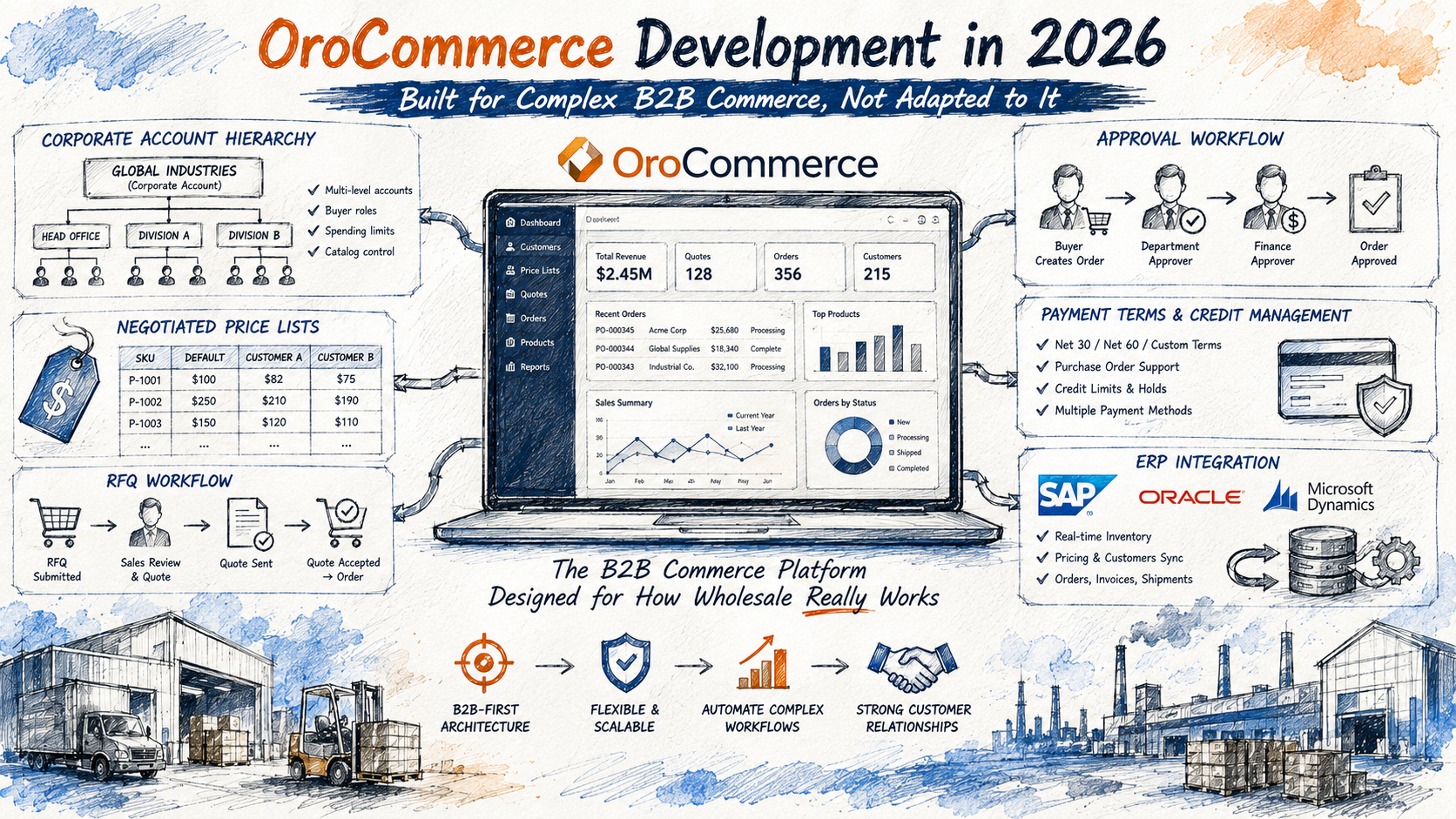
OroCommerce’s data model has corporate accounts, buyer roles, spending limits, and approval workflows as core schema objects. They are not plugins. They are not features bolted onto a B2C base. When you set up a corporate account, you can assign roles at the company level, the division level, and the individual buyer level, each with different permissions and spending authorities. This is what wholesale looks like operationally. The platform already thinks the way a wholesale business thinks.
OroCommerce Features That Make Wholesale Operations Actually Work
Corporate Account Hierarchy and Multi-Buyer Management
OroCommerce’s corporate account structure models how B2B customers are actually organised. One company can have multiple buyers with different roles: a purchaser who can add to the basket but not confirm, an approver who must sign off above a spending threshold, and a finance contact who receives invoices and manages credit.
Spending limits, catalogue visibility, and allowed payment methods are set at the role level. If a purchaser submits an order that exceeds their authority, the order routes to the approver automatically. No workaround, no manual email chain. It is in the order management flow from day one.
Negotiated Price Lists and Native RFQ Workflow for B2B Ecommerce Development
The feature that surprises most B2B businesses when they first see OroCommerce is the price list engine. Most platforms have tiered pricing: buy more, pay less. OroCommerce has price lists. Each is a complete, separate pricing layer assigned to a specific customer, customer group, contract period, or region. One SKU can carry fifteen different prices across fifteen different price lists. The price list that applies is determined dynamically at checkout based on who is logged in and what contracts are active.
For a distributor with 300 reseller accounts, each with individually negotiated pricing built through years of sales relationships, running this through tiered discounts is a constant manual override exercise. Running it through OroCommerce price lists is mostly automated once the data is structured correctly.
The RFQ workflow is equally native. A buyer submits an RFQ from the catalogue. The sales team reviews, adjusts line items if needed, and sends a quote back with an expiry date. The buyer accepts and the quote converts directly to an order without re-entering data. The full cycle, including approval routing within the buyer’s organisation, happens inside the platform.
Payment Terms and Credit Management
OroCommerce supports net 30, net 60, purchase order, and custom payment terms natively. Credit limits can be assigned per customer account. Credit hold status blocks checkout automatically when a customer exceeds their limit. These are not features built with extensions. They are in the platform.
OroCommerce vs Magento B2B: A Direct Comparison for Wholesale Businesses
Feature Coverage and Total Cost of Ownership
| Factor | OroCommerce Community | OroCommerce Enterprise | Magento Open Source | Adobe Commerce |
|---|---|---|---|---|
| Licence cost | Free (OSL 3.0) | From $45,000/year | Free | From $22,000/year |
| Native B2B features | Comprehensive | Comprehensive | None | Moderate |
| Extensions needed for B2B | Few | Few | Many | Several |
| RFQ workflow | Native | Native | Requires build | Partial |
| Multi-level approvals | Native | Native | Requires build | Requires build |
| Developer availability | Symfony specialists | Symfony specialists | Large pool | Large pool |
| Typical TCO over 3 years | $15k to $40k | $150k to $200k | $10k to $30k | $90k to $120k |
The TCO figures above cover infrastructure and licensing only, not development cost. OroCommerce uses Symfony PHP, where experienced developers are rarer than standard PHP developers and command higher day rates. That is a real cost. But for a business that needs price lists, corporate accounts, RFQ workflow, and purchase order payments, OroCommerce’s native coverage means you are not paying for custom development and plugin maintenance every time a pricing rule changes.
Developer Ecosystem and When Magento Still Wins
The honest case for Magento: the developer ecosystem is larger and the upgrade path is more predictable. If your B2B operation is essentially tiered discounts, a different checkout page, and a B2B customer segment, well-configured Adobe Commerce handles that at lower risk.
Gartner predicted that 80% of B2B sales interactions between suppliers and buyers would occur in digital channels by 2025. For businesses reaching that inflection point, choosing a platform with the wrong B2B architecture is not just a technical problem. It is a commercial constraint on every new buyer relationship you try to onboard.
What an OroCommerce Development Implementation Actually Looks Like
Technology Stack: Symfony, PostgreSQL and Elasticsearch
OroCommerce runs on Symfony PHP with PostgreSQL or MySQL as the database and Elasticsearch for catalogue search. If your development team has Symfony experience, OroCommerce projects run smoothly. If their background is WordPress or plain PHP, the framework introduces a learning curve that adds three to four weeks of ramp-up time to the project.
The buyer portal frontend is built in React or Twig depending on the level of customisation required. For portals where the buyer experience needs to match a specific workflow, React gives you the flexibility. For implementations where OroCommerce’s default storefront is close enough to the requirement, Twig-based customisation is faster.
ERP Integration: The Part That Always Takes Longer
The integration that extends every OroCommerce timeline is ERP synchronisation. OroCommerce is designed to run with real-time inventory and pricing from SAP, Oracle, or Microsoft Dynamics. The platform has a built-in integration framework and official connectors. The complexity is not in OroCommerce’s API layer. It is in the ERP’s data model and what it exposes cleanly.
In every SAP integration our team has delivered, the first two weeks are spent mapping OroCommerce fields to SAP data structures and resolving inconsistencies in the ERP data before any sync can run reliably. Price changes in SAP need to reflect in OroCommerce within a defined window. The sync architecture, including sync frequency, conflict resolution, and error handling, involves decisions that uncover edge cases in pricing data no one in the business knew existed until the data was pulled.
We implemented OroCommerce Community Edition for an industrial components distributor in dublin operating across 800 SKUs with five distinct customer tiers and three-level approval workflows. Their previous system was Magento with a custom pricing module requiring developer intervention every time pricing rules changed. The build took 16 weeks from kickoff to go-live, including full SAP integration. Quote processing time dropped by 65%. The project ran two weeks over the original estimate. Both extra weeks were in the ERP sync validation phase. That is standard, not exceptional.
Is OroCommerce the Right Wholesale eCommerce Platform for Your Business?
Clear Fit: When OroCommerce Is the Obvious Choice
OroCommerce is the right platform when your business involves any of these: a manufacturer selling direct to distributors with different contract pricing per account; a wholesaler with more than 200 accounts and individually negotiated pricing; a B2B marketplace managing buyer and seller relationships with RFQ workflows at scale; or any operation currently managing pricing in a spreadsheet because the ecommerce platform cannot hold the complexity.
McKinsey’s B2B Pulse Survey 2023 found that 70% of B2B decision-makers are now prepared to complete transactions worth up to $500,000 entirely through digital self-serve channels, without speaking to a sales representative. That is the scale of B2B transaction OroCommerce is designed to support. If your current platform cannot handle that deal complexity, the cost of staying where you are compounds every quarter.
Wrong Fit: When a Simpler Platform Serves You Better
A B2C brand with occasional B2B orders does not need OroCommerce. A small wholesale operation with fewer than 50 customers and straightforward pricing should use Shopify Plus B2B or a simpler configured system. The implementation cost and Symfony developer requirement make OroCommerce disproportionate for simple operations.
Migrating from Magento to OroCommerce: What to Plan For
Migration from Magento to OroCommerce is a genuine replatform, not an upgrade. The data models are different enough that your product catalogue, customer accounts, and order history need remapping, not copying. Order history migration is particularly complex if your Magento store has custom order attributes that do not map directly to OroCommerce objects. Budget four to six weeks specifically for data migration planning and validation, separate from the platform build itself.
Conclusion – OroCommerce Development Is a Platform Choice, Not a Trend Decision
The B2B ecommerce market is not short of platforms. It is short of platforms designed for wholesale from the beginning rather than adapted to it after the fact.
OroCommerce’s strength is also its constraint: it is specialist infrastructure for genuine B2B complexity. If you have that complexity, it is the most technically coherent choice available today. If you do not, the implementation cost and narrower developer pool make it harder to justify against simpler alternatives.
The businesses getting the most value from OroCommerce in 2026 have one thing in common. They hit a wall running complex wholesale operations on a B2C-core platform. They switched not because OroCommerce was trending, but because it was the tool that matched the actual shape of their problem.
Forrester’s 2025 predictions note that more than half of large B2B transactions will be processed through digital self-serve channels in the coming years. If your current platform cannot support the deal complexity that self-serve B2B demands, the decision deserves more rigour than most businesses give it.
Our B2B eCommerce platform development team has delivered OroCommerce implementations for distributors, manufacturers, and wholesale marketplace operators across India and the Middle East. If you are currently on Magento and evaluating whether to upgrade to Adobe Commerce or move to OroCommerce, our Magento development services team can assess your current customisations and map the migration cost honestly before any commitment is made. For businesses that want commerce and CRM on the same data layer, our CRM integration guide for eCommerce covers the OroCRM setup specifically.
Frequently Asked Questions About OroCommerce Development
Is OroCommerce open source?
Yes. OroCommerce Community Edition is open source under the OSL 3.0 licence. Enterprise Edition adds official SLA-backed support, advanced workflow tools, and access to the Oro partner network. Most mid-size wholesale businesses start with Community Edition and upgrade when they need guaranteed support response times and enterprise-grade infrastructure.
How does OroCommerce handle multiple price lists for different customers?
OroCommerce’s native price list engine lets you create unlimited price lists and assign them at the customer, customer group, or website level. Prices can be entered manually or calculated using rules against a base product price. For businesses migrating from spreadsheet-managed pricing, the price list import is the most time-consuming data task, but the result is a system that handles complex pricing without manual overrides per order.
Can OroCommerce integrate with SAP?’
Yes. OroCommerce has a built-in integration framework and established connectors for SAP, Oracle, and Microsoft Dynamics. In practice, integration quality depends on how clean and consistent your ERP data is. The first two weeks of every SAP integration we have done are spent mapping fields and resolving data inconsistencies before any sync can run reliably. Budget for this specifically.
What is the difference between OroCommerce and OroCRM?
OroCommerce is the B2B ecommerce platform. OroCRM is a CRM built on the same Oro codebase. When deployed together, your sales team gets a single view of customer orders, active quotes, pricing contracts, and communication history. For wholesale businesses where sales representatives manage named accounts, this unified view eliminates the data duplication you get from maintaining separate CRM and ecommerce systems.
How long does OroCommerce implementation take?
A standard B2B portal with product catalogue, corporate accounts, price lists, RFQ workflow, and ERP integration takes 14 to 20 weeks. Multi-website setups, custom approval chains, or marketplace seller management typically take 6 to 9 months. ERP integration is almost always the phase that extends the timeline. Plan for it to take twice as long as your first estimate, especially if your ERP data requires cleaning before it can sync reliably.