For decades, “using Salesforce” meant a straightforward process: opening a browser, logging in, and navigating through various screens. A sales manager would refresh a pipeline view, while a customer service representative would click into a case. Even the most advanced Salesforce configurations relied on a human user at a keyboard interacting with the user interface.
The core shift allows businesses to move from human-in-the-loop navigation toward 100% automated background execution, minimizing UI dependency. If you’re a business leader assessing your Salesforce investment considering the future of enterprise software, let’s delve into this blog post. It explains what Salesforce Headless 360 is, why it’s important for your business, and what steps you should take moving forward.
Table of Contents
What “Headless” Means for Ecommerce Businesses?
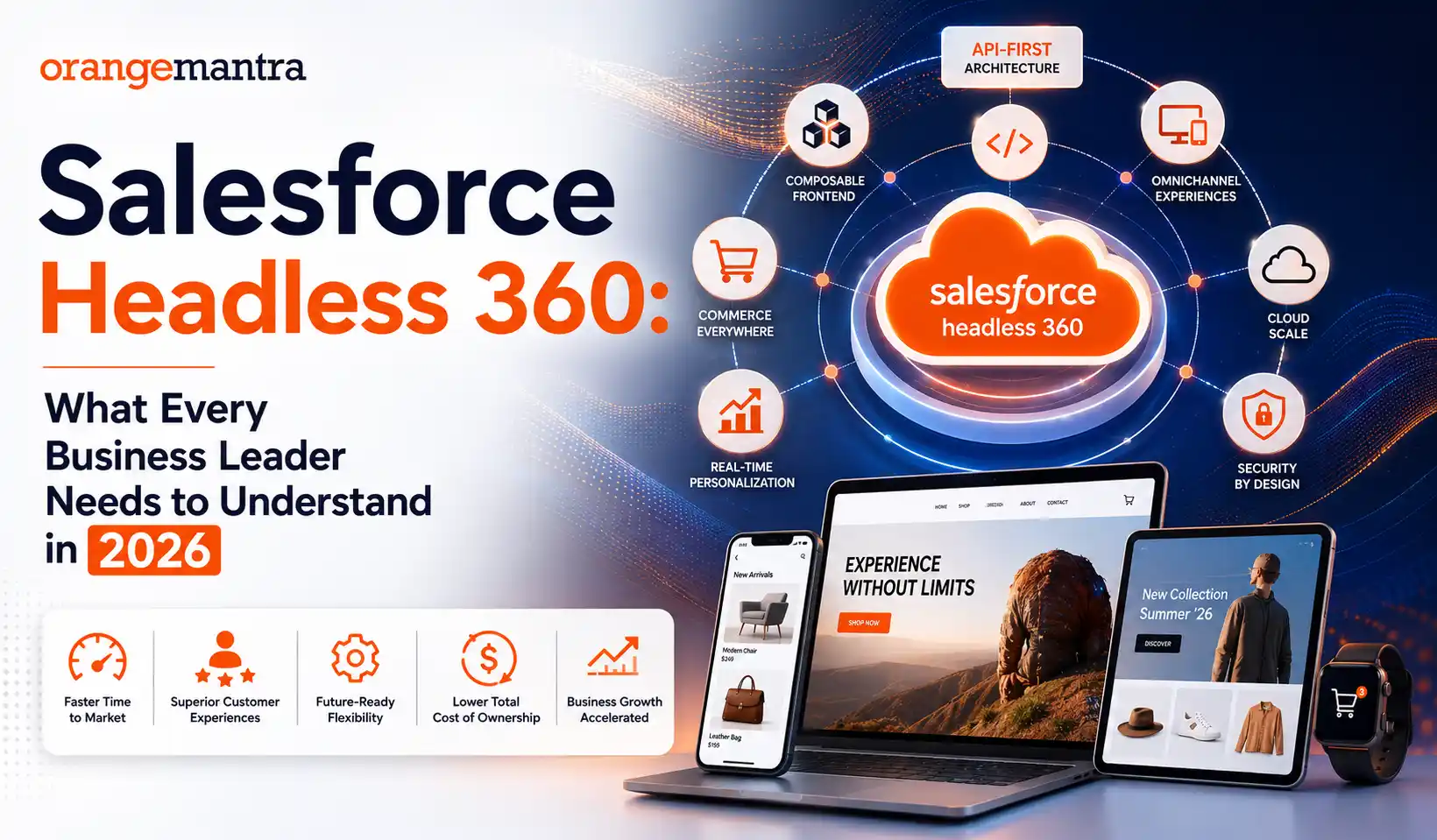
The word “headless” means without a head. It simply means without a graphical user interface that a person needs to interact with. Salesforce Headless 360 turns every Salesforce capability like data, workflows, and business logic into an API, MCP tool, or CLI command accessible by humans and AI agents.
Everything your business has built inside Salesforce. Such as customer records, approval chains, SLA rules, workflow automations, compliance policies, and relationship histories. It is now programmable and accessible from anywhere without a click.
The LLM provides intelligence. The platform provides everything else: identity, access, capabilities, governance, and the context that makes intelligence useful. When an agent calls an MCP tool, it is invoking accumulated state.
This is the critical insight that separates Salesforce Headless 360 from a simple “add some APIs” project. Headless 360 makes that business logic accessible to AI agents without rebuilding it from scratch.
Why Salesforce Built This And Why It Matters Right Now
Here are the major benefits of Salesforce Headless 360.
Freedom to Build Experiences Anywhere
One of the biggest advantages of Salesforce Headless 360 is that it gives freedom to businesses to create experiences. Salesforce development services are no longer limited to predefined templates or channels. Developers can use modern frameworks and technologies to design websites, mobile apps, customer portals, and AI-powered interfaces. This flexibility accelerates innovation, improves user engagement, and helps brands deliver experiences in competitive markets.
Faster Time-to-Market
Traditional applications often slow down innovation because frontend and backend systems are tightly coupled. With Salesforce headless architecture, teams can work independently. Frontend developers can launch new features while backend teams focus on business logic and integrations. This approach shortens development cycles and enables firms to respond to changing user expectations and market opportunities.
Enhanced Customer Personalization
Modern customers expect experiences that feel relevant and personalized across every touchpoint. Salesforce Headless 360 combines Data Cloud, CRM data, and AI capabilities to create unified customer profiles. Businesses can deliver personalized recommendations, targeted communications, and consistent experiences for customers engaging digital channels. This level of personalization helps strengthen relationships, improve customer satisfaction, and increase long-term loyalty.
Stronger Integration Capabilities
Modern enterprises depend on multiple systems working together seamlessly. Salesforce Headless 360 makes integration easier by connecting CRM platforms, ecommerce apps, Salesforce automation tools, mobile apps, and AI solutions. Organizations create a unified ecosystem where data flows freely across departments and channels. It improves efficiency, enhances customer experiences, and allows businesses to make faster decisions.
Better Developer Experience
Developers value flexibility, and Salesforce Headless 360 offers exactly that. Teams can work with technologies such as React, Next.js, Angular, Vue.js, and Node.js without being tied to a single framework. Independent deployments and reusable APIs simplify development processes and increase productivity. This modern approach enables developers to innovate faster, maintain apps, and deliver high-performing digital experiences.
Yes. For better readability and a more human, business-focused tone, keep sentences shorter and avoid overly technical explanations. Here’s a simplified version:
The Three Ways Salesforce Is Now Accessed
Salesforce is no longer limited to its traditional interface. Businesses and AI agents can access its capabilities in multiple ways.
APIs
APIs allow external applications, mobile apps, and AI agents to interact directly with Salesforce. They can read customer records, update cases, trigger workflows, and access business data without opening the Salesforce interface. This creates faster and more flexible experiences.
MCP Tools
Model Context Protocol (MCP) tools help AI agents discover and use Salesforce capabilities automatically. Salesforce Headless 360 includes more than 60 MCP tools. These tools allow AI assistants to access data, workflows, and services from any compatible environment.
CLI Commands
CLI commands help developers automate Salesforce tasks from the command line. Teams can deploy metadata, validate configurations, and perform changes without manual setup. This speeds up development and simplifies operations.
Salesforce Headless 360 turns Salesforce into a platform that works beyond the browser. AI agents and applications can interact with Salesforce through multiple channels and environments.
The Core Components That Make It Work
Salesforce Headless 360 combines several technologies that work together to create a connected and intelligent ecosystem.
Data 360
Data 360 acts as the central data layer. It provides access to customer records, transactions, service cases, and account information. AI agents receive real-time business context instead of isolated data points. This helps deliver smarter and more accurate experiences.
Agentforce
Agentforce is the AI agent platform within Salesforce. It helps organizations build, manage, and scale intelligent agents. Businesses can define workflows, permissions, and actions while maintaining full control over operations.
Agentforce Vibes 2.0
Agentforce Vibes 2.0 is Salesforce’s AI development environment. It understands your metadata, objects, and business processes. Developers spend less time on repetitive work and more time on innovation. This accelerates implementation and improves productivity.
Agentforce Experience Layer
The experience layer separates AI functionality from the user interface. A single workflow can work across Slack, WhatsApp, Microsoft Teams, ChatGPT, mobile apps, and other channels. Businesses can build once and deliver everywhere.
Agent Fabric
Agent Fabric provides governance for AI environments. It manages agents, tools, and models from different vendors in one place. This ensures better security, visibility, and compliance for large enterprises.
How Agentforce Strengthens Salesforce Headless 360?
Agentforce adds intelligence to Salesforce Headless 360, and here’s how.
Automate Support Operations
Customer support teams often spend time answering repetitive questions. Agentforce automates these requests and provides instant responses. This reduces waiting times and improves service quality. Support teams can focus on complex issues.
Assist Sales Teams
Agentforce analyzes customer data and recommends next actions. Sales teams can identify opportunities faster and engage customers more effectively. This helps improve productivity and close deals quicker.
Improve Customer Service
Agentforce automates workflows and supports service agents with recommendations. Employees can spend more time solving important issues. Faster responses and better experiences lead to higher customer satisfaction.
Enhance Productivity
AI agents reduce manual work and repetitive tasks. Employees can focus on strategic activities instead of routine operations. Businesses can scale services without significantly increasing resources.
Real-World Use Cases of Salesforce Headless 360
Here is how Salesforce Headless 360 is making waves across the verticals.
E-Commerce Personalization
Retail brands use Salesforce Headless 360 to create personalized shopping experiences. AI-powered recommendations and omnichannel engagement improve conversions and customer loyalty. Businesses can adapt quickly to changing customer preferences.
Financial Services
Banks and insurance companies use Salesforce Headless 360 to build secure customer portals. Customers can access accounts and services easily. At the same time, businesses maintain compliance and protect sensitive information.
Healthcare Platforms
Healthcare organizations build patient portals using Salesforce Headless 360. Patients can schedule appointments, access records, and communicate with providers. The platform also helps manage workflows securely.
B2B Manufacturing
Manufacturers use the platform to create dealer portals and self-service applications. Teams gain better visibility into supply chains and customer relationships. This improves collaboration and operational efficiency.
Telecommunications
Telecom companies manage customer interactions across multiple channels. Salesforce Headless 360 helps deliver consistent experiences and unified customer profiles. Businesses can launch new services faster and improve customer support.
Why Developers Love Salesforce Headless Architecture?
Here is why you must hire Salesforce developers for headless implementation.
Technology Flexibility
Developers can use React, Vue.js, Angular, Next.js, or other frameworks. They are not restricted to a single technology. This encourages innovation and supports modern development practices.
Independent Deployments
Frontend and backend teams can work separately. New features can be released without affecting core systems. This reduces downtime and speeds up development cycles.
Reusable APIs
Developers can create APIs once and use them across multiple applications. This reduces duplicate work and simplifies maintenance. Reusable services also improve scalability.
Faster Innovation
Teams can experiment and launch new ideas quickly. Changes can be made without disrupting existing operations. This helps businesses adapt to changing market demands faster.
Reduced Technical Debt
Headless architecture supports modular development. Systems become easier to maintain and upgrade. This lowers long-term costs and creates a more sustainable technology foundation.
Challenges Businesses Should Consider before Salesforce Headless Integration
Here are some challenges faced in the Salesforce implementation services process.
Integration Complexity
Connecting multiple systems requires careful planning. Businesses need secure and scalable integrations. Working with experienced experts helps avoid unnecessary complexity.
API Management
APIs are the backbone of headless architecture. They need proper monitoring and security. Effective API management ensures reliability and smooth performance.
Skill Requirements
Headless implementations require expertise in APIs, cloud technologies, and frontend frameworks. Organizations may need skilled professionals or implementation partners to achieve success.
Data Governance
Businesses must maintain consistent and secure data across channels. Strong governance policies improve compliance and support better decision-making.
The Future of Salesforce Headless 360
Customer experiences are becoming more intelligent and connected. Businesses need platforms that support AI, automation, and omnichannel engagement.
Salesforce Headless 360 combines API-first architecture, unified data, and Agentforce capabilities. This helps organizations build future-ready digital experiences.
As AI adoption grows, flexibility will become even more important. Businesses that invest in Salesforce Headless 360 today will be better prepared for tomorrow’s customer expectations.
Conclusion:
Customer expectations continue to evolve. Traditional systems often struggle to keep up. Salesforce Headless 360 introduces a more flexible and composable approach. It combines CRM, AI, Data Cloud, and Agentforce capabilities with any frontend technology.
Whether you are building customer portals, mobile apps, AI assistants, or eCommerce experiences, Salesforce Headless 360 provides the speed, scalability, and intelligence needed to stay competitive.
Organizations that adopt this approach today will be better equipped to deliver seamless and connected customer experiences in the future.
FAQs
What is Salesforce Headless 360, and how does it work?
Salesforce Headless 360 is an API-first architecture that separates the frontend experience from Salesforce backend services. It allows businesses to build websites, apps, and digital experiences using any framework while leveraging Salesforce CRM, Data Cloud, AI, and Agentforce capabilities.
What are the benefits of Salesforce Headless 360 for enterprises?
Salesforce Headless 360 helps enterprises deliver personalized customer experiences, accelerate development cycles, improve scalability, integrate multiple business systems, and enable AI-driven automation. It provides greater flexibility compared to traditional monolithic CRM architectures.
Can Salesforce Headless 360 integrate with Microsoft, ERP, and third-party platforms?
Yes. Salesforce Headless 360 supports integration with Microsoft applications, ERP systems, eCommerce platforms, marketing tools, and third-party applications through APIs and MuleSoft. This creates a connected ecosystem and ensures seamless data flow across business operations.
Which industries can benefit from Salesforce Headless 360 solutions?
Industries such as retail, banking, insurance, healthcare, manufacturing, telecommunications, and eCommerce can benefit from Salesforce Headless 360. It enables organizations to create custom portals, AI-powered experiences, and omnichannel customer journeys tailored to industry-specific requirements.
How can a Salesforce development company help implement Salesforce Headless 360?
A Salesforce development company can help with architecture planning, API integration, custom frontend development, Agentforce implementation, Data Cloud configuration, and ongoing optimization. This ensures businesses can successfully deploy Salesforce Headless 360 and maximize their digital transformation investments.