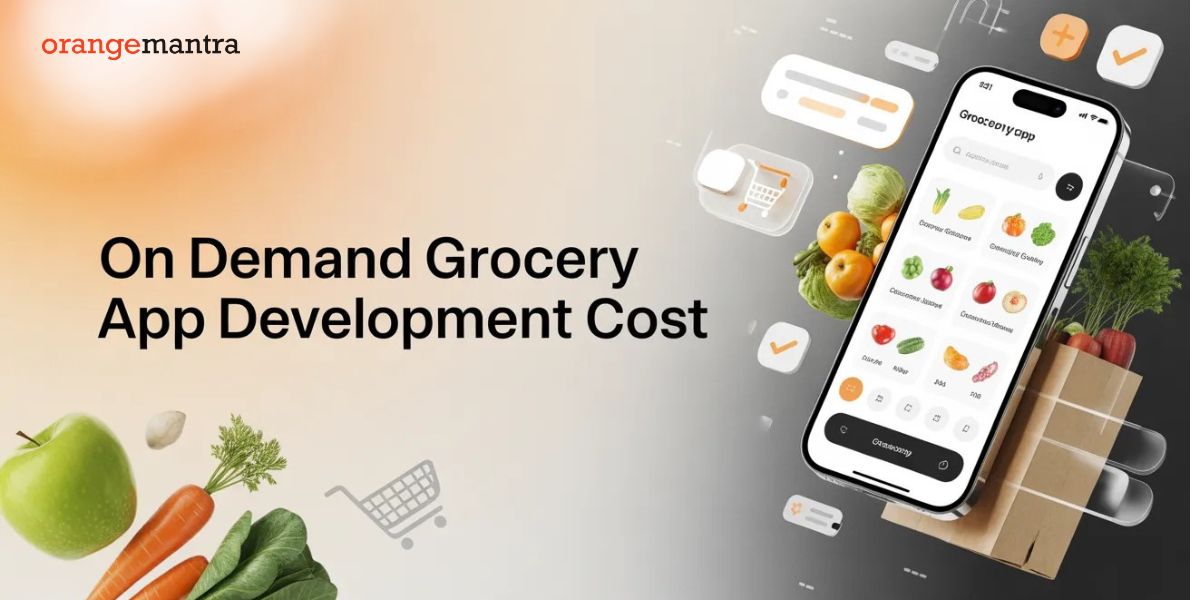
This guide explains the complete cost of on-demand grocery app development, including key pricing factors, essential features, and recommended technology stack. It helps businesses understand how to plan budgets, choose the right development approach, and build a scalable, high-performance grocery delivery app for long-term growth and better user experience.
-
 Key factors influencing grocery app development cost and overall project budgeting decisions
-
Essential features and modern tech stack required for scalable grocery delivery applications
-
Smart strategies to reduce development cost while ensuring performance, scalability, and user experience

The pandemic had a lasting impact on consumer buying behavior.
One of the most notable changes is the rise in adoption of online shopping, the rise in same-day shipping, support of digital payments, and quick on-demand delivery services.
That’s why every company around the world is currently working on or already has an on-demand grocery app development in the market.
Here are some quick facts about the state of same-day delivery and the rise in on-demand grocery app development services.
- Target, which is a US-based corporation, recorded increased revenue in the previous year, thanks to increased sales thanks to its same-day delivery services.
- According to Mordor Intelligence, the US same-day delivery market is expected to rise from 9.86 billion to 13.69 billion by 2031.
- Amazon announced expanding its same day grocery delivery in 2300 cities.
- Instacart, a US-based grocery service which got into prominence during the pandemic, has become the third-largest player in the online grocery market.
- Similarly, the Indian market has recorded 2 billion-plus record revenue, 280%+ sales growth, and 600M+ combined app downloads for apps like Zepto, Swiggy Instamart, and various other players.
- UAE’s online grocery market is expected to reach 6.73 billion valuation by 2030, growing at 12.60% CAGR during this period, according to MarkNtel Advisors’s report.
Let’s explore the cost of on-demand grocery app development, the different types available, key factors that influence pricing, and other essential considerations
Table of Contents
What is On Demand Grocery App? Technically & Non-Technically Explained
A grocery app is a mobile or web application that allows users to browse, order, and receive groceries digitally, instead of visiting a physical supermarket.
Generally, there are four types of on-demand grocery apps. They are
- Supermarkets {Walmart, Kroger, Target}
- Dark stores (delivery-only warehouses) {Gopuff}
- Local kirana / neighbourhood stores {Shopify local delivery, ChowNow}
- Marketplace of multiple sellers {BigBasket, Instacart}
- Quick Commerce {Swiggy, Zepto, DoorDash, UberEats}
How a Grocery App Operates from A User Perspective?
According to the experts at our on-demand grocery app development company, the workings of on-demand grocery apps are straightforward.
Your users install the app, browse the products, add them to the cart, and then finally check it out.
As soon as the order is placed, the nearest store/warehouse starts packing the order while the driver gets assigned.
Simultaneously, store location, order placement, packing, and pick-up status are shown to the user on the mobile app.
Once delivered, the user gets the opportunity to rate the experience or reach out to support if they receive an incorrect, spoiled, or expired item.
How On Demand Grocery App Work from Technical Perspective?
We reached out to our mobile app development services team to find out how a grocery app works, and how it impacts the grocery app development cost.
So, our cross-development app development services team broke down on demand grocery app into 7 separate dedicated apps.
iOS& Android Customer App
There are two approaches to building your mobile app; you can either go with a native or cross-platform mobile app.
You can choose a multi-platform language like Flutter to share a common codebase, which reduces maintenance efforts. Or, go with a native development approach, which increases development time, maintenance, and long-term cost.
The usual
- Sign up / login
- Browse restaurants or grocery items
- Add to cart
- Payment integration
- Order tracking (live location)
- Push notifications
- Ratings & reviews
Web Ordering Platform
Some brands also prefer having a web ordering platform or PWA with features parity with the mobile app. This includes building advanced search filters, checkout, coupons, AR capabilities, and other capabilities.
- Responsive UI
- Web-based checkout
- Payment gateway integration
- SEO optimization
- Admin-manageable content
Backend System
Backend is what powers your Android, iOS, PWA, or web platform. A generic backend won’t cut for m-commerce app development, as it is the brain for your mobile app.
It handles:
- User accounts
- Order processing
- Payment validation
- Restaurant/store onboarding
- Inventory updates
- Driver allocation
- Notifications
- Database management
- Fraud detection
- APIs connecting all apps
Your backend development is done correctly and scalable if required, while maintaining security.
Admin / Operator Console
Besides customer facing grocery app development cost, you also need to account for admin/operator/dashboard development.
This is used by:
- Platform admins
- Support teams
- Operations managers
- Sometimes restaurants
It allows:
- Approving restaurants
- Managing users
- Handling refunds
- Viewing analytics
- Managing commissions
- Monitoring live orders
- Blocking fraud users
From the technical standpoint, this is the 5th separate on-demand grocery app development project.
Delivery Partner App
To manage your riders and delivery partners, you need a distinct and different partner-focused UI, UX, and backend logic.
It helps you manage:
- Order pickup
- Navigation
- Delivery confirmation
- Earnings tracking
- Optimized route suggestions
- Go Online / Go Offline
Vendor/WarehouseApp
You also need a warehouse, marketplace, or your store-facing frontend that allows you to update inventory, offers, or manage orders.
Typical Features:
- Change offers & discounts
- Start/stop flash sales
- Manage inventories
- Live Inventory status
So, What is the Final Grocery Delivery App Development Cost?
As we have discussed before, the grocery app is a combination of 6 to 7 different mobile apps. They include a front-facing UI for users, store/warehouse managers, delivery partners, third-party brand partners, and other stockholders.
Complexity and on-demand grocery app development cost are further increased by dedicated backend logic development, user permission management, analytics dashboard, AR features, AI/ML recommendation engine, and other bespoke solutions.
| Tier | Best For | Core Features | Cost | Relative Investment |
| Tier 1: Lean MVP (City-Level Launch) | Single supermarket / 1 city / 1–15 stores | Login, browse, cart, checkout, basic payment, manual store assignment, simple order status (Packing / Out for Delivery / Delivered), basic notifications | $30,000–$70,000 | 1-3 Months |
| Tier 2: Growth-Ready App (Intermediate) | Growing supermarket chains / Multi-store in one city | Live map tracking, delivery partner allocation, coupon engine, loyalty points, push notifications, basic analytics dashboard | $40,000- $1,00,000 | 2-4 Months |
| Tier 3: Advanced Commerce Platform | Regional grocery brands / Marketplace model | Recommendation engine, advanced search & filters, voice search, third-party vendor onboarding, dynamic pricing, inventory sync, multi-language | $1,50,000-$2,00,000 | 4-9 Months |
| Tier 4: Enterprise-Grade Grocery Ecosystem | Large chains / Multi-city / National operations | ML-based personalization, predictive inventory, warehouse routing logic, multi-warehouse allocation, automated refunds, advanced fraud detection | $2,00,000-$3,50,000 | 9-12 Months |
| Tier 5: Custom Enterprise+ (Strategic Platform Build) | National retail groups / Dark store networks / Aggregator model | Custom business logic, ERP/POS integrations, AI demand forecasting, AR product previews, hyperlocal fulfillment engine, subscription commerce, B2B + B2C model | $3,00,000-$4,00,000 | 12-18 Months + |
Factors Affecting On-Demand Grocery App Development Cost
There are various business, technical, and features that affect the final grocery app development cost. Let’s break down and discuss each factor one by one.
A. Frontend Development
Your frontend is what the customer, internal team, third-party partner, delivery partners, and other users/stakeholders see. Each needs a specific feature to ensure a good experience for all stakeholders.
Here are some common examples and features that need to be built for different users.
Customer App Frontend:
This frontend typically includes handling product browsing, cart, checkout, order tracking, push notifications, and account management.
Delivery Partner App Frontend:
Includes order acceptance, navigation integration, status updates, earnings dashboard, and background location tracking.
Store / Brand Partner / Vendor App Frontend:
Helps manages incoming orders, stock updates, pricing changes, product lisyings, and fulfillment status.
Admin / Operator Dashboard Frontend:
Analytics panels, order management, refund handling, commission management, and system monitoring.
Cost impact:
- More apps = more frontend modules to build.
- Complex animations and real-time updates increase complexity as well as on demand grocery app development cost.
Frontend Development Cost
| Package | What’s Included | Timeline | Estimated Cost |
| Basic MVP | (User App + Simple Admin) | 2–3 Months | $8,000 – $17,000+ |
| Intermediate Platform | (User + Delivery + Admin + Real-time tracking) | 3–6 Months | $15,000 – $25,000+ |
| Advanced / Multi-Vendor Platform | (Native, AI-driven, Multi-vendor) | 4–18+ Months | $30,000 – $100,000+ |
B. Backend Architecture
Grocery delivery apps rely on a backend system to manage orders, users, payments, dispatch logic, and inventory.
Firebase (BaaS):
Ideal for MVPs and single-city launches. It offers authentication, real-time database, push notifications, and hosting. However, as order logic, inventory complexity, and courier assignment grow, Firebase can become limiting. Costs increase with usage and real-time reads/writes.
Custom Backend (Node.js, Django, Laravel, Spring Boot):
Provides full control over business logic, routing, and marketplace functionality. Requires DevOps setup and higher development investment but scales better for multi-store, multi-region, and enterprise operations.
Cost impact:
- Firebase reduces the initial on-demand grocery app development cost.
- Custom backend increases development pricing but improves scalability.
- Microservices architecture significantly increases engineering effort and hosting cost.
| Package | What’s Included | Timeline | Estimated Cost |
| Simple / MVP Backend | Firebase (BaaS) or Basic Monolithic Backend, User Authentication, Basic Order Management, Simple Inventory Control (Single Store), Basic Payment Integration, Push Notifications, Manual Dispatch Logic | 1–3 Months | $2,000 – $30,000 |
| Moderate Backend (Standard) | Custom Backend (Node.js / Django / Laravel), Automated Courier Assignment, Real-Time Order Tracking, Inventory Sync, Coupon Engine, Basic Analytics, Role-Based Admin Controls, Cloud Hosting Setup (AWS/GCP) | 3–6 Months | $20,000 – $60,000 |
| Complex / Enterprise Backend | Scalable Custom Architecture or Microservices, Multi-Store & Multi-Warehouse Inventory Management, Advanced Dispatch & Routing Engine, AI-Based Recommendations, Split Payments & Wallet System, Fraud Detection, ERP/POS Integrations, Auto-Scaling Cloud Infrastructure, Multi-Region Deployment | 6–12+ Months | $50,000 – $100,000+ |
c. Real-Time Communication & Tracking
Live status tracking often increases the on-demand grocery app development Price, but it also results in a better user experience. There are plenty of ways mobile app developers can implement the live activity tracking feature.
WebSockets / Socket.io:
Enable real-time order status, live courier tracking, and chat. Requires persistent connections and more server resources.
Firebase Real-Time Database:
Simpler real-time sync, but higher data read/write costs at scale.
Polling (Basic Model):
Cheaper option where the app refreshes order status periodically instead of live streaming updates.
Cost impact:
- Status-based updates = lower cost
- Live GPS tracking = higher infra + API costs
- Predictive routing = advanced backend + algorithm development
| Complexity Level | What’s Included | Estimated Cost Range |
| Low-Level Activity Tracking | Basic order status updates (Packing / Out for Delivery / Delivered), Periodic status refresh (Polling), Simple push notifications | $5,000 – $15,000 |
| Medium Activity Tracking | Live GPS courier tracking, Real-time order status, In-app chat, Map-based delivery visualization, ETA calculation | $40,000 – $95,000 |
| High / Advanced Activity Tracking | Predictive routing, Batch delivery optimization, Real-time dispatch engine, Smart ETA recalculation, Delivery heat maps, Advanced analytics dashboards | $90,000 – $200,000+ |
| Enterprise / Smart Logistics Tracking | AI-based route optimization, Dynamic courier reallocation, Multi-warehouse tracking, IoT / wearable device integration (smartwatches for delivery updates), Driver behavior tracking, Geo-fencing alerts, SLA performance monitoring | $150,000 – $300,000+ |
D. Inventory Management System
Avoid stockout, over hoarding, or other inventory-related problems with adavnced inventory management system. However, depending on your requirements and scope, it can also be one of the biggest grocery app development cost drivers.
Basic Inventory:
Manual updates, daily sync, single-store management.
Real-Time Inventory:
Auto-deduction when added to cart, stock locking, warehouse sync.
Advanced Multi-Warehouse System:
Dynamic stock allocation, intelligent fulfillment routing, predictive restocking.
Cost impact:
- Manual stock = low cost
- Real-time deduction = medium complexity
- Multi-warehouse sync = high engineering + infrastructure cost
| Complexity Level | What’s Included | Estimated Cost |
| Basic Inventory (MVP) | Manual stock updates, Daily inventory sync, Single-store management, Basic barcode scanning, Simple admin dashboard | $15,000 – $50,000 |
| Medium Complexity (Real-Time Inventory) | Auto stock deduction when added to cart, Stock locking during checkout, Real-time inventory updates, Multi-store sync (single region), Low-stock alerts | $50,000 – $100,000 |
| High-End / Enterprise Inventory | Multi-warehouse inventory management, Dynamic stock allocation, Intelligent fulfillment routing, ERP/POS integration, Batch management, Advanced reporting dashboards | $100,000 – $400,000+ |
| Enterprise+ / Predictive Inventory System | Predictive restocking (AI-based demand forecasting), Automated supplier integration, Smart warehouse allocation, Real-time analytics, Geo-based stock distribution, Inventory heatmaps | $250,000 – $500,000+ |
E. Payment Processing & Fraud Management System
Payments are not just gateway integration. As your grocery platform grows from MVP to marketplace to enterprise, payment handling evolves into a full financial infrastructure. Depending on business complexity, this can become one of the most critical on-demand grocery app development cost drivers.
Basic Payment Integration:
Single gateway integration, standard transaction processing, and basic refund handling.
Marketplace Payment Model:
Split payments (platform commission), vendor payouts, courier payouts, automated settlements.
Advanced Fintech System:
Wallet system, tipping with tax accounting, multi-ledger reconciliation, automated refunds, subscription billing.
Fraud & Risk Monitoring:
Fake order detection, refund abuse monitoring, payment fraud detection, behavioral tracking, anomaly detection.
Cost Impact:
- Basic gateway = low development on demand gorcery app development cost + transaction fees
- Split payouts = requires ledger system & settlement engine
- Wallet + tax-compliant tipping = advanced accounting logic
- Fraud detection engine = high development + monitoring cost
| Complexity Level | What’s Included | Estimated Cost |
| Basic Payments (MVP) | Single payment gateway (Stripe / Razorpay / PayPal), Basic transaction logging, Manual refunds, Basic reporting dashboard | $2,000 – $20,000 |
| Marketplace Payments (Split Payout Model) | Commission calculation engine, Vendor payouts, Courier payouts, Automated refunds, Settlement tracking, Financial reporting | $20,000 – $65,000 |
| Advanced Fintech System | In-app wallet, Cashback logic, Tipping with tax compliance, Multi-ledger reconciliation, Subscription billing, Escrow-style payments | $65,000 – $150,000+ |
| Enterprise+ Payment & Fraud Engine | AI-based fraud detection, Risk scoring engine, Refund abuse detection, Behavioral monitoring, Real-time anomaly detection, Compliance & audit trails | $120,000 – $300,000+ |
As your grocery app scales:
- Payment gateway → becomes a settlement engine
- Settlement engine → becomes a financial ledger system
- Ledger system → becomes a compliance & fraud management infrastructure
The more vendors, couriers, transactions, and regions you add, the more sophisticated and costly the payment architecture becomes.
F. Courier Routing, Dispatch & Fulfillment Management System
Delivery efficiency and order fulfillment are the operational backbone of an on-demand grocery app. As the system scales from a small city launch to enterprise logistics, routing logic and workforce management become major cost drivers.
Basic Courier & Fulfillment Model:
Manual courier assignment or nearest-driver logic, simple order dashboard, manual picking process.
Rule-Based Dispatch System:
Automated courier allocation based on delivery zone, order size, workload, and courier rating. Basic picker assignment and role-based staff access.
Advanced Optimization Engine:
Batch delivery routing, SLA optimization, predictive courier availability modeling, internal KPI tracking, shift scheduling, performance analytics.
Requires Integration With:
- Google Maps
- Mapbox
- Routing & Distance APIs
- Real-time location services
Cost Impact:
- Nearest-driver logic = moderate backend complexity
- Rule-based dispatch = increased automation logic
- Route optimization engine = high engineering + infrastructure cost
- Workforce management dashboards = additional development & reporting systems
| Complexity Level | What’s Included | Estimated Cost |
| Basic Dispatch & Fulfillment (MVP) | Nearest courier assignment, Manual dispatch override, Basic order dashboard, Manual picking workflow | $15,000 – $40,000 |
| Rule-Based Dispatch + Staff Management | Automated courier allocation (zone/workload-based), Basic route mapping, Picker assignment system, Role-based access control, Shift tracking | $40,000 – $90,000 |
| Advanced Routing & Optimization Engine | Batch delivery logic, SLA optimization, Smart ETA recalculation, Performance dashboards, Internal KPI tracking, Shift & workforce analytics | $90,000 – $180,000+ |
| Enterprise Logistics & Fulfillment Platform | Predictive courier allocation, AI-based route optimization, Dynamic rerouting, Multi-warehouse dispatch coordination, Geo-fencing, Real-time performance analytics | $150,000 – $300,000+ |
Dispatch starts simple:
- Nearest courier → becomes rule-based automation
- Rule-based → becomes optimization engine
- Optimization engine → becomes logistics intelligence system
As you add:
- Multiple stores
- Higher order volume
- Delivery SLAs
- Workforce scaling
The routing and fulfillment system transitions from basic logic to a complex logistics engine.
G. Multi-Platform Development
Customer-facing grocery apps must operate seamlessly across:
- Web
- Android
- iOS
Your platform choice significantly impacts overall on-demand grocery app development pricing. The decision between cross-platform and native development affects engineering time, testing complexity, performance optimization, and long-term scalability.
Cross-Platform Development (Flutter / React Native):
Single codebase for Android and iOS, faster deployment, reduced engineering effort.
Native Development (Swift + Kotlin):
Separate codebases for iOS and Android, better device optimization, higher performance, but increased development and maintenance cost.
Cost Impact:
- Cross-platform = reduced development time and lower upfront cost
- Native development = higher engineering effort and long-term maintenance cost
- Web + Mobile combination = additional frontend and testing layers
- Multi-Platform Development Cost
| Complexity Level | What’s Included | Estimated Cost |
| Basic Cross-Platform (MVP) | Single Flutter/React Native app for Android & iOS, Basic web admin panel, Standard UI components, Limited device optimization | $10,000 – $30,000 |
| Cross-Platform + Web Expansion | Cross-platform mobile app, Customer-facing web app, Admin dashboard, Responsive design, API integration across platforms | $25,000 – $60,000 |
| Native Dual-App Development | Separate iOS (Swift) & Android (Kotlin) apps, Custom UI/UX optimization, Device-level performance tuning, Advanced push & background services | $50,000 – $120,000+ |
| Enterprise Omni-Channel Platform | Native iOS & Android apps, Customer web platform, Delivery app, Vendor app, Progressive Web App (PWA), Performance optimization across regions | $100,000 – $250,000+ |
As your grocery platform evolves:
- Cross-platform MVP → native optimization → full omni-channel infrastructure
- The more platforms you support, the higher your frontend engineering and QA investment.
H. Hosting & Cloud Infrastructure
Infrastructure determines long-term scalability.
Basic Hosting:
Firebase hosting or shared server.
Cloud Infrastructure (AWS / GCP / Azure):
Auto-scaling, load balancers, CDN.
Enterprise Architecture:
Microservices, Kubernetes, CI/CD pipelines, multi-region deployment, disaster recovery.
Cost impact:
- Shared hosting = lowest cost
- Auto-scaling cloud = usage-based cost
- Multi-region clusters = highest infra + DevOps cost
I. UI/UX Development
The design layer directly impacts both development effort and long-term user retention. Grocery apps require intuitive navigation, fast product discovery, and frictionless checkout to reduce cart abandonment.
A well-designed UX reduces drop-offs, improves conversion rates, and increases repeat purchases, but depending on depth and customization, it can significantly affect overall on-demand grocery app development cost.
Template / Generic UI:
Pre-built layouts with limited customization. Faster to deploy and cost-effective but lacks strong brand differentiation and optimized conversion design.
Custom Branded UI:
Tailored design system aligned with brand identity. Includes user research, wireframing, prototyping, usability testing, and structured design iterations.
Premium / Advanced UX:
Includes micro-interactions, animated transitions, optimized checkout flow, accessibility compliance, conversion-driven layouts, A/B testing, and performance-focused UI refinement.
Cost Impact:
- Template UI = reduced design hours and lower cost
- Custom branding = increased design effort and iteration cycles
- Advanced UX = higher research, testing, animation, and optimization investment
| Complexity Level | What’s Included | Estimated Cost |
| Basic App (Template UI) | Pre-built UI kit, Minimal customization, Standard user flow, Basic product listing & checkout layout | $600 – $1,200 |
| Mid-Range App (Custom Branded UI) | Custom design system, Wireframes, Interactive prototypes, Branded layouts, Improved product discovery flow | $1,200 – $3,000 |
| Advanced App (Premium UX) | Micro-interactions, Animated transitions, Optimized checkout UX, Accessibility compliance, Conversion-focused layouts | $3,000 – $6,000+ |
| Premium / Enterprise UX | AI-driven UI personalization, Behavioral UX optimization, A/B testing, Multi-device optimization, Advanced usability research | $9,000+ |
UI/UX cost scales with:
- Simple layout → branded experience → conversion-optimized UX → AI-personalized interface
While UI may seem like a small portion of the budget, better UX directly impacts:
- Cart abandonment rate
- Customer retention
- Average order value
- Lifetime value
J. Developer Location & Team Structure
On-demand grocery app development cost also varies significantly based on geography of developers. While the app architecture may remain the same, labor rates, communication efficiency, regulatory compliance, and project management maturity differ across regions.
Your choice of development location directly impacts:
- Total project budget
- Timeline flexibility
- Communication flow
- Legal and IP protection
- Long-term maintenance cost
Offshore development reduces upfront cost, while hybrid or US-based teams increase overall project budget but may offer closer collaboration and enterprise compliance benefits.
Cost Impact:
- India → lower hourly cost, strong technical pool
- Eastern Europe → mid-range pricing, strong engineering quality
- Middle East → higher operational cost
- US → premium pricing, enterprise-grade delivery
- Same architecture. Different labor cost.
Developer Cost by Region
| Region | Average Hourly Rate | Basic MVP Cost | Advanced / Enterprise App Cost |
| India | $15 – $80 per hour | $10,000 – $25,000 | $70,000 – $150,000 |
| Eastern Europe | $40 – $120 per hour | $25,000 – $60,000 | $100,000 – $200,000+ |
| Middle East | $50 – $150 per hour | $35,000 – $80,000 | $120,000 – $250,000+ |
| United Kingdom | $50 – $250 per hour | $38,000 – $100,000 | $225,000 – $500,000 |
| United States | $100 – $250+ per hour | $50,000+ | $250,000+ |
Key Insight
The cost difference is primarily driven by:
- Developer salary benchmarks
- Operational overhead
- Taxation and compliance costs
- IP protection frameworks
- Market demand for engineering talent
Final Thoughts
Mobile app development, especially for an on-demand grocery platform, involves far more than just building screens. It requires coordination across frontend, backend, logistics logic, payments, inventory systems, testing, deployment, and ongoing optimization. There are simply too many moving parts for it to be treated as a small side project.
If you’re considering building your own on-demand grocery app, we generally do not recommend relying solely on freelance developers. While freelancers can be skilled, complex platforms demand structured workflows, documentation standards, security practices, and long-term maintenance planning that are difficult to manage without a coordinated team.
If you have the internal budget, technical leadership, and long-term product vision, building an in-house team gives you full ownership of your codebase, documentation, and product roadmap. This approach works well for organizations that see technology as a core strategic asset, and it reduces long-term on-demand grocery app development cost.
For businesses that prefer to focus on operations, growth, and market expansion rather than hiring and managing technical teams, partnering with an experienced agency can be a smarter route. A dedicated development partner provides structured delivery, defined milestones, accountability, and cross-functional expertise, without the overhead of internal recruitment and management.
Our On-Demand Grocery App Development Process
Discovery & Strategy
We begin by understanding your vision, target market, operational model, and growth goals. This phase defines the architecture, feature roadmap, and technical foundation required for long-term scalability.
Design. Engineer. Integrate.
We design a conversion-focused user experience, then engineer the complete application, frontend, backend, logistics systems, payment integrations, and third-party services, ensuring everything works as a unified ecosystem.
Testing & Quality Assurance
Through comprehensive QA testing, performance audits, and security validation, we ensure your app is stable, secure, and optimized for real-world usage before launch.
Launch & Deployment
We manage deployment across web, Android, and iOS platforms, ensuring a smooth release and successful rollout to your users.
Post-Launch Support & Evolution
After launch, we monitor real-time performance, analyze user behavior, fix issues proactively, and use data-driven insights to continuously improve and evolve your platform.
The Bottom Line
An on-demand grocery app is not just an app, it’s a logistics engine, a fintech system, a marketplace, and an operational management platform combined.
The right development approach depends on your budget, technical capability, and long-term strategy. Choose wisely, because the foundation you build today determines how easily you can scale tomorrow.
Frequently Asked Questions
Q.1 How much does it cost to develop a grocery delivery app?
On-demand grocery app development cost usually starts from $30,000 to $4,00,000+. There are various factors that affects the final cost, which include integration to third-party platforms, UI/UX development, hosting, bespoke features like AR, live order tracking, and so on.
Q2. How to create a grocery delivery app?
You can create a generic grocery delivery app using generic AI builders, but as you scale or expand, you will need to hire mobile app developers to scale your on-demand grocery app.
Q3. How to Create App for Grocery Store?
You can on board technical co-founder to develop app in-house, hire developers from a freelance platform, contact a professional mobile app development company like orangemantra, or use a generic AI builder.
Q4. How Much Time Does It Take for On-Demand Grocery App Development?
It can take around 1 to 18 months+ to develop your on-demand grocery app based on your frontend, backend, third-party integration, features, and other requirements.
Q5. Which Company Should I Choose for On Demand Grocery App Development?
You should check the Clutch score, Google My Business, and the portfolio of the agency you are interested in partnering with.
Q6. How Can We Keep On Demand Grocery App Development Cost Low?
First, develop a minimal viable product and focus all your resources on marketing, onboarding employees, partners, and users. As you gain traction, invest in more robust features, backend, frontend, and third-party integrations.
Q7. Which is the Best On-demand Grocery App Development Company?
orangemantra with its extensive portfolio of mobile app development, is one of the best companies to develop a grocery app. We understand the business nuances, cultural sensitivities, consumer behavior, conversion optimization strategy, localization, and use cutting edge tools to create enterprise grade app.
About the Author


Related Articles