
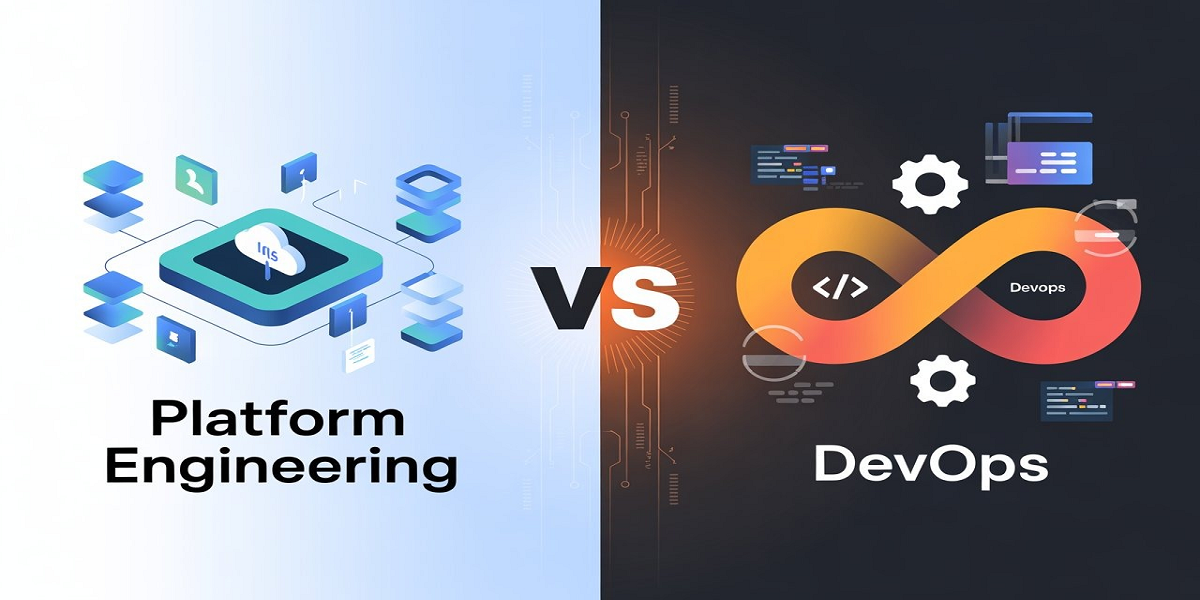
Understand the key differences between Platform Engineering and DevOps. Learn how each approach impacts team structure, delivery speed, scalability, and long term product stability.
Here's What You’ll Learn
-
 Core differences between Platform Engineering and DevOps models
-
Tools, workflows, and ownership structure in each approach
-
When to choose one over the other based on business goals
-
Real world use cases and implementation challenges

As companies scale up their software development operations, the choice between traditional DevOps practices and emerging platform engineering services becomes increasingly critical. The comparison of DevOps and Platform engineering has eventually gained importance as businesses look for optimization for their development workflows, enhanced cloud solutions deployment, and improved overall efficiency.
Both methodologies promise to streamline development processes and accelerate delivery, but they approach these goals from fundamentally different perspectives. Understanding methodologies that align with your business needs will ultimately require a deep dive into the core principles, implementation strategies, and long-term implications.
This comprehensive analysis explores how DevOps consulting services and platform engineering differ in their approaches.
Table of Contents
Understanding DevOps: Core Principles and Practices
DevOps emerged as a cultural and technical movement designed to break down silos between development and operations teams. At its core, DevOps emphasizes collaboration, automation, and continuous improvement throughout the software development lifecycle.
Key DevOps Components
Continuous Integration/Continuous Deployment (CI/CD): Minimal processes of deploying code quickly and reliably by automating DevOps-based tools and practices. Teams are also able to make changes to their code more than once within a day, knowing that the process of automated tests and automated deployment will uncover any problems earlier.
Infrastructure as Code (IaC): Operating and provisioning infrastructure in code and not in a manual way provides consistency between cloud solutions. Such tools as Terraform and Ansible enable teams to version infrastructure; hence, it becomes reproducible and auditable.
Monitoring and Observability: Full-fledged devops monitoring systems give real-time data on application performance, infrastructure performance, and user experience. Contemporary observability solutions extend beyond the metrics to offer distributed tracing, logging aggregation, and analytics.
Collaboration Culture: The Dev managerial approach promotes shared responsibility and removes organizational boundaries between teams. The hardest part of devops implementation is a cultural change that may need executive sponsorship and a long-term commitment.
Effective deployment of DevOps cannot be achieved without a change of culture within an organization, as well as the use of technical tools.
What is Platform Engineering? The Next Evolution
Platform engineering is a development of the ideas of DevOps, which specifically aims at establishing self-service Internal Developer Platforms (IDPs) to provide abstraction over the complexity of infrastructure.
Instead of requiring all developers to figure out the complexity of cloud solutions, DevOps automation, and deployment pipelines, platform engineering establishes golden paths that developers may use.
Core Platform Engineering Principles
Experience First: Platform engineering establishes a low cognitive load platform by offering self-service applications as well as standard workflows. This results in increased productivity and job satisfaction because developers do not have to struggle with infrastructure configurations and instead can concentrate on business logic.
Golden Paths: Pre-cooked, best-practice paths to typical development tasks enable one to just do the right thing. These paths include security standards, compliance, and operational best practices by default, alleviating the individual developer’s load.
Platform as a Product: By moving internal platforms into their own products with teams, roadmaps, and user feedback loops, improvements will keep on improving. Platform teams are actively involved in interacting with the developer users, including obtaining feedback and iterating on features, as external product teams do.
Standardization at Scale: Platform engineering allows similar practices on several projects and teams. This standardization eliminates operational overhead and eases the burden of devops monitoring across services and ensures that it is easier to maintain security and compliance standards.
The type of organizations that consume the services of platform engineering usually have well-established DevOps practices already in place and are interested in scaling their operations in a more efficient way, as well as decreasing the load on individual development teams. The shift of DevOps to platform engineering is more evolutionary than revolutionary.
Platform Engineering vs DevOps: An In-Depth Comparative Analysis
Although both methods are intended to enhance software delivery and operational excellence, the platform engineering vs DevOps comparison shows that there is a vast difference in terms of scope, implementation, and impact on the organization. These differences are important to the businesses that consider either devops consulting services or platform engineering services.
Scope and Focus
DevOps focuses on cultural change and the cooperation of the development team and operations teams. It is essentially silo-busting, building cross-functional responsibility, and establishing feedback loops at every phase of the software lifecycle. The emphasis is on practices, attitude, and organizational change to the same extent that technical implementation is of concern.
Platform Engineering is concerned with the construction of self-service infrastructure platforms upon which developer autonomy is provided. It is mainly focused on minimizing cognitive load, workflow standardization, and building excellent experiences as developers using custom-built internal platforms.
Team Structure and Responsibilities
DevOps Teams: Multidisciplinary teams in which developers and operations engineers collaborate, with all of them being responsible for the whole lifecycle of an application. The members of the team normally require general knowledge that consists of development, infrastructure, and operations.
Platform Engineering Teams: Specialized platform engineering teams, which construct and support internal developer platforms, as consumers of product development teams. Platform engineers are concerned specifically with the development and provision of tools and services that are used by other engineers, for whom they consider the platform as a product.
Tool Selection and Standardization
DevOps Approach: Teams usually have the freedom to select the tools that best suit their requirements, which results in organic tool adoption and possible sprawl. Although this freedom facilitates innovation, it may introduce difficulties in integrating among the teams and knowledge silos where teams make different technical decisions.
Platform Engineering Approach: Stores a well-defined system of tools and processes that is both flexible and consistent. When teams still need to go off-course, the platform still offers reasonable defaults that are applicable in 80-90 percent of the situations.
Scalability Considerations
DevOps is scaled by means of replication, the addition of more cross-functional teams. This may, however, result in duplication of effort as individual teams end up solving the same problems without consulting one another. Sharing of knowledge is very crucial but difficult as the organization continues to expand.
Platform Engineering is a scaling process based on abstraction, whereby the teams that consume platforms construct reusable platforms. The cost of initial entry is greater, but the strategy is more economically scaled, as the addition of new teams does not need a reconstruction of the base competencies.
Developer Cognitive Load
DevOps shares the responsibility widely, so developers have to know about infrastructure, deployment, monitoring, and operations. Although this is a skill-acquiring experience, it may have the negative effect of overwhelming developers and slackening the pace of feature development because they context-switch between application code and infrastructure issues.
Platform Engineering minimizes cognitive load based on abstraction and self-service. Developers deal with simplified interfaces, the platform team deals with underlying complexity, and they can deal mainly with business logic and application features.
Also Read – DevOps Vs DevSecOps: What’s Best for Your Team in 2025?
When to Choose DevOps: Use Cases and Scenarios
This is because knowledge of timing when to implement the devops approach prevents organizations from over-engineering their development processes. DevOps is effective in a number of situations:
Startups and Small Teams: DevOps is flexible and requires less initial investment by organizations that have fewer resources. At this scale, it is not economically viable to build up a complete platform team. The cost of platform infrastructure and overhead can be avoided by hiring the services of devops consulting to help speed up time-to-market engagement.
Digital Transformation Initiatives: DevOps practices are required in companies starting their cloud migration process to provide the base cloud solutions capabilities. You must have functional CI/CD pipelines, infrastructure as code, and devops monitoring first before thinking of platform engineering.
Quickly Hacking and Testing Ideas: DevOps solutions can be used in organizations that are experimenting with new technology or business systems. The fact that innovation can be quickly embraced through adopting new tools and strategies without restrictions in the platforms allows quicker innovation cycles.
Budget Constraints: DevOps costs less to start up than platform teams and infrastructure. Devops automation tools and practices can be gradually picked up as the budget and organizational maturity permit.
Simple or Homogeneous Architectures: Organizations that have a relatively simple tech stack (or few distinct services) do not require the abstraction layers in platform engineering. The costs of operating a platform are greater than the advantages in the case where a small number of similar applications are supported.
When Platform Engineering Makes Sense
Platform engineering services are needed when companies achieve some inflection point in their growth and complexity:
Scale and Complexity (100+ Developers): Multiple product teams in an organization have issues of tool sprawl, inconsistency, and duplication of efforts. Platform engineering makes workflows more standardized and less redundant, as it makes scaling more efficient.
Large Cognitive load on Developers: A developer can be unproductive when they spend a lot of time managing infrastructure than developing features. Devops automation creates a self-service platform that enables a significant improvement in developer experience and speed.
Several Product Teams sharing the same needs: When the majority of the teams need the same infrastructure (databases, caching, messaging, observability), a platform solution would remove redundant efforts. The development of solutions by each of the teams is wasteful and inconsistent.
Compliance and Governance Requirements: Platform engineering has the benefit of enforcing security policies, compliance standards, and best practices via golden paths and centralized devops monitoring on regulated industries. Standardized platforms make auditing and compliance much more convenient.
Mature DevOps Practices: Platform engineering is most effective when it is established on already existing bases of DevOps. Platform engineering should not be invested in without organizations having operational CI/CD pipelines, infrastructure as code practices, and monitoring systems.
Developer Experience Issues: A high turnover rate, slow onboarding, and occurrences of frequent production due to misconfigurations in infrastructure are indicative of the fact that developer experience could use some enhancement. Platform engineering specifically deals with these pain points.
Implementation Strategy: A Practical Roadmap
Whether it is the process of devops implementation or platform engineering capability, to achieve a successful process, a structured approach that strikes a balance between quick wins and long-term transformation is needed.
Roadmap of DevOps Implementation
Phase 1 – Foundation (Months 1-3): Implement underlying CI/CD pipelines of major applications, adopt best practices of version control, and start to adopt infrastructure as code. Automate the most painful manual processes first to get value delivered in very little time. Devops consulting activity is performed by many organizations at the critical base stage.
Phase 2 – Automation and Integration (Months 4-6): Enact the extensive devops automation of testing, deployment, and provisioning infrastructure of cloud solutions. Increase the CI/CD applications and create security scanning in pipelines.
Phase 3 – Observability and Optimization (Months 7-9): Implement strong devops monitoring systems that can log, give metrics, and have distributed tracing. Position on-call rotations and incident response. Prioritize the reliability of pipelines and their frequency of deployment.
Phase 4 – Culture and Continuous Improvement (Months 10-12): Build a collaborative culture by using shared metrics, blameless post-mortems, and cross-functional projects. Create closed feedback mechanisms and constantly streamline operations using team feedback and operational statistics.
Platform Engineering Evolution
Phase 1 – Assessment and Planning (Months 1-2): The developers of the survey should carry out interviews and surveys. Ultimate audit of existing tooling and determine pain points. Identify platform requirements and measures of success. Get executive backing and budget authorization.
Phase 2 – MVP Platform Development (Months 3-6): Develop a skeleton Internal Developer Portal with golden paths of typical activities such as service development, database instantiation, and deployment. Collaborate with the service providers of platform engineering to speed up development when necessary.
Phase 3 – Pilot andIteration (Months 7-9): You need to get close feedback with embedded platform engineers. Prototype on features and usability. Record achievements and difficulties.
Phase 4 – Scale and Enhancement (Months 10-18): Massive platform uptake within the organization by incorporating training and migration support. Incorporate superior functions on a feedback basis. Create a platform-as-a-product mentality, roadmap, and periodic releases.
Cost Analysis: Investment and ROI Considerations
Financial implications of each approach assist the organizations in making informed decisions in accordance with the business goals and limitations.
DevOps Investment Profile
Initial Investment: $50,000-200,000 in tooling licenses, initial training programs, and possible devops consulting to determine the best practices and pitfalls to avoid.
Continuous Expenses: Tool licensing is the usual cost of about 10,000-50,000 per year, based on the size of the team. The cost of cloud solutions also depends a lot depending on their usage. Further training and constant improvement programs can help to increase the initial cost by another 20,000-40,000 a year.
Team Costs: Does not need a special DevOps team in the beginning; can be acquired by the rest of the staff and provided with extra training. As the organization grows in size, including 1-2 full-time DevOps engineers will incur an addition of $150,000-300,000 per year in salary and benefits.
ROI Timeline: Organizations normally attain positive ROI in 12-18 months. It has such benefits as 30-50% quicker deployment times, 40% decrease in production incidents, and 20-30% higher productivity of developers.
Platform Engineering Investment Profile
Initial Investment: 250,000-1,000,000 to develop the platform, hire staff, license technology, and consider partnerships with platform engineering services. This increased initial expense includes the large amount of engineering work.
Recurring Expenses: Dedicated platform team salaries are the highest expenditure of up to $500,000-2,000,000 every year to have a group of 4-10 engineers based on their experience level and place of residence. There is an additional charge of infrastructure expenses, tooling, and ongoing platform improvement of about $100,000 to $300,000 per year.
Undisclosed Costs: Migration of existing services to use the platform may require a lot of time for developers. The success of adoption is guaranteed by change management and training programs.
ROI Timeline: Platform engineering would generally take 18-24 months to lead to positive ROI, whereas DevOps would take a shorter time because of lower upfront cost. The gains of scale pay off, however, 60-80 times less developer time on infrastructure, 70 times faster time to onboard a new engineer, and 50 times higher deployment frequency.
Typical Problems and Problem Solutions
The two strategies are susceptible to foreseeable problems that will hurt implementations unless handled appropriately.
DevOps Challenges
Cultural Resistance: Pre-existing organizational frameworks and mentality do not welcome the collaboration and communal friendship that DevOps demands.
Solution: Get executive sponsorship early on, achieve visible wins, make gradual change as opposed to big-bang changes, and spend heavily on change management.
Tool Sprawl and Integration: Various teams use varying tools, which leads to a disjointed landscape that is hard to maintain and integrate. Resolution: Have architectural principles and governance, and reasonable team autonomy. Establish communities of practice to share knowledge and standardize on critical integrations.
Security Integration Lag: DevSecOps activities tend to be slower than deployment velocity, and this causes security vulnerabilities.
Solution: Move security left by automating security scanning into CI/CD pipelines. Transform security teams into collaborators in the DevOps transformation and not gatekeepers.
Skill Gaps: Team members might also be short of required automation, cloud solutions, or infrastructure management skills. Resolution: Invest in extensive training, assign seasoned practitioners to the trainees, and also give a thought to engaging devops consulting services to impart knowledge.
Platform Engineering Challenges
Resistance to Platform Adoption: Developers can be reluctant to adopt the platform, and they will want to stick to their current tools and processes.
Solution: Engage developers during the early design of platforms, ensure golden paths are actually superior to alternatives (e.g. faster, easier, more reliable), and constantly collect and respond to user feedback.
Striking the right balance between Flexibility and Standardization: Standardization is death to innovation; a platform that is too flexible is pointless.
Solution: Have escalated cases clearly documented as escapes, and golden paths as simple to follow in normal cases. Permit deviation in teams when well-founded, but promote ways of doing things.
Ongoing Investment and Time: Platform engineering is a long-term endeavor that can cause short-term rewards.
Solution: Turn the platform into a product of its own that has specific funding, a roadmap, and executive sponsorship. Report the victories frequently and track the metrics of adoption to show the improvement.
Maintaining the Platform Up-to-Date: Platforms may become obsolete due to technological changes, which are a source of technical debt.
Solution: 20-30% of the platform team capacity should be available for modernization and paying down technical debt. Create depreciation policies and migration routes for old capabilities.
Key Takeaways
DevOps or platform engineering is not binary; it is evolutionary. The Platform Engineering vs DevOps debate misses a crucial point: most successful organizations begin with solid DevOps implementation practices, establishing CI/CD pipelines, devops automation, and comprehensive devops monitoring before evolving toward platform engineering as they scale.
The best value is obtained by investing in devops consulting services to help define best practices. Pay attention to the development of powerful DevOps backgrounds: effective automation, efficient monitoring, and team spirit. These functionalities will be beneficial even in terms of future architectural choices.
Individual developers have a bottleneck on the cognitive load as the teams grow, and the complexity increases. It is at this point that the shift to platform engineering services is not only effectively helpful but also essential to continue moving speedily and keeping developers satisfied.
These two strategies demand experience, long-term investment, and cultural change. Regardless of whether you are putting up your first CI/CD pipeline or creating an Internal Developer Platform that is extensive in scope, the key to success is familiarity with the level of maturity your organization is at, its growth rate, and where it is experiencing pain.
DevOps offers the cultural underpinnings and practices; platform engineering scales the practices with self-service and intelligent abstraction that keep pace with the growth of the organization.