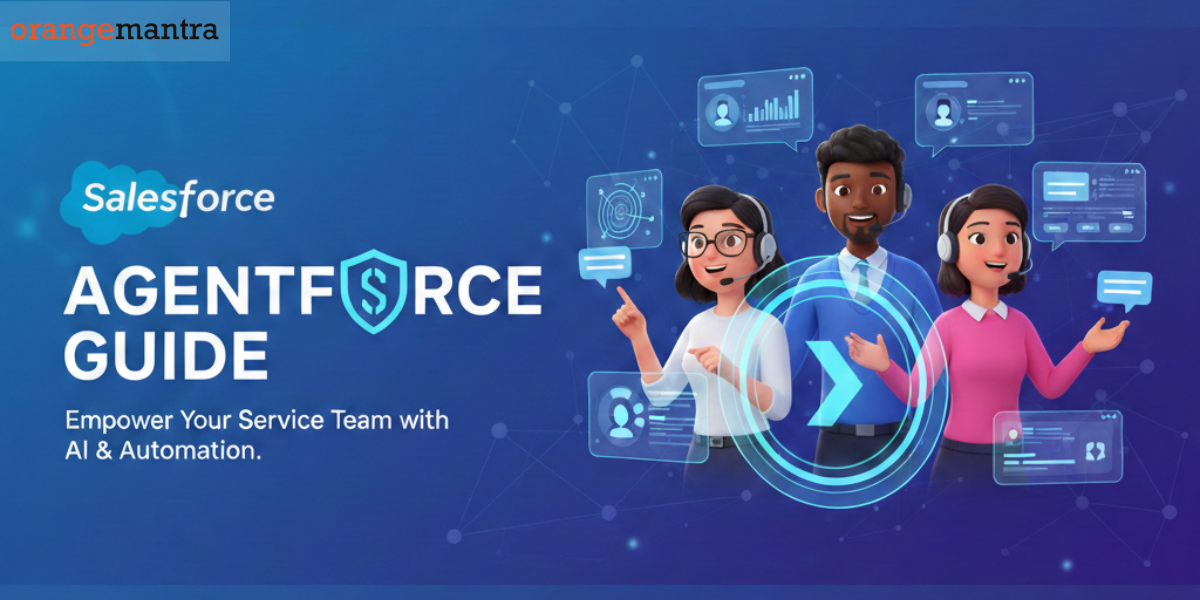
A practical Salesforce Agentforce guide for 2026 that explains what enterprises must fix before deploying AI agents covering data, processes, governance, Service Cloud, pricing, and ROI risks.
Here’s what you will learn:
-
 What Salesforce Agentforce actually is (and why it’s not a chatbot)
-
Why most AI pilots fail without readiness

As most leaders already know, AI is no longer the differentiator. Execution is where real advantages are created.
Most enterprises today already have access to AI either through Salesforce, third-party tools, or internal initiatives. Yet very few see consistent business impacts. The reason is simple: AI adoption has outpaced AI readiness.
Salesforce Agentforce marks a shift from AI that assists to AI that acts. But autonomous AI agents don’t succeed by default. They require strong foundations across data, processes, governance, and intent.
This Salesforce Agentforce readiness guide 2026 breaks down what enterprises must prepare before deploying AI agents and why skipping these steps leads to stalled pilots, compliance risks, and poor ROI.
Table of Contents
Salesforce Agentforce Explained: Why It’s Not Just Another AI Tool
Before readiness, clarity matters.
It’s important to get a clear picture of what Agentforce really is. A lot of teams assume it’s “just another AI feature” in Salesforce development services that is like a chatbot or a recommendation engine, but that couldn’t be further from the truth.
Agentforce is built to take action, not just provide suggestions. It can reason through business scenarios, follow complex rules, and execute tasks directly inside Salesforce workflows. This means it’s not just about generating answers; it’s about making real business decisions safely and reliably.
As you start planning for Agentforce, understanding this distinction is key. Readiness isn’t just about enabling AI, it’s about preparing your data, workflows, and governance so that your agents can actually perform in the real world. Without that clarity, even the most advanced AI can fail to deliver impact.
Understand What Salesforce Agentforce is in Detail
Salesforce Agentforce is an AI agent platform that enables organizations to build autonomous AI agents capable of reasoning, making decisions, and executing actions directly within Salesforce.
Unlike traditional AI tools that wait for prompts, Agentforce agents:
- Operate continuously
- Understand business context thoroughly
- Take multi-step actions
- Work across Salesforce clouds using trusted enterprise data
This makes Agentforce fundamentally different from chatbots or copilots. It is designed to function as AI-powered digital workers, especially within the Salesforce Service Cloud.
Agentforce is Changing the AI Game
When you start planning for Agentforce, it helps to understand why it’s not just another AI tool. Generic AI can generate answers, but Agentforce is built to act directly inside Salesforce workflows.
Data That Knows Your Business:
What makes this possible is the way it works with your Salesforce data. Agentforce doesn’t rely on public datasets, they learn from your own Data cloud. That means every recommendation, every action, respects your company’s rules, workflows, and compliance requirements.
Controlled Access for Trusted Outputs:
Agents know what they can and can’t do, and they only interact with data they’re allowed to access. That’s why enterprises can trust the outputs instead of double-checking everything manually.
Governance Built In:
Governance is built in, so you never have to worry about “black box” decisions. Every action is tracked, every workflow can be reviewed, and you can decide when a human should step in. That level of accountability makes it possible to deploy AI at scale without taking risks that could compromise operations or compliance.
Integration with Service Cloud:
Integration with Salesforce Service Cloud makes it even more seamless. Agents can resolve support cases on their own, suggest the right knowledge of articles, and route tickets intelligently based on priority, workload, or context. Because it’s part of the platform, everything happens in real-time, without complicated workarounds or extra systems.
Highly Scalable:
Finally, Agentforce can scale. It doesn’t stop at one workflow or department. You can run agents across customer service, sales, and internal support channels all at once, maintaining consistent performance even as usage grows. The architecture is built to handle large volumes and multiple channels simultaneously, so as your enterprise expands, your AI keeps pace.
Salesforce Service Cloud Features
- Salesforce Service Cloud brings all customer service operations into a single, unified platform. Key features include intelligent case management, where issues are automatically captured, prioritized, and tracked from start to resolution.
- Omni-channel routing ensures each case is sent to the most suitable available agent, reducing wait times and improving resolution quality
- Knowledge management plays a major role in centralizing articles for both customers and agents, helping teams resolve issues faster while enabling self-service. On the AI side, Einstein Bots and Einstein for Service assist with handling routine queries, suggesting next-best actions, generating responses, and summarizing cases, lightening the load on human agents.
- Service Cloud also supports automation through Flows and process rules, removing repetitive manual work. For more complex scenarios, features like Field Service tools, mobile support, and Visual Remote Assistance enable teams to manage on-site operations and remote troubleshooting efficiently
- Finally, built-in analytics and Slack integration help teams collaborate better and monitor performance in real time, turning customer support into a measurable, continuously improving operation.
The Role of Salesforce Service Cloud in Agentforce Adoption
Most enterprises begin their Agentforce journey in Salesforce Service Cloud, and for good reason.
Salesforce Service Cloud already houses:
- Customer cases
- Knowledge bases
- SLAs and escalation rules
- Agent workflows
- Omnichannel support data
When Agentforce is layered onto existing Salesforce service cloud features, AI agents can:
- Resolve routine cases autonomously
- Route complex issues intelligently
- Recommend knowledge articles contextually
- Maintain compliance through predefined rules
Service Cloud provides the structured environment Agentforce needs to operate safely at scale.
Why Generic AI Fails and Why Agentforce Requires Readiness
Most foundation AI models are trained on the public internet. Enterprise systems are not.
This gap creates predictable failure patterns:
Confident but Incorrect Answers
Generic AI often produces fluent responses that sound right but lack business accuracy. In enterprise environments, this leads to misinformation, customer dissatisfaction, and operational risk.
Poor Handling of Edge Cases
Enterprise workflows are filled with exceptions: priority customers, regulatory constraints, and legacy contracts. Generic AI lacks the context to handle these reliably.
Zero Understanding of Compliance Rules
Regulatory frameworks, internal policies, and audit requirements are invisible to generic models unless explicitly embedded.
Outputs That Look Good but Can’t Be Trusted
When AI responses can’t be audited, traced, or explained, enterprises cannot deploy them in production systems.
Agentforce addresses these gaps, but only if the organization is ready.
Step 1: Data Readiness (The Foundation of Agentforce)
Agentforce relies on trusted, unified data, primarily through Salesforce Data Cloud.
Data readiness means more than data availability.
What Data Readiness Actually Involves
- Consistency: Customer records, case histories, and knowledge articles must follow standardized formats.
- Relevance: AI agents need the right data, not all data.
- Freshness: Outdated records degrade decision quality.
- Access controls: Agents must only see what they are allowed to see.
Without data readiness, Agentforce agents either hesitate or act incorrectly.
Step 2: Domain Clarity (Precision Beats Scale)
This is where most AI initiatives fail.
“Customer service AI” is not a domain.
“Sales AI” is not a domain.
Clear domains look like:
- Case deflection for Tier-1 support in telecom
- Order status automation for eCommerce customers
- Internal IT ticket triage for enterprise employees
Why Domain Clarity Matters
Clear domains define:
- What data matters (and what doesn’t)
- What mistakes are unacceptable (compliance, SLAs, financial impact)
- How success is measured (resolution time, deflection rate, CSAT)
Agentforce performs best when deployed as narrow, purpose-built intelligence, not generalized AI.
Step 3: Process Maturity (AI Can’t Fix Broken Workflows)
Agentforce agents execute workflows, but they don’t invent them.
If your processes are:
- Undocumented
- Inconsistent across teams
- Heavily dependent on tribal knowledge
AI agents will replicate chaos, not efficiency.
Process Readiness Means:
- Clearly defined decision paths
- Documented escalation rules
- Explicit exception handling
- Ownership clarity
AI amplifies systems. It does not repair them.
Step 4: Governance, Trust, and Control
Enterprise AI adoption fails without trust.
Salesforce addresses this through:
- The Einstein Trust Layer
- Built-in audit trails
- Role-based permissions
- Explainable AI actions
But governance is not automatic.
What Enterprises Must Define
- When AI can act autonomously
- When human approval is required
- How errors are logged and corrected
- Who is accountable for AI decisions
Without governance, AI remains stuck in pilot mode.
Salesforce Agentforce Features That Enable Enterprise Control
Understanding Salesforce Agentforce features is key to readiness.
Core capabilities include:
- Autonomous agent execution
- Data Cloud integration
- Secure reasoning engines
- Compliance-friendly logging
- Multi-channel deployment
These features allow enterprises to scale AI responsibly but only when configured intentionally.
Agentforce Salesforce AI Agent Builder: Where Strategy Becomes Reality
The Agentforce Salesforce AI agent builder is where readiness translates into execution.
Using the builder, teams:
- Define agent objectives
- Assign data access
- Configure actions and workflows
- Test behavior in controlled environments
This is where domain clarity, data readiness, and governance intersect.
Salesforce Agentforce Use Cases That Deliver ROI
Successful Salesforce Agentforce use cases share three traits:
- Narrow scope
- Clear metrics
- Business ownership
High-impact examples include:
- Autonomous customer service resolution
- Internal employee support agents
- Intelligent case routing and prioritization
- Knowledge-driven self-service automation
Enterprises that scale start small and expand deliberately.
Agentforce Salesforce Demo: Why Demos Aren’t Enough
An Agentforce Salesforce demo showcases potential, not preparedness.
Demos don’t expose:
- Data quality issues
- Process gaps
- Compliance risks
- Organizational resistance
Readiness determines whether a demo becomes production or stays on a slide.
Salesforce Agentforce Pricing Model: Readiness Controls Cost
At a high level, there are two ways Agentforce is priced:
Pay‑as‑you‑go (consumption‑based)
- You can buy Flex Credits (e.g., $500 for 100,000 credits) and consume them as agents perform actions.
- You can also choose conversation pricing (about $2 per customer/agent conversation) for straightforward use cases like support chat.
- Starting out, Salesforce even offers a foundations tier for free with some credits included to experiment.
License‑based add‑ons
- For internal teams, enterprises can choose unmetered usage with add‑on licenses (around $125/user/month) tied to specific Service, Sales, or Field Service AI bundles.
- There are also full Agentforce editions from around $550/user/month that bundle credits and Data Cloud access.
This kind of pricing gives flexibility, but it also means that cost can vary widely depending on scale, use case, and the volume of actions your agents execute.
Here’s a simple way to think about it:
| Pricing Component | Typical Cost Estimate | Notes |
| Foundations (starter credits) | $0 | Includes Agent Builder + initial credits |
| Flex Credits | ~$500 per 100,000 credits | Pay only for actions you use |
| Conversation Pricing | ~$2 per conversation | Good for simple customer‑facing chat scenarios |
| Agentforce Add‑On License | ~$125/user/month | Unlimited internal usage for Service/Sales/Field teams |
| Agentforce Full Edition | From ~$550/user/month | Bundles credits + Data Cloud capacity |
| Agentforce User License | ~$5/user/month | Metered internal access (requires credits) |
Note: Actual pricing will vary and often depends on negotiation, contract terms, and enterprise agreements.
Why Readiness Matters for Cost
Pricing is tied to usage and that means readiness drives whether you get value or waste money:
- Without clear use cases, credits can burn quickly with low business impact.
- Lack of data governance can lead to unnecessary actions (and costs) for poor results.
- Poor process alignment may cause agents to perform redundant or irrelevant actions.
When your team is ready-clear use cases, governed data, and defined outcomes. Agentforce costs become predictable and tied to actual value, rather than unpredictable consumption spikes.
Salesforce Agentforce Updates and the Road to 2026
Ongoing Salesforce Agentforce updates continue to improve:
- Agent reasoning
- Data orchestration
- Security controls
- Industry adaptability
By 2026, Agentforce will be deeply embedded across Salesforce ecosystems. Enterprises that prepare now will adopt faster and scale more safely.
Final Takeaway
Agentforce is not just another AI feature. It’s a new operating model for enterprise automation.
Organizations that succeed with Agentforce:
- Prepare their data
- Narrow their domains
- Mature their processes
- Govern AI deliberately
That’s how Salesforce Agentforce moves from experimentation to enterprise infrastructure.
FAQs
1. What is SalesforceAgentforce?
Salesforce Agentforce is an AI platform that lets enterprises build intelligent AI agents capable of reasoning, taking actions, and automating workflows directly inside Salesforce. Unlike chatbots or generic AI, these agents don’t just provide suggestions—they execute tasks safely and reliably.
2. How does Salesforce Service Cloud work withAgentforce?
Service Cloud provides the structured data, workflows, and case management foundation that Agentforce needs to operate. By integrating with Service Cloud, AI agents can automatically resolve tickets, recommend knowledge articles, and route cases intelligently. This makes deployment faster and more accurate.
3. Whataresome key Salesforce Agentforce features?
Agentforce comes with features like autonomous task execution, deep integration with Data Cloud, workflow automation, audit trails, and compliance controls. These capabilities allow enterprises to scale AI while maintaining governance and trust.
4. How does the Salesforce Agent force pricing model work?
Agentforce is priced based on usage and flexibility. Enterprises can use Flex Credits, conversation-based pricing, or add-on licenses depending on their needs. Costs vary with scale and use case, which is why readiness:clear processes, use cases, and governance-is critical to controlling spend.
5. Can you give examples of SalesforceAgentforceuse cases?
Common use cases include:
- Autonomous case resolution in customer service
- Internal IT or HR support automation
- Intelligent routing of service tickets
- Knowledge-driven self-service support for customers
These use cases show how AI agents can take action rather than just provide advice.
6. What is theAgentforceSalesforce AI agent builder?
The AI agent builder is a no-code/low-code interface where you define agent objectives, assign data access, configure actions, and test behavior. It turns enterprise readiness data, workflows, and governance into working AI agents that perform real tasks.
About the Author


Related Articles