

If you’re thinking about building a mobile app and Flutter is on your shortlist, one question usually comes up early, and it’s a fair one:
How much does Flutter app development cost?
You’ll find plenty of answers online. Some say it’s budget friendly. Others quote a wide range that doesn’t really help you plan. And many articles throw numbers at you without explaining why those numbers exist.
So instead of guessing, let’s slow this down and walk properly through how much does flutter cost.
In this guide, we’ll look at Flutter app development cost in India from every angle that matters what influences pricing, where money is usually spent, how costs change based on app type and location, and what happens after launch.
More importantly, we’ll connect the dots so you can understand how decisions you make early on affect your budget later. By the end, you should be able to answer not just “how much does flutter cost?” but also “What should my app cost, based on what I’m trying to build?”
Table of Contents
Flutter App Development Pricing at a Glance
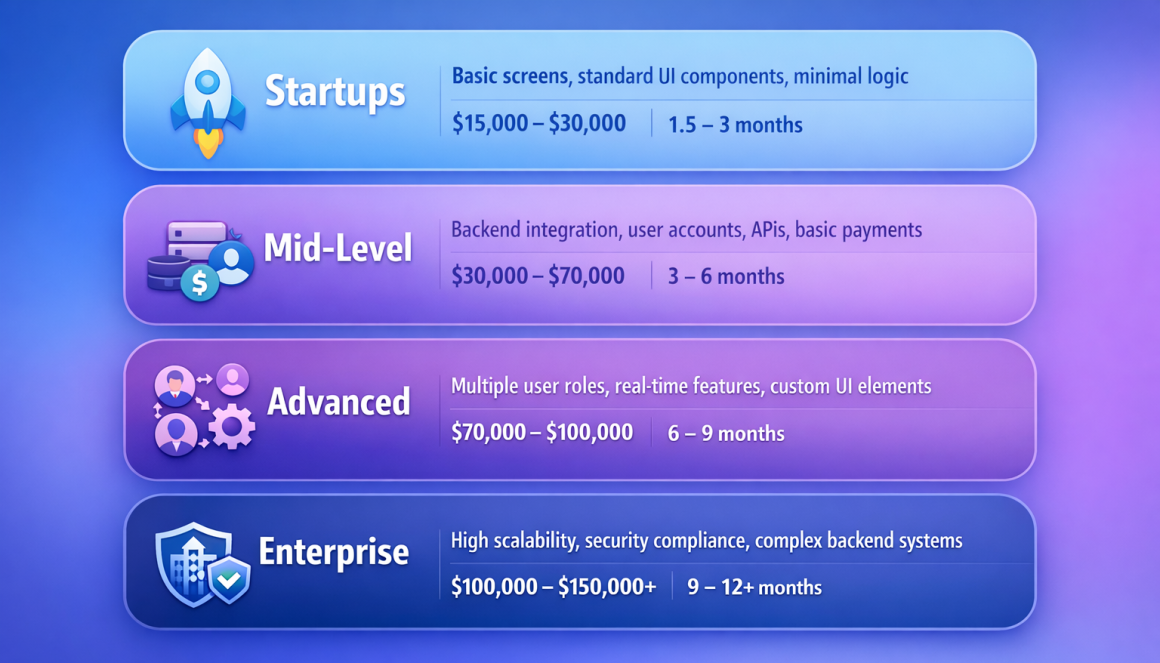
Before we head ahead and have a detailed flutter app development cost breakdown, for people who just want a quick numbers of updates here is a broad division of which one will be the bucket to your app as well.
| App Level | Description | Estimated Cost Range | Estimated Timeline |
| Startups | Basic screens, standard UI components, minimal logic | $15,000 – $30,000 | 1.5 – 3 months |
| Mid-Level | Backend integration, user accounts, APIs, basic payments | $30,000 – $70,000 | 3 – 6 months |
| Advanced | Multiple user roles, real-time features, custom UI elements | $70,000 – $100,000 | 6 – 9 months |
| Enterprise | High scalability, security compliance, complex backend systems | $100,000 – $150,000+ | 9 – 12+ months |
Flutter App Development Cost Based on Features
Let’s address the question most teams quietly struggle with:
“Why does the cost of Flutter app development vary so much from one quote to another?”
The short answer is, Flutter itself is not expensive. The decisions you make around the app are. And once you understand those decisions, the cost stops feeling like a guess and starts making sense.
Let us walk you through the factors that actually shape Flutter app development cost the same ones every digital transformation services company bring to consideration when they estimate projects internally
1. Complexity of App
Every cost discussion starts here. A simple app that shows information and collects basic input is a very different beast from an app handling real-time data, user roles, or workflows.
If your app logic is straightforward, Flutter keeps things lean. As soon as you introduce things like live tracking, chat, dashboards, or complex rules in the background, development time naturally goes up, and so does the cost.
There’s no trick here. More moving parts mean more effort. Here is a breakdown of flutter app development cost by app complexity.
| Complexity Level | Typical Use Case | Estimated Time | Estimated Cost (USD) |
| Basic complex app | MVPs, internal tools, early-stage startups | 4–6 weeks | $5,000 – $15,000 |
| Medium complex app | Growing startups, consumer apps | 8–12 weeks | $20,000 – $40,000 |
| Highly complex | Large orgs, complex workflows | 6–9+ months | $120,000 – $300,000+ |
2. Requirement of Features
Features look small on paper but carry weight in development.
Login systems, payments, push notifications, search, filters each one adds design work, coding time, and testing. Flutter helps reduce duplication across platforms, but features still need to be built, connected, and tested properly.
This is often where budgets stretch, not because of one big feature, but because so many small ones are added over time. Below is the flutter app development services cost breakdown as per the features you are looking forward to integrating into your app.
| Feature Scope | Examples | Estimated Time | Estimated Cost (USD) |
| Core Features | Login, basic screens, forms | 2–3 weeks | $3,000 – $8,000 |
| Standard Features | Search, filters, notifications | 4–6 weeks | $10,000 – $20,000 |
| Advanced Features | Payments, chat, dashboards | 6–10 weeks | $20,000 – $40,000 |
| Heavy Features | Real-time sync, AI logic | 10–14 weeks | $40,000 – $70,000 |
3. UI/UX Design
Design is where many teams underestimate cost.
If you’re fine with a clean, familiar layout that users already understand, the cost stays controlled. But if your brand needs a custom look, animations, or a very polished feel, that effort shows up in the budget.
Good design isn’t just how it looks; it’s how much thinking and refining goes into making it feel right. Let us have a breakdown of how much does flutter cost in this particular bar.
| Design Level | Typical Fit | Estimated Time | Estimated Cost (USD) |
| Basic UI | MVPs, proof of concept | 1–2 weeks | $2,000 – $4,000 |
| Standard UX | Most startup apps | 3–4 weeks | $5,000 – $10,000 |
| Custom UI | Brand-focused products | 5–7 weeks | $12,000 – $20,000 |
| Premium UX | Consumer-grade, enterprise | 8+ weeks | $25,000 – $30,000+ |
4.Backend & Data Handling
If your app needs user accounts, data storage, admin panels, or analytics, you’ll need a backend.
Flutter handles the front beautifully, but the backend still needs to be designed, secured, and scaled. Whether you’re using Firebase, AWS, or a custom setup, backend work often runs in parallel and adds a solid chunk to the total cost.
No backend usually means a lower budget. A strong backend means a stronger app but at a higher investment. Here is A flutter app development cost calculator as per this.
| Backend Type | Used By | Estimated Time | Estimated Cost (USD) |
| No / Minimal Backend | Simple apps | 1–2 weeks | $2,000 – $4,000 |
| Managed Backend | Startups (Firebase, Supabase) | 3–5 weeks | $5,000 – $12,000 |
| Custom Backend | Growing products | 6–8 weeks | $15,000 – $30,000 |
| Enterprise Backend | Large-scale systems | 10–14 weeks | $40,000 – $70,000+ |
5. Third-Party Integrations
Maps, payment gateways, social logins, chat tools, analytics integrations speed things up, but they’re not free.
Each integration needs setup, testing, and sometimes custom handling to fit your app flow. They reduce long-term effort but add to upfront development time.
Think of them as shortcuts that still need careful driving. Let’s see how much does flutter app development cost considering integrations.
| Integration Level | Examples | Estimated Time | Estimated Cost (USD) |
| Light | Google login, analytics | 1–2 weeks | $2,000 – $4,000 |
| Moderate | Payments, maps | 3–4 weeks | $5,000 – $10,000 |
| Heavy | Chat, CRM, ERP | 5–7 weeks | $12,000 – $25,000 |
| Enterprise | Multiple systems | 8+ weeks | $30,000+ |
6. Platforms & Devices
Flutter’s biggest win is one codebase for Android and iOS. That alone cuts costs compared to native development.
But apps still need testing across different devices, screen sizes, and OS versions. If you’re also planning for web or desktop later, that adds more planning and effort.
Flutter reduces duplication, not responsibility. Here is a detailed look of what is the cost of building a flutter app on different platforms and devices.
| Platform Scope | Typical Scenario | Estimated Time | Estimated Cost (USD) |
| Android or iOS Only | Early MVP | 3–4 weeks | $4,000 – $8,000 |
| Android + iOS | Most businesses | 5–6 weeks | $8,000 – $15,000 |
| Mobile + Web | SaaS products | 7–9 weeks | $18,000 – $30,000 |
| Multi-Platform | Enterprise tools | 10+ weeks | $35,000+ |
7. Team Location & Experience Level
This is where numbers start to look very different.
When you hire flutter app developers a senior team brings speed, better decisions, and fewer mistakes but at a higher hourly rate. Flutter app development company cost may be comparatively low by a less experienced team, but take longer to reach the same result.
Here is a detailed breakdown of estimated flutter app development cost per hour according to the different team types.
| Team Type | Best For | Hourly Rate | Impact on Cost |
| Junior Team | Simple apps | $20 – $30/hr | Lower cost, slower |
| Mid-Level Team | Startups | $30 – $50/hr | Balanced |
| Senior Team | Scale & enterprise | $50 – $80/hr | Higher cost, faster |
| Specialist Team | Complex systems | $80+/hr | Fewer errors, stable |
8. Maintenance & Updates
Many teams forget this part.
Once the app is live, it needs updates for OS changes, bug fixes, performance improvements, and sometimes new features. Flutter makes updates easier, but maintenance is still ongoing work.
Most companies plan 10–20% of the development cost per year for this, and that’s a healthy rule of thumb.
| Maintenance Level | Includes | Time Commitment | Annual Cost |
| Basic | Bug fixes | 5–10 hrs/month | $2,000 – $5,000 |
| Standard | Updates, tweaks | 15–25 hrs/month | $6,000 – $12,000 |
| Active Growth | New features | 30–40 hrs/month | $15,000 – $25,000 |
| Enterprise Support | SLA, monitoring | Dedicated team | 20%+ of dev cost |
9. Hiring Model
This is one of the most overlooked cost drivers, and honestly, one of the most important.
Two apps with the same scope can end up costing very different amounts simply because of who builds them. Each hiring model comes with its own trade-offs, and there’s no universal right answer. It depends on how much control, speed, and accountability you need. Let us have a view of weather flutter app development hourly rate are more effective or hiring an in house team.
| Hiring Model | Best Suited For | Estimated Time Impact | Estimated Cost Range (USD) |
| Freelancers | Small startups, MVPs | Slower coordination | $20 – $40/hr |
| Outsourcing Agency | Growing businesses | Structured & predictable | $30 – $70/hr |
| In-House Team | Long-term products | Full control, slower setup | $80 – $120/hr |
10. Hidden Costs
This is where budgets quietly slip.
Hidden costs don’t show up in proposals, but they do show up during execution. Not because someone is dishonest but because these things often surface only after real users start interacting with the app.
Have an eye on flutter app development charges that are often just staying hidden but may cause much more to your final budget.
| Hidden Cost Type | When It Appears | Time Impact | Estimated Cost (USD) |
| Scope Changes | Mid-development | 1–4 weeks | $3,000 – $15,000 |
| App Store Compliance | Pre-launch | 1–2 weeks | $1,000 – $3,000 |
| Performance Optimization | Post-launch | 2–3 weeks | $3,000 – $8,000 |
| Cloud & API Usage | Ongoing | Continuous | $1,000 – $10,000/year |
| Security Enhancements | Scaling phase | 2–4 weeks | $5,000 – $20,000 |
11. Cost Based on Development Region
This is the comparison most people look for and for good reasons. Flutter app development cost for startups, mid level companies and even enterprises vary widely across regions. Below is a regional breakdown.
| Region | Typical Use Case | Hourly Rate (USD) | Estimated Project Cost |
| India | Startups, global delivery | $20 – $40 | $10,000 – $50,000 |
| Southeast Asia | Cost-focused builds | $25 – $45 | $15,000 – $60,000 |
| Eastern Europe | Quality + cost balance | $40 – $70 | $30,000 – $90,000 |
| Western Europe | Regulated industries | $70 – $100 | $60,000 – $150,000 |
| North America | Enterprise products | $90 – $150 | $80,000 – $250,000 |
| Australia | Local-first teams | $80 – $120 | $70,000 – $200,000 |
| Middle East | Govt & enterprise | $60 – $100 | $50,000 – $180,000 |
Development Timeline and Its Impact on Flutter Cost
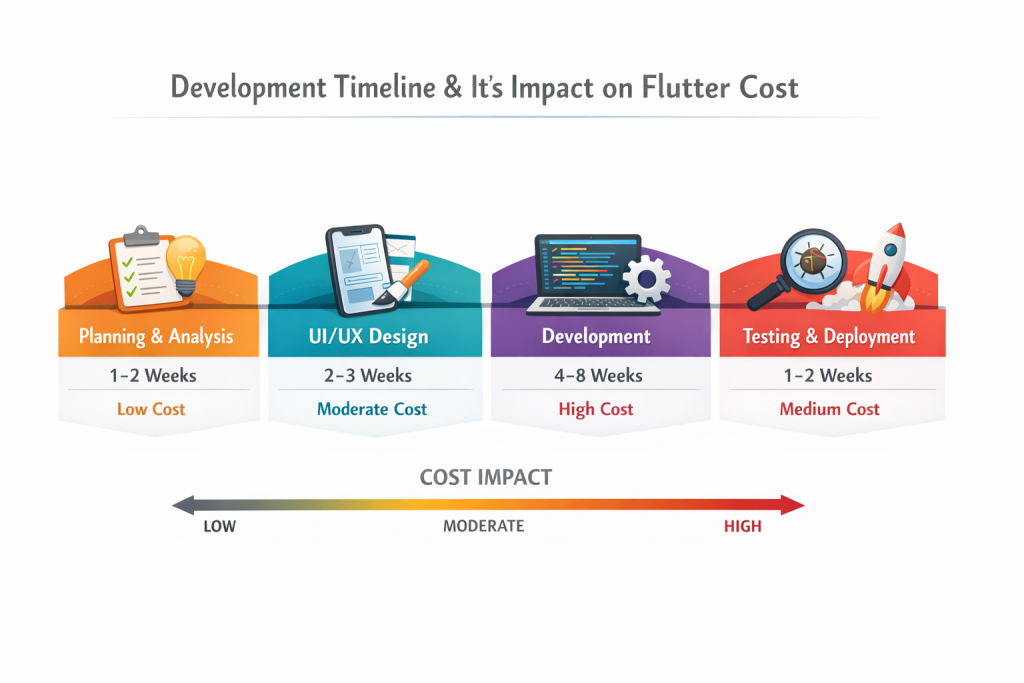
Let’s talk about something most teams underestimate until it’s too late: time.
Not features. Not a platform. Time.
In Flutter app development cost 2026, timeline of Mobile app development services not only gives you the date of your launch but also plays an important part in deciding how much will you end up paying in the entire process.
Let us explain how this really works.
Why Timeline Matters More Than People Think
On paper, speeding up a project sounds simple:
“Let’s just finish it faster.” In reality, a compressed timeline usually means:
- More developers working in parallel
- Less room for iteration
- Higher coordination effort
- Increased risk of rework
Flutter helps by allowing one shared codebase, but even Flutter has its limits. Quality still needs time.
Timeline vs Quality: The Trade-Off Nobody Likes
One honest truth: You can shorten time, or you can reduce cost but not both at the same time without losing quality.
Flutter reduces duplication, yes. But thoughtful architecture, testing, and polish still need breathing room.
The most stable apps are rarely rushed. They’re planned.
Flutter App Development Cost by Timeline Phase
| Phase | What Happens in This Phase | Estimated Timeline | Estimated Cost Impact (USD) |
| Planning & Discovery | Requirements, scope, tech stack, roadmap | 1–2 weeks | $2,000 – $5,000 |
| UI/UX Design | Wireframes, user flows, visual design | 2–4 weeks | $5,000 – $15,000 |
| Development | Flutter coding, backend integration | 6–16 weeks | $15,000 – $80,000 |
| Testing & QA | Functional, performance, device testing | 2–4 weeks | $3,000 – $10,000 |
| Deployment | App store prep, release, monitoring | 1 week | $1,000 – $3,000 |
A Quick Reality Check
Most delays and overruns don’t happen because Flutter is slow—they happen because:
Scope wasn’t locked early
- Feedback came late
- Decisions were unclear
- When the timeline flows cleanly, cost stays predictable.
Practical Ways to Reduce Flutter App Development Cost
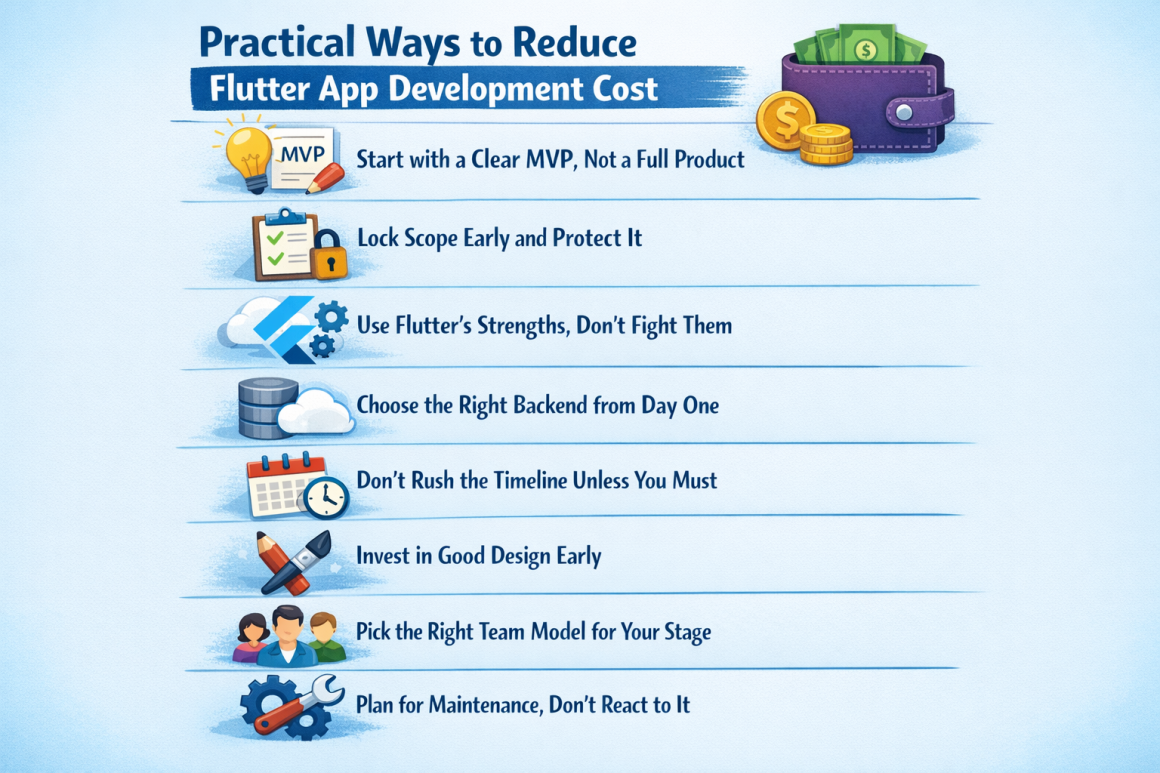
Let’s be honest for a moment. Reducing Flutter app cost doesn’t mean cutting corners. It means making fewer expensive mistakes.
Most teams don’t overspend because Flutter is costly they overspend because decisions are rushed, scope of drifts, or priorities aren’t clear early on. The good news? A few practical moves can make a noticeable difference without hurting quality.
Here’s how experienced teams keep costs under control
1. Start with a Clear MVP,Nota Full Product
This is the biggest lever you have.
Instead of building everything at once, focus on the smallest version of your app that actually delivers value. Flutter is perfect for this because it lets you launch fast and iterate without rebuilding from scratch.
When you build only what users need at the start, you:
- Reduce development time
- Lower initial cost
- Learn faster from real usage
Features can always come later. Rewriting an overbuilt app costs far more
2. Lock Scope Early and Protect It
Scope creep is silent and expensive.
Once development starts, even small changes—new screens, extra logic, revised flows—add up quickly. The best way to avoid this isn’t saying “no” to ideas, but parking them for the next phase.
A locked scope keeps:
- Timelines predictable
- Teams focused
- Costs stable
You’ll still improve the product—just in planned steps
3. Use Flutter’s Strengths,Don’tFight Them
Flutter shines when you reuse components and keep logic clean.
Custom widgets are powerful, but over-customization can slow things down. Smart teams lean on Flutter’s built-in widgets and proven patterns where possible, and customize only where it truly adds value.
This approach:
- Speeds up development
- Reduces bugs
- Lowers testing effort
Good architecture saves money long after launch
4. Choose the Right Backend from Day One
Backend choices have a long-term impact on cost to develop a flutter app.
For many startups and early-stage products, managed backends like Firebase or Supabase are more than enough. They reduce setup time and ongoing maintenance.
You can always move to a custom backend later when scale demands it but starting simple avoids unnecessary upfront spend
5. Don’tRush the Timeline Unless You Must
A tighter deadline almost always costs more.
Adding developers, running parallel workstreams, and compressing testing cycles increases coordination effort and risk. Flutter already gives you speed forcing more speed often works against you.
If you have flexibility, a steady timeline almost always costs less than a rushed one
6. Invest in Good Design Early
This might sound counterintuitive, but it’s true.
Clear UX decisions reduce:
- Rework during development
- Confusion during testing
- Changes after launch
When user flows are thought through early, developers don’t need to guess and guessing is expensive. Good design is not a luxury. It’s a cost control tool
7. Pick the Right Team Model for Your Stage
Freelancers, agencies, and in-house teams all make sense—but not at the same time.
Early-stage products usually benefit from a focused external team. Building an in-house Flutter team too early often increases overhead without adding speed but on the other hand may be fruitful for flutter app development cost for enterprises level businesses.
Align the hiring model with your growth stage, not only to your long-term vision
8. Plan for Maintenance,Don’tReact to It
Post-launch costs are easier to manage when expected.
Instead of fixing issues reactively, plan regular updates and improvements. Small, steady improvements cost far less than large, urgent fixes later.
A maintained app is always cheaper than a neglected one.
Conclusion
Flutter app development cost in 2026 isn’t a fixed number and that’s actually a good thing.
Flutter gives you flexibility, but the final cost depends on the choices you make early on various flutter app development cost factors discussed in the article. When these decisions are clear, budgets stay predictable. When they aren’t, costs tend to drift.
Custom software development services that get the most value from Flutter don’t chase the lowest price. They plan carefully, start with a focused MVP, keep scope under control, and treat maintenance as part of the product, not an afterthought.
So instead of asking “How much does Flutter cost?”, the better question is:
“What should my app cost, based on what I’m trying to build?” and you’ll have a perfect customized quote by your side.
Frequently Asked Questions
1. How much does it really cost to build a Flutter app in 2026?
Flutter app development cost in 2026 typically starts around $15,000 for a basic app and can go beyond $150,000 for enterprise-level solutions. The final cost depends on app complexity, features, design depth, backend needs, and the team you choose.
2. Is Flutter cheaper than native app development?
Yes, in most cases. Flutter uses a single codebase for Android and iOS, which reduces development time and effort compared to building two separate native apps. This usually results in 20–40% cost savings, especially for startups and mid-sized businesses.
3. How long does Flutter app development usually take?
A simple Flutter app can take 1.5–3 months, while more complex apps may take 6–9 months or longer. Timelines depend on features, integrations, design requirements, and how quickly decisions and feedback are provided.
4. Is it better to hire freelancers or a Flutter mobile app development company?
It depends on your project stage. Freelancers can be cost-effective for small MVPs but require close management. A Flutter app development company offers structure, accountability, and faster delivery, which often saves money in the long run for growing or complex projects.
5. Does Flutter handle performance well for complex apps?
Yes, when built correctly. Flutter compiles to native code and delivers near-native performance. Performance issues usually come from poor state management, heavy UI rebuilds, or unoptimized backendcalls and not Flutter itself.
6. Can Flutter support real-time features like chat or live tracking?
Yes. Flutter works smoothly withWebSockets, Firebase, and real-time APIs. These features increase backend complexity and testing time, which raises cost, but Flutter itself handles the UI side efficiently.