Choosing between IT Staff Augmentation and Managed Services is a common challenge for business owners and technology leaders looking to scale operational efficiency. In an era of tight budgets, taking decisions on whether to extend your in-house team with external talent or fully outsource IT operations to a managed service provider has become a tough job for business entrepreneurs.
Both models aim to enhance productivity and innovation. But it differs significantly in structure, control, and cost dynamics. Understanding these differences can help you choose the right model that aligns best with your business goals.
Businesses in the present day are under pressure to provide more intelligent, smarter and faster technology solutions. Statista estimates that the world market in outsourced IT will amount to $512.5 billion by 2025, whereas Gartner states that almost three-quarters of companies already use third-party IT services to address a skills shortage or provide end-to-end services. The point is obvious: outsourcing is no longer an option; it has become a must to be competitive.
The trick here, however, is the following: whereas staff augmentation assists you in the mobilization of experienced individuals to your current team to undertake certain projects, managed it services entrust a service provider with the entire responsibility of some IT operations. Both may serve the purpose of growing a business, but the size of the control, scalability, cost, and accountability are vastly different.
Therefore, prior to choosing between the two outsourcing models, it would be prudent to know how the two outsourcing models compare to one another. Here, in this blog, we are going to discuss IT Staff Augmentation vs Managed Services—we are going to discuss how they work, their respective advantages, and the model that could be the ideal one to meet your business needs in 2025.
Table of Contents
A Light on IT Staff Augmentation vs Managed Service
It is hard to directly understand the difference between IT Staff Augmentation vs Managed Services. As for this, it is necessary to have a basic understanding of these two separately. So, firstly, let’s go through this before jumping on the difference between both.
How they Differ
| Parameters | IT Staff Augmentation | Managed Services |
| Definition | A flexible outsourcing model where external professionals are hired to fill skill gaps within your in-house team temporarily. | A long-term outsourcing model where an external service provider takes full responsibility for managing and delivering specific IT functions or services. |
| Ownership of Project | The client retains complete ownership and control over the project, including planning, execution, and outcomes. | The service provider owns and manages the project or service delivery, ensuring performance and results. |
| Management Control | The client manages the augmented staff directly, just like internal employees. | The service provider manages all operations, personnel, and service delivery independently. |
| Scalability | Highly flexible resources can be scaled up or down quickly based on project requirements. | Moderate flexibility—scaling usually requires changes in service-level agreements (SLAs). |
| Cost Model | Typically charged on an hourly or monthly rate per resource basis. | Usually based on fixed pricing or SLA-based models covering outcomes or service packages. |
| Duration of Engagement | Short-term mid-term—ideal for temporary skill shortages or project-based needs. | Long-term engagement—suitable for ongoing IT operations or support. |
| Resource Control | High—client can select, interview, and manage specific team members. | Low—service provider handles hiring, management, and performance of their team. |
| Focus Area | Focuses on augmenting internal capabilities with external talent. | Focuses on achieving business outcomes and continuous service improvement. |
| Risk Responsibility | The client assumes most of the project risk and quality assurance. | The vendor takes on the risk of service delivery and performance. |
| Integration with Internal Team | Works closely with in-house staff, often as part of the internal team. | Operates independently with minimal direct involvement from internal teams. |
| Expertise Level | Brings in specialized skills for specific technologies or domains. | Provides end-to-end expertise and management across processes, infrastructure, and technology. |
| Speed of Deployment | Quick—can onboard resources within days or weeks. | Slower—requires setup, process alignment, and SLA agreements before starting. |
| Monitoring and Reporting | Client handles monitoring, reporting, and performance evaluation. | Service provider delivers regular reports and performance metrics as per SLAs. |
| Best Suited For | Businesses needing extra hands for development, testing, or short-term IT projects. | Organizations looking to outsource complete IT functions like infrastructure, cybersecurity, or cloud management. |
| Examples of Use Cases | Hiring developers for a new app launch, filling temporary skill gaps, or scaling dev teams quickly. | Outsourcing help desk support, network management, cloud infrastructure monitoring, or cybersecurity services. |
| Benefits | Cost-effective for short-term projects, easy scalability, complete control over resources, and faster onboarding. | Predictable costs, reduced operational burden, 24/7 support, continuous improvement, and SLA-based accountability. |
How Does the IT Staff Augmentation Model Work?
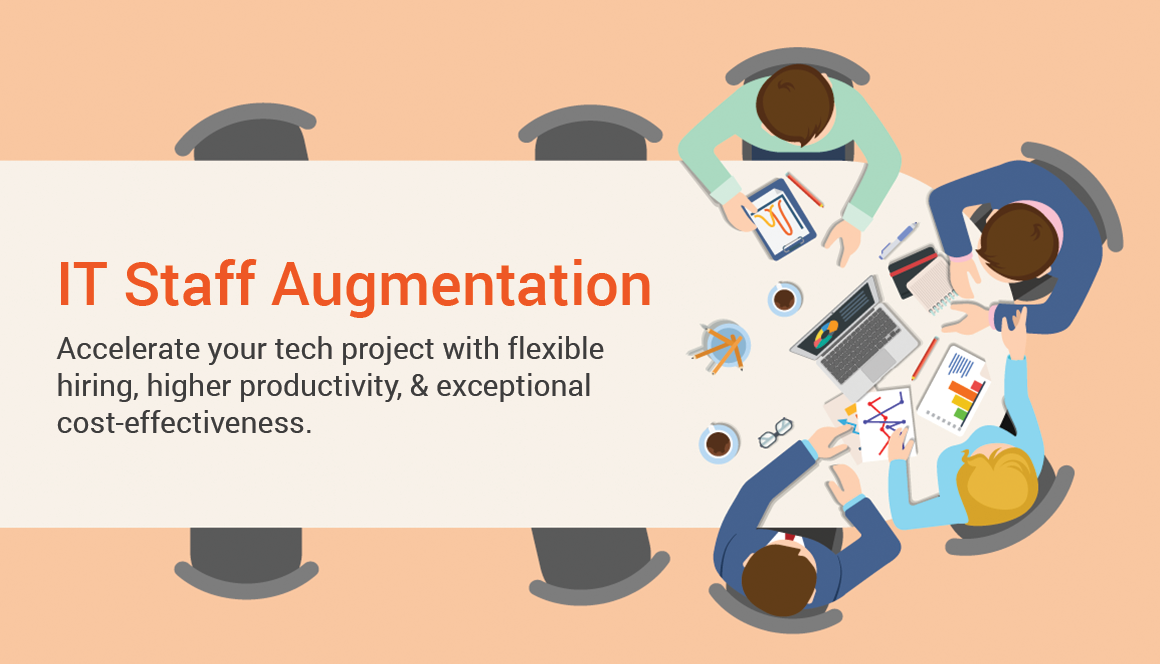
IT staff augmentation services help a company scale up (or, at times, scale down) its tech capabilities as per current needs. Rather than putting efforts into hiring permanent IT personnel, staff augmentation allows you to work temporarily with specialists.
The team of staff augmentation companies gives you access to a pool of the best tech talent in the industry as soon as a need arises. Contrary to the popular wisdom that staff augmentation is perfect for SMEs, tech giants like Spotify, Google, and Disney, too, rely substantially on staff augmentation services. Both startups and well-established companies can leverage IT staff augmentation to boost overall productivity.
Top Benefits of Staff Augmentation Services
From exceptional flexibility to staggering cost savings, IT staff augmentation services could help you in divergent ways. Here’s how most companies benefit from customized staff augmentation.
1.Flexibility
With this model, you can change the size of your team seamlessly. When a considerable workload is present, and your in-house developers can’t deal with it, you can add new talents. At the same time, once your team is expanded, it doesn’t mean using the same size forever. You can reduce the number and organize their work to avoid overstaffing.
2.Productivity
Outsourcing companies have a team of talents. It means that it is easy to find professionals who will have exactly those skills and expertise that are relevant to your project. In addition, these experts will work diligently on your tasks, which will ultimately help you achieve the desired results within the set deadline.
3.Cost & Time Efficiency
It is much easier and cost-efficient to expand your in-house team with external experts provided by one vendor than to hire your developers. In addition, there isn’t any extra pressure on your HR team, and you do not need to think about onboarding and other management processes.
When Should You Look for IT Staff Augmentation Service?
- You already have a development team and now need to enrich new talents.
- You have a limited budget and do not want to extend your in-house staff.
- Your project needs some particular skills.
- You require additional resources for the short-term period.
- Your project requirements are changing, and you require flexibility.
How Does the Managed IT Services Model Work?
The managed services also use the capacities of external talent to create your projects. But here, you hire a complete team of specialists (developers, designers, business analysts, QA engineers, and project managers) having the required knowledge and expertise.
Small businesses prefer this model, as they do not have their own IT departments. A managed IT services provider will help your tech infrastructure and meet your needs. With the availability of cloud platforms, all software-related services can be performed remotely. This is one of the major factors that boost the popularity of this approach to establishing cooperation with IT professionals.
Key Benefits of the Managed Service
-
Reduction in Costs
From a financial point of view, it is perfect for small businesses to work with an external team of tech experts. Instead of investing money into building their respective IT departments.
-
Talented Pool of Experts
Without spending too much time on the hiring work, you can avail yourself of the services of professionals who will have the proper qualifications to offer the services you need.
-
Less Overhead
When working with your internal team, only you have to manage the processes and other resources. But when you invest in managed services, they will monitor all the required processes. And you can focus more on your crucial business tasks.
When Should You Consider Managed IT Services?
- You do not have your in-house development team
- You want to outsource the complete project.
- Your project is a long-term project.
- You are just starting to build a startup and have to start from scratch.
Futuristic Trends of IT Staff Augmentation Services
In the post-pandemic era, IT outsourcing is growing at an exponential rate. Some of the trends we see in IT staff augmentation services are:
1.Cybersecurity
As demand for remote work increases, cybersecurity attacks become a key concern. The demand for cybersecurity experts is obvious, with every organization needing tools to shield their systems from hackers.
2.Advanced Technology
Technologies including cloud computing, AI, ML, Big Data, etc., are being extensively used to streamline business workflows. There will be a huge demand for experts in this area.
3.Customer Experience (CX)
Organizations have started improving CX aggressively, as it translates directly to sales in the current business market. There are several opportunities in the CX field as businesses of all scales focus on customer experience.
4.New Locations
As Staff Augmentation Services India becomes popular, competition is growing. Vendors from all regions are offering staff augmentation services and challenging conventional markets.
Staff Augmentation vs. Managed Services
Staff augmentation and managed services are two different staffing models. While both are outsourcing strategies, they are very different from each other. Let’s discuss their differences.
- In staff augmentation, a company hires experts with relevant skill sets through a provider, and they work in-house. While in managed services, the project is outsourced to an external team, and a specific delivery is expected from them.
- The service provider takes care of administrative aspects for staff augmentation. The hiring company can select the candidates and manage them. In managed services, the hiring company can’t choose the resources or manage them.
- The hiring company can control the staff’s augmented resources and can manage them like their in-house team. But for managed services, the hiring company has no control and cannot access work.
- If you are opting for managed services, you don’t need any resources to manage the outsourced team. They work independently and make all decisions by themselves. With staff augmentation services, you are hiring resources and are solely responsible for managing them.
Future trends of IT Managed Services
The following are the futuristic trends that are making the world of IT Managed Services (and which you can incorporate in your blog section as to what is coming next towards this model). The trends are useful in illuminating the way the managed-services model (with which you are comparing staff augmentation) is changing – and how companies can keep pace.
1.Predictive Operations AI-Powered Automation
To remove human resources, AI/ML is being increasingly deployed by the service providers to automate routine activities (ticket, classification, routing), allowing human resources to do strategic work.
- Predictive maintenance is gaining more prevalence: the MSP can sense possible failures before they take place, and this lowers downtimes.
- It is no longer the predict-prevent-optimize approach, but the change in focus between the previous state, where service providers merely react to problems once they arise, and the new competitive position of service providers.
When your business is managed, you should be prepared to have capabilities such as faster response, fewer surprises, and improved uptimes.
2.Compliance & Cybersecurity as Core Values
Cyber threats are becoming more sophisticated and more frequent, and security is not an IT matter anymore but a board-level concern.
- Such trends as Zero Trust architecture (i.e., never trust, always verify) or managed detection and response (MDR) or compliance-as-a-service are gaining momentum.
- To businesses, it is how the business is choosing a partner in managed services where they expect them not only to ensure that things keep going on, but they are also expected to defend and make sure that the business complies with regulatory and security requirements.
3.Multi-Cloud or Hybrid Infrastructure and Edge Computing
- Single cloud is being replaced by hybrid or multi-cloud by most organizations to provide flexibility and resilience.
- Edge computing is gaining significance—computing data where it is created, reducing latencies, and improving real-time reactions.
- Your blog: this trend implies that it is not only someone taking care of your servers, but a larger, more distributed, and dynamic terrain of IT.
4.Everything-as-a-Service (XaaS) Subscription Models
- The model of as-a-Service is constantly growing Infrastructure-as-a-Service (IaaS), Security-as-a-Service (SECaaS), and AI-as-a-Service (AIaaS).
- This renders IT consumption to be more flexible, scalable, and cost-predictable.
- In the business decision-making respect: When you go to managed services, you must think more about subscription or managed application than about projects.
5.Individualizations and Data Engagement
- Instead of standard support, which is one size fits all, there is a push towards bespoke service levels, business-specific dashboards, and predictive analytics.
- Managed services are becoming strategic alliances: providers are becoming insight providers, offering services that can assist you in strategizing future IT investments, not just keeping the lights on.
- Stress that the model of managed services is evolving, i.e., not merely of outsourcing operations, but of a business strategy.
IT Staff Augmentation or Managed Services—What’s Best for You?
Both methods save you from spending time and resources needed for recruiting the experts needed to build your products and reach the company’s goals. But many companies appreciate the flexibility and control of IT staff augmentation over managed services. Since IT outsourcing employs the most talented team of developers, programmers, and coders, you may find more success in IT outsourcing than hiring in-house staff.
Concluding Thoughts
If this blog post makes you think that your Staff Augmentation lowers operational costs and increases overall revenues, then you are completely right. Also, if you are looking on onboard a development agency and understand the process, you can simply reach out to us. OrangeMantra offers elite services and a track record of satisfied clients; we promise to deliver the best services. With our experienced resources, we are committed to completing your projects before time with the best delivery outcomes.
Frequently Asked Questions
1.What is Staff Augmentation?
Staff Augmentation is the process of hiring external IT professionals for a company’s particular project. It helps enterprises to hire on-demand IT experts from a reliable company to avail much-needed assistance.
2.What is the difference between Staff Augmentation and Managed IT services?
Staff Augmentation refers to the process of hiring IT experts for a particular project. While managed IT services are availed for an entire outsourcing project.
3.How to hire a cost-effective development team?
If you are planning to avail of IT Augmentation staffing services, then you can get in touch with us. We are a full-stack development company offering end-to-end digital transformation solutions to deliver excellent technical benefits to clients.