
This guide provides a complete overview of mobile hospital app development, helping healthcare providers understand how digital solutions improve patient care, streamline hospital operations, and enhance overall efficiency. You’ll gain insights into essential features, development costs, technology stack, and the long-term business benefits of investing in a hospital app.
-
 Must-have features like patient management, appointment booking, EHR integration, and telemedicine
-
Key cost factors, development stages, and estimated timelines for building a hospital app
-
Recommended tech stack for secure, scalable, and high-performance healthcare applications
-
Business and operational benefits for hospitals, doctors, staff, and patients, including improved efficiency and patient engagement

The healthcare industry as a whole has been going through a significant digital transformation. As we have already noticed, sector and governments worldwide are steadily increasing expenditure toward healthcare.
While there was an aggressive push in healthcare spending post 2019, it has now plateaued in some markets while continuing to rise in others. Countries such as Poland, Turkey, and India are witnessing a significant increase in healthcare expenditure, according to organizations like EY and OECD.
At the same time, governments and citizens alike are embracing digitalization, which makes this an ideal moment for app development for healthcare. As hospitals, clinics, and healthcare providers accelerate their digital journeys, hospital app development is no longer optional, they are becoming essential.
In this mobile hospital app development guide, we will discuss the key trends, features, types, cost, benefits, and tech stack businesses should consider for medical app development and healthcare mobile application development.
Let’s first start with the trends in the healthcare industry:
Table of Contents
Top Healthcare Mobile App Development Trends:
- As per Deloitte’s 2026 outlook, empowering consumers through digital experiences has emerged as a core strategy, accelerating demand for patient-facing platforms and hospital mobile app development.
- Major medical app development growth driver in health services technology is the AI, hospital app development software platforms and outsourced digital solutions, according to McKinsey’s report.
- More customers are using mobile apps to access healthcare services as healthcare costs continue to rise. This shift has supported demand for hospital app development and hospital mobile app development, as providers look for digital channels to manage appointments, consultations, and follow-up care. According to Deloitte, users who have previously used virtual healthcare services report a willingness to use them again.
- Healthcare organizations are also adopting AI development services as part of medical app development. AI-powered platforms are used to improve operational efficiency, digitize workflows, reduce administrative costs, support early patient discovery questionnaires, and provide preliminary analysis in defined use cases.
- App development for healthcare is increasingly tied to broader digital transformation services. These services are used by healthcare providers to maintain operational continuity and support measured growth as service delivery models change.
- The rise in personal wearable devices and growing consumer acceptance of these tools is further driving healthcare mobile application development. With wider access to smart monitoring devices, smart patches, and early diagnostic tools connected through apps, hospitals are integrating these systems into care processes to support ongoing patient monitoring and service delivery.
Major Considerations Before Undertaking Hospital App Development
Compliance First Design
Compliance defines the legal scope of hospital app development and directly affects timelines and cost through approvals, documentation, audits, and technical controls. Regulatory requirements force specific architecture, security, and validation steps, but long-term they reduce rework, penalties, and launch delays across regions.
Regulatory scope by app type
| App type | HIPAA (US) | GDPR (EU) | FDA / MDR (medical) |
| Fitness tracker | No | Yes | No |
| Telemedicine | Yes | Yes | No |
| Symptom checker | Yes | Yes | Likely (Class II) |
| Diagnostic AI | Yes | Yes | Mandatory |
Accessibility Focused Development
Modern laws require healthcare apps to meet defined technical accessibility standards, influencing UI design, frontend development, and testing cycles. This increases build time during hospital mobile app development, but it reduces litigation risk and avoids post-launch remediation.
Accessibility laws and standards
| Region | Law / directive | Technical standard |
| United States | ADA Titles II & III, Section 504, Section 1557 | WCAG 2.1 AA |
| European Union | European Accessibility Act, Web Accessibility Directive | EN 301 549 (WCAG 2.1 AA) |
| India | RPwD Act | IS 17802 (WCAG 2.1 AA aligned) |
| Middle East | UAE Health Data Law, Saudi digital mandates | WCAG-based national standards |
AI and ML feature usage
AI and ML features expand scope by requiring data pipelines, model training, validation, and regulatory review. In medical app development, this adds cost and extends delivery timelines, but supports automation and clinical decision support when deployed within approved boundaries.
AI regulation impact
| Region | Regulation | Impact on development |
| United States | FDA SaMD guidance | Clinical validation, documentation |
| European Union | EU AI Act (2026) | Risk classification, audits, human oversight |
| India | DPDP Act | Consent-driven data use |
| Middle East | PDPL, UAE Health Data Law | Restricted data usage, localization |
Security and privacy
Security mandates force implementation of encryption, MFA, audit logs, and incident response workflows. These requirements increase engineering effort and infrastructure cost, but reduce breach exposure and regulatory penalties over the lifespan of the application.
Core security requirements
| Region | Regulation | Mandatory controls |
| United States | HIPAA, HITECH | MFA, encryption, 24-hour incident reporting |
| European Union | GDPR | Data minimization, breach notification |
| India | DPDP Act | Explicit consent, data fiduciary accountability |
| UAE / Saudi Arabia | Health Data Law, PDPL | Data localization, retention mandates |
Platform and framework choice
The choice between native and cross-platform frameworks affects performance, development speed, and long-term maintenance. Native development increases upfront cost but improves hardware integration, while cross-platform mobile app development reduces initial timelines but may require optimization for clinical features. This decision directly influences hospital app development budgets and upgrade cycles.
Ecosystem and system integration
Integration with IoMT devices, ERP, CRM, and EHR systems increases scope through API Integration development and testing. Costs rise initially, but integration-led IoT app development services approach reduces manual workflows, supporting internal, clinical, and patient-facing use cases over time.
Integration scope examples
| Integration type | Development impact | Long-term outcome |
| IoMT devices | BLE, sensor data handling | Remote monitoring |
| ERP / CRM | Data mapping, sync logic | Operational efficiency |
| EHR systems | Compliance-driven APIs | Continuity of care |
Blockchain and modern protocols
Blockchain introduces additional design and infrastructure requirements. Development timelines increase due to specialized implementation, but long-term benefits include immutable audit trails and controlled data sharing across institutions.
Processing model selection
Processing location affects compliance, latency, and cost structure. Cloud-based models require ongoing infrastructure spend, while edge and on-device processing increase development effort but reduce data exposure and response time in critical scenarios.
Processing models and cost impact
| Processing model | Development cost | Ongoing cost | Typical use |
| Cloud-based | Medium to high | Medium to high | Population analysis |
| Mobile gateway | Medium | Low | Near real-time feedback |
| Edge / on-device | High | Low | Time-critical alerts |
Each of these considerations adds upfront effort and cost, but they define scalability, compliance stability, and operational control over the long term.
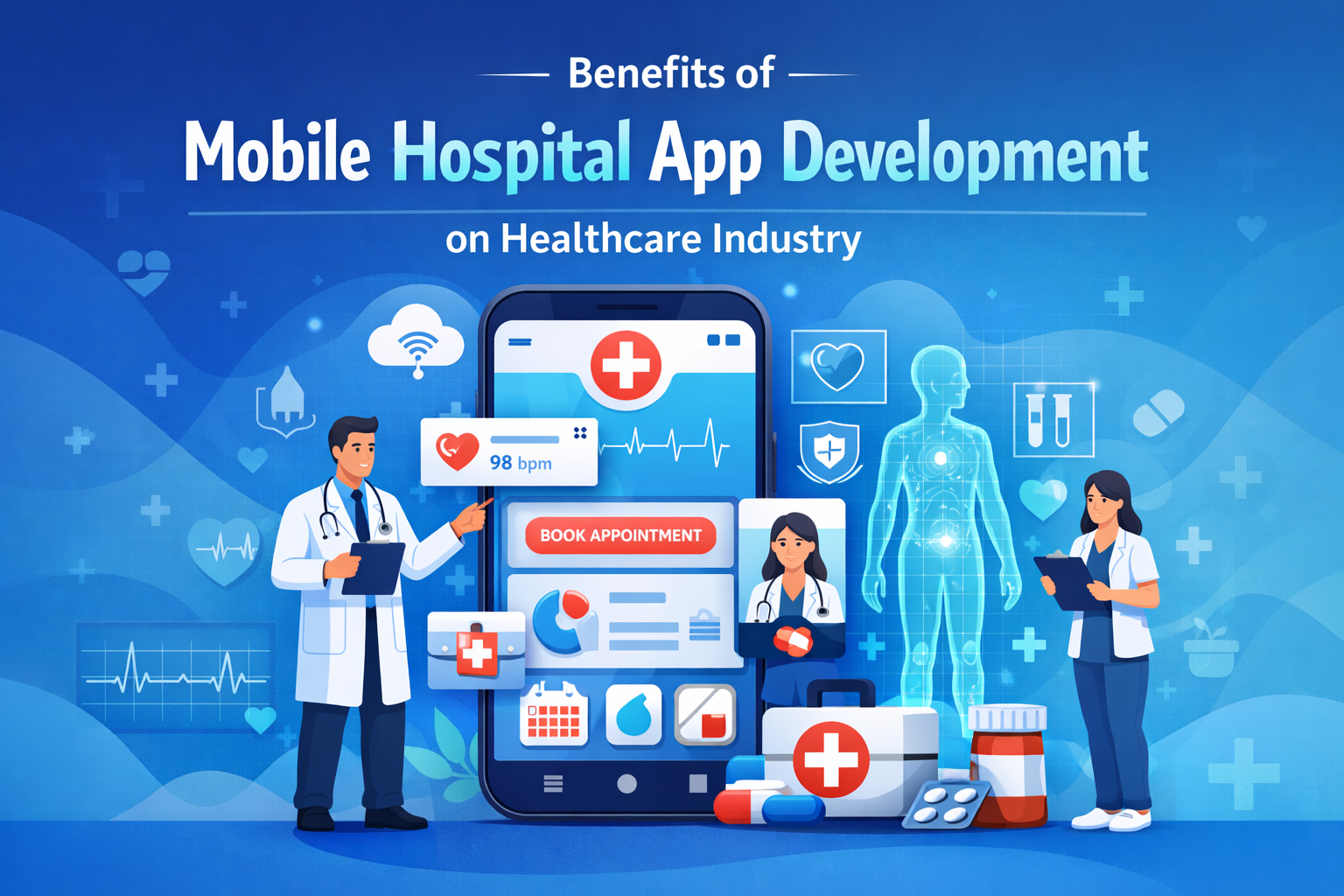
Benefits of Mobile Hospital App Development on Healthcare Industry
Transparency in patient experience
Mobile applications improve visibility for the end user across appointments, records, prescriptions, and billing process. Through digital document system development services, hospitals can replace paper-driven processes with structured digital workflows.
Adding these features while undertaking hospital app development reduces delays and manual follow-ups while giving patients clearer access to their own information, which directly affects satisfaction and trust.
Electronic health records (EHR)
Integrating EHR into mobile platforms simplifies how patient history is accessed and updated. Staff can retrieve records without switching systems, and patients can view reports as well as visit summaries in one place.
EHR integration increases the initial effort, cost, and development time of hospital app development. However, it reduces data duplication and long-term operational friction.
Instant access to information for Audit
Mobile apps give doctors, nurses, patients, finance teams, HR, and operations staff access to relevant information anytime and anywhere. This reduces repeated support requests and internal coordination overhead.
Enabling role-based access adds development complexity, but it lowers ongoing dependency on manual communication channels. To get the most benefit, we recommend consulting with all stakeholders before starting your healthcare mobile application development.
Remote care and follow-ups
The healthcare industry can reduce the burden on its shoulder by embracing remote care solutions. Post-discharge follow-ups, and remote monitoring can be supported through mobile apps, teleconsultation, e-prescribing, and connected devices.
These built-in capabilities require additional compliance and infrastructure planning during app development for healthcare, but they reduce avoidable hospital visits and allow care to continue outside physical facilities.
Cost control over time
Although upfront costs for security, compliance, and integration are higher, mobile apps reduce recurring expenses linked to manual processes and in-person visits.
However, cost benefits increase as adoption grows without requiring proportional increases in staffing or infrastructure.
Regulatory alignment and audit readiness
Hospital mobile app development done with carefully built consent tracking, access logs, and encryption, simplify routine audits as well as reporting.
This adds engineering effort during hospital app development, but it lowers exposure to penalties, data breaches, and retroactive compliance fixes later.
E-prescribing and virtual care delivery
Modern hospital apps can support electronic prescriptions and virtual consultations on scale. These features expand service reach without adding physical capacity.
These features allow healthcare providers to capitalise on their brand and service value to capture more market
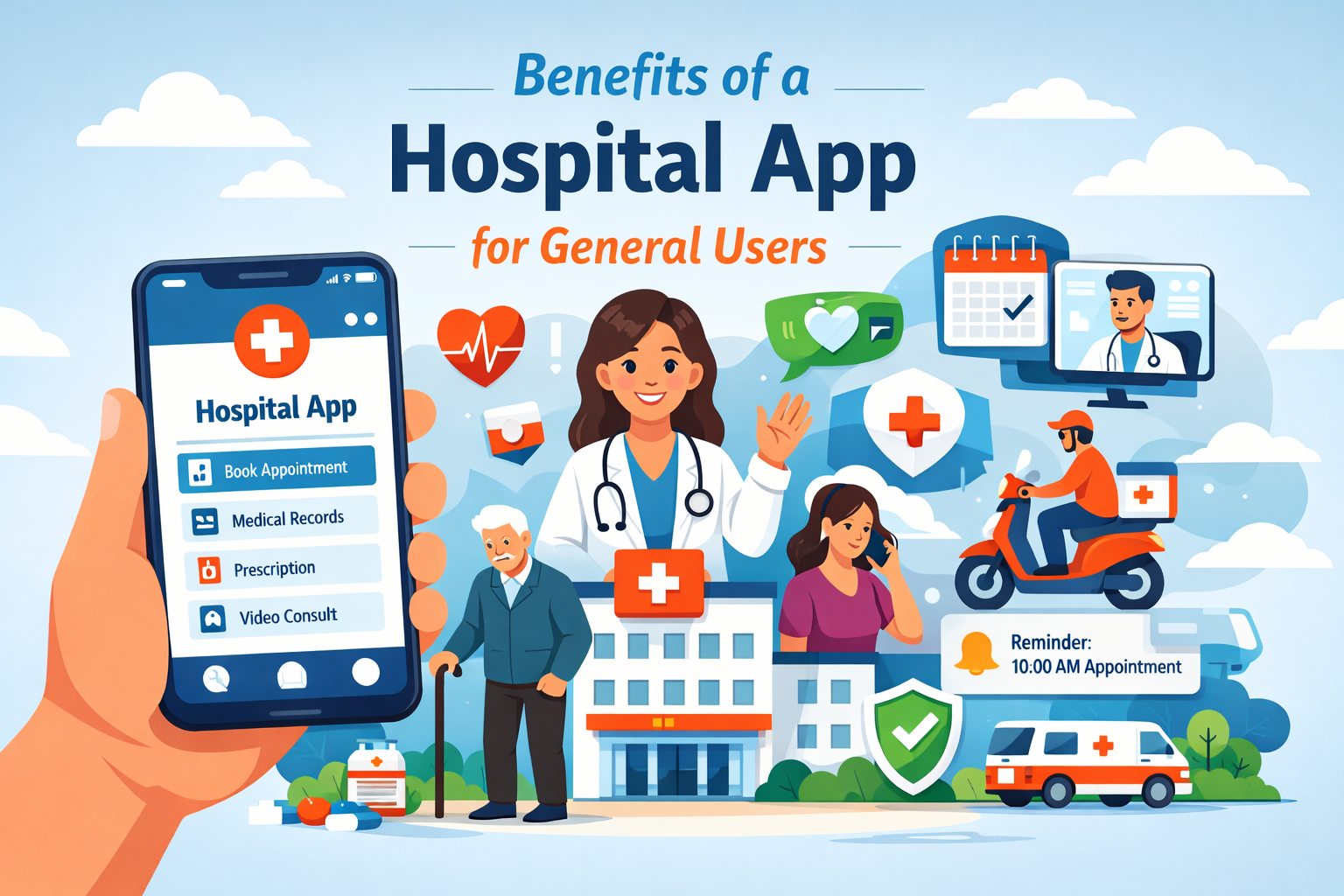
Benefits for general users of a hospital app
Instant support
Patients can raise requests, access instructions, or receive updates without waiting on call centers. This reduces response time and improves service use continuity of the service provider or healthcare programs.
Improved access to services
Mobile access lowers hesitation around booking appointments or seeking follow-up care. By simplifying navigation and communication, a hospital mobile app can help patients engage with services earlier and more consistently.
Remote health monitoring
Connected devices such as portable ECGs and monitoring tools allow users to track health indicators while maintaining daily routines.
Device integration adds to cost, but it supports cost-effective monitoring, enables timely care intervention and ensure end user still gets benefits from modern healthcare.
Convenient and user-friendly onboarding
Large hospital networks benefit from apps that manage onboarding, room upgrades, service access, and in-hospital navigation. This use case increases complexity in hospital app development, but it standardizes experiences across locations.
Flexible financing options
With a significant share of households carrying medical debt, mobile apps can integrate flexible payment plans or BNPL providers.
In app development for healthcare, payment integration increases compliance and security effort, but it gives patients clearer options to manage expenses.
End-user oriented features
Features such as personal note-taking, reminders, and saved care instructions help patients manage their treatment outside consultations
These additions are low-cost within hospital mobile app development and improve ongoing engagement without increasing clinical workload.
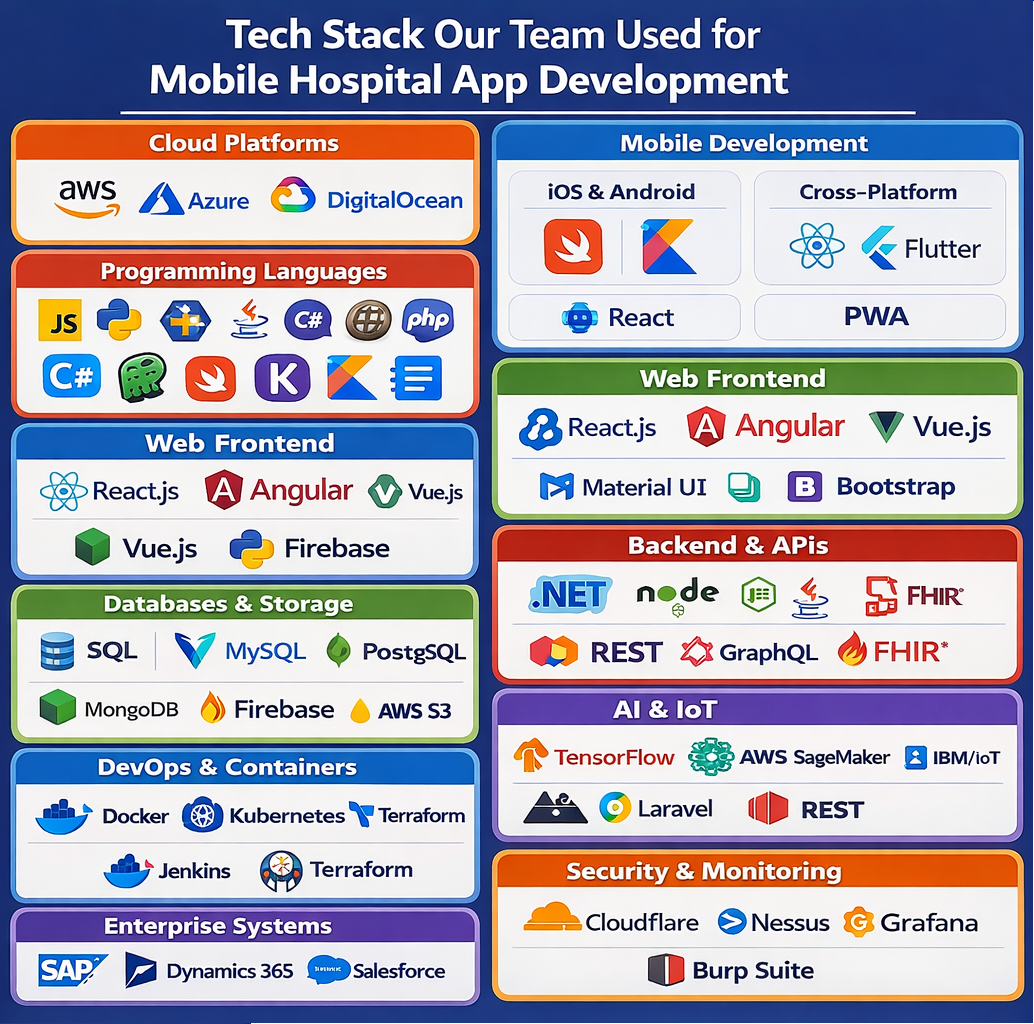
Tech Stack Our Team Used for Mobile Hospital App Development
Different Types & Features of Hospital App Development
Most app for the hospitality industry falls either under either hospital management, treatment, or patient support categories.
Let’s discuss these three categories in detail and what the various types of hospital apps are that come under them, along with some of the major features driving the hospital mobile app development.
Hospital Management Apps
1. Hospital Central Information System
As the names suggest, a Hospital Information System is a comprehensive application used by large hospitals and multi-location healthcare chains to manage day-to-day operations. These systems are designed to support clinical, administrative, and operational workflows within a single platform.
These HIS hospital apps enable doctors, nurses, and administrative staff to manage patient records, track admissions and discharges, generate billing, and coordinate activities across departments. Integration with laboratories, radiology, and medical imaging systems allows information to move between teams without manual handoffs, reducing delays and duplication of work.
Key Features
- Patient registration & demographics
- Doctor & department management
- OPD / IPD workflows
- Billing & invoicing
- Insurance & TPA handling
- User roles & access control
- Integration with EHR, LIS, RIS, PACS
2. Digital Health Records & Exchange App
Electronic Health Record and Health Information Exchange applications focus on maintaining and sharing patient medical information across departments and healthcare organizations. These apps are used by hospitals and care networks that require continuous access to patient history beyond a single visit or facility.
Hospitals use these apps to centralise medical records, maintain patient histories, enable secure data exchange between hospitals, labs, pharmacies, and insurers. Leading custom software development companies like orangemantra enables interoperability standards such as HL7 and FHIR for structured data sharing. We ensure controlled access and regulatory compliance without relying on manual documentation.
Key Features
- Centralized patient medical records
- Longitudinal patient history
- Inter-hospital data exchange
- HL7 / FHIR interoperability
- Consent management
- Audit logs & access tracking
- Secure data sharing with labs, pharmacies, insurers
3. Patient Flow & Bed Management App
ADT (Admission, Discharge, Transfer) app systems help manage how patients move through a hospital, from the point of admission to discharge or internal transfer. These applications focus on tracking patient location, status, and care transitions across wards, departments, and facilities.
These apps allow staff to standardize admission workflows, manage bed allocation, track transfers between departments, and generate discharge summaries. It also ensures transparency for patients and removes manual coordination between clinical and finance teams.
Key Features
- Patient admission workflows
- Bed & ward allocation
- Discharge summaries
- Transfer tracking between departments
- Real-time bed availability
- Billing triggers based on stay duration
4. Smart Inventory & Medical Asset Management App
These types of hospital app development are used to monitor medical equipment, consumables, and critical assets across hospital facilities. These applications focus on visibility and control over physical resources that support clinical and operational activities.
By tracking equipment through RFID or barcode systems, hospitals can monitor stock levels, manage procurement, and schedule maintenance. Asset lifecycle tracking supports timely servicing and replacement, while automated alerts reduce shortages, overstocking, and equipment downtime.
Key Features
- Medical equipment tracking
- RFID / barcode-based inventory
- Stock level alerts
- Supplier & procurement management
- Maintenance schedules
- Asset lifecycle tracking
5. Healthcare Insights & Analytics App
These types of app development for healthcares allows hospitals to analyse and understand how services are used on daily basis.
Using data analytics platforms, healthcare providers can aggregate and analyze data generated across clinical, operational, and financial systems. Built-in predictive analytics support allows staff to forecast and do capacity planning quickly.
Key Features
- Operational dashboards
- Patient flow analytics
- Clinical performance metrics
- Revenue & cost analysis
- Predictive analytics (AI-driven)
- Compliance & audit reports
6. Billing & Revenue Optimization App
To simply the billing and reimbursement, a good mobile hospital development would be RCM app. These apps allow you to do billing using ICD and CPT standards, which reduces disputes between the service user and the health care provider.
These hospital app features improve claim accuracy, shorten payment cycles, and provide clearer visibility into hospital revenue and outstanding receivables.
Key Features of This Hospital App
- Coding (ICD, CPT)
- Claims submission
- Insurance verification
- Denial management
- Payment reconciliation
- Financial reporting
7. Clinic & Practice Operations App
Most of our clients in the healthcare industry have this mobile hospital app developed to manage day-to-day administrative and clinical coordination activities. These systems focus on organizing provider schedules, patient interactions, and operational tasks using a simple interface.
Key Features
- Doctor schedules
- Appointment booking
- Billing & invoicing
- Insurance claims
- Patient communication
- Workflow automation
8. Smart Appointment & Scheduling App
These applications focus on organizing patient scheduling and provider availability across hospital departments. They are used to reduce manual coordination and improve visibility into appointment workflows for both staff and patients. These mobile hospital app features reduce no-shows, improve schedule utilization, and lower administrative workload.
Key Features
- Online appointment booking
- Calendar sync
- Automated reminders (SMS, email, push)
- Rescheduling & cancellations
- Doctor availability management
9. Patient Relationship & Engagement CRM App
Using these apps hospital can manage patient relationships beyond individual visits by organizing communication, referrals, and engagement over time. They are used by hospitals to track interactions across marketing, care coordination, and follow-up activities.
Key Features
- Patient lifecycle tracking
- Lead & referral management
- Personalized communication
- Campaign management
- Feedback & surveys
- Patient retention analytics
10. Immersive Medical Training App
These hospital apps use immersive technologies to support clinical training and skill development within hospital environments. They are applied in scenarios where hands-on practice is required without direct patient involvement.
Staff can leverage these apps to practice procedures, assess competency, and standardize training outcomes across teams without disrupting clinical operations.
Key Features
- Virtual simulations
- Skill-based training modules
- Interactive 3D anatomy
- Performance tracking
- Certification management
Treatment Asist Apps
11. Clinical Diagnosis Support App
These mobile hospital apps help assist experts in making final decisions while rendering the final diagnosis. They are not here to replace the doctor, nurses, or expert staff, but to make the diagnosis faster and remove potential oversight.
Key Features
- Diagnostic rule engines
- Symptom-to-condition mapping
- AI-assisted diagnosis
- Integration with labs & imaging
- Clinical decision alerts
12. Smart Prescription & CDS App
Address the evolving need for healthcare consumers with drug prescription assistance and the CDS mobile hospital app. These apps help in better medication management and reduce prescription-related errors. Most heathcare organization also leverage these too publish and share helpful blogs and resources with the existing hospital app users.
Key Features
- Drug interaction checks
- Allergy alerts
- Dosage recommendations
- Clinical guidelines
- Evidence-based treatment suggestions
13. Digital Orders & Nursing Workflow App
Reduce transcription errors, improve coordination between different teams, and give same level of care with different teams using CPOE (Computerized Physician/Provider Order Entry) and NIS (Nursing Information System) apps.
Key Features
- Digital physician orders
- Nursing task management
- Medication administration records (MAR)
- Alerts & reminders
- Shift handover documentation
14. Pharmacy Operations Management App
Remove over-or under stocking issues with the Pharmacy information hospital app development. These apps help you keep an eye on inventory in real time and ensure your store, hospital, or clinic never runs out of crucial medical supplies.
They also come in handy during the audit to prevent billing, insurance, and any other discrepency.
Key Features
- Prescription fulfillment
- Drug inventory tracking
- Expiry & batch management
- E-prescription integration
- Billing & insurance sync
15. Laboratory Workflow Management App
These hospital apps help manage laboratory operations by tracking diagnostic tests from order placement to result delivery. They are used to standardize lab workflows and reduce manual handling of samples and reports.
Most clinics use them to ensure consistent laboratory operations by reducing turnaround time and reducing errors.
Key Features
- Test order management
- Sample tracking
- Result validation
- Report generation
- Integration with EHR & doctors
- Quality control workflows
16. AI-Powered Medical Imaging App
Give a consistent and reliable clinical assessment despite a large volume of clinical data with custom hospital app development for image analysis. Using these soffware, experts can quickly spot anomalies in X-Rays, CT Scans, and MRIs.
Key Features
- AI-assisted image interpretation
- Pattern & anomaly detection
- Radiologist annotation tools
- Diagnostic confidence scoring
- Integration with PACS
17. DAM System Apps for Hospitals
Within hospital radiology environments, digital asset management software systems are used to store, manage, and distribute medical images generated during diagnostic procedures. They support routine imaging operations and enable access to reports across departments and various locations.
Key Features
- Image storage & retrieval
- DICOM support
- Secure image sharing
- Radiology workflows
- Remote image viewing
18. Surgical Planning & Simulation App
In surgical environments, immersive tools are used to support procedure planning before operations take place. That’s where hospital mobile app development helps clinicians visualize anatomy and procedural steps in advance, reducing uncertainty during complex interventions.
Key Features
- 3D surgical simulations
- Pre-operative planning
- Risk visualization
- Anatomy overlays
- Training & rehearsal environments
Patient Support Apps
19. Patient Engagement & Care Companion App
Engagement-focused applications support ongoing interaction between patients and healthcare providers beyond clinical visits. They are designed to maintain communication and adherence over time.
Key Features
- Health reminders
- Personalized care plans
- Notifications & alerts
- Educational content
- Feedback & satisfaction surveys
20. Virtual Care & Teleconsultation App
Remote consultation platforms enable clinical interactions without requiring patients to visit healthcare facilities. These systems support scheduled and on-demand consultations.
Key Features
- Video & audio consultations
- Secure chat
- E-prescriptions
- Appointment scheduling
- Payment processing
- Consent management
21. Remote Patient Monitoring Software
Monitoring software connects clinicians to patient health data outside hospital settings. These systems are commonly used for post-discharge care or high-risk patient monitoring.
Key Features
- IoT device integration
- Real-time vitals monitoring
- Alerts for abnormal readings
- Doctor dashboards
- Historical data analysis
22. AI Healthcare Assistant App
Automated conversational tools handle routine patient interactions and basic triage tasks. They are used where high volumes of inquiries would otherwise require staff involvement.
Key Features
- Symptom triage
- Appointment booking
- FAQs & patient guidance
- Medication reminders
- Integration with EHR & CRM
23. Experience & Service App
During hospital stays, dedicated inpatient mobile apps enable seamless patient communication and service coordination. These systems focus on day-to-day inpatient experiences.
Key Features
- Nurse call systems
- Meal & service requests
- Care schedule visibility
- Real-time updates
- Patient satisfaction tracking
Hospital Mobile App Development Cost
The cost of building a hospital mobile app depends heavily on the platform, device, testing, compliance effort, and long-term maintenance scope.
For hospital mobile app development, these factors carry more weight than in consumer apps because healthcare software must meet stricter security, reliability, and regulatory requirements.
Android hospital app development cost
Publishing on Google Play involves a one-time USD 25 registration fee. Google retains roughly 15 to 30 percent of in-app transaction revenue, depending on the payment model and scale.
Typical cost ranges for Android-based hospital apps are:
| App complexity | Typical features | Estimated cost range (USD) |
| Simple | Appointment booking, basic record access | 25,000 – 55,000 |
| Mid-level | EHR access, teleconsultation, billing | 55,000 – 110,000 |
| High complexity | Remote monitoring, AI features, deep integrations | 110,000+ |
iOS hospital app development cost
Apple’s App Store review process is strict, and healthcare apps often require additional documentation around data handling, privacy, and security.
Access to the Apple Developer Program costs USD 99 per year and is required for App Store distribution and in-app payments.
Estimated costs for iOS hospital apps typically fall into these ranges:
| App complexity | Estimated cost range (USD) |
| Simple | 20,000 – 50,000 |
| Medium complexity | 50,000 – 95,000 |
| High complexity | 95,000 – 200,000+ |
You Might Be Interested In: Detailed iOS App Development Cost Breakdown
Cross-platform and other solutions
Maintaining a single codebase for Android and iOS lowers development effort and simplifies long-term app updates. That’s why most heath sector use cross-platform mobile app development services to create their apps.
Typical cost ranges for cross-platform hospital apps are:
| App complexity | Estimated cost range (USD) |
| Simple | 20,000 – 45,000 |
| Medium complexity | 45,000 – 85,000 |
| High complexity | 85,000 – 160,000+ |
You Might Be Interested In: Detailed Mobile App Development Cost Breakdown
Custom Hospital Software Development Cost
The cost of custom hospital software development depends on system scope, number of modules, integrations, compliance requirements, and long-term scalability needs.
Unlike mobile apps, full-fledged hospital software suites involve backend systems, role-based portals, data interoperability (HL7/FHIR), analytics layers, and higher security standards, which significantly impact development effort and cost.
Typical cost ranges for custom software development services are:
| Software complexity | Estimated cost range (USD) |
| Simple | 35,000 – 80,000 |
| Medium complexity | 80,000 – 180,000 |
| High complexity | 180,000 – 500,000+ |
This approach allows healthcare organizations to build modular, scalable software platforms that evolve with operational, clinical, and regulatory demands, without locking into rigid off-the-shelf systems.
Frequently Asked Questions
Q1 What is custom hospital software development?
Custom hospital software development involves building full-scale, tailor-made healthcare systems designed around a hospital’s specific clinical, operational, and administrative workflows. These platforms typically include backend systems, role-based web portals, analytics layers, and integrations with EHR, labs, imaging, insurance, and compliance frameworks—unlike standalone mobile apps.
Q.2 What factors influence the cost of hospital software development the most?
Key cost drivers include the number of workflows involved, depth of clinical logic, HL7/FHIR interoperability, data security requirements, audit readiness, and long-term scalability. AI features, real-time monitoring, imaging integrations, and multi-location deployment significantly increase development effort.
Q.3 Is custom hospital software more expensive than mobile app development?
Yes. Custom hospital software typically costs more than mobile apps because it includes backend infrastructure, multiple user roles, complex integrations, and higher compliance standards. While mobile apps focus on user interaction, hospital software systems support mission-critical operations across departments.
Q.4 Can hospital software be built in modules instead of one large system?
Most healthcare organizations prefer a modular approach. They start with core systems like HIS, scheduling, and billing, then gradually add EHR, labs, pharmacy, analytics, and AI modules. This phased model reduces upfront cost and allows the platform to scale with operational needs.
Q.5 What ongoing costs should hospitals plan for after development?
Beyond development, hospitals should budget for maintenance, security updates, cloud infrastructure, compliance audits, and system enhancements. Annual maintenance typically ranges between 15–25% of the initial development cost, depending on system complexity and usage scale.
About the Author


Related Articles